






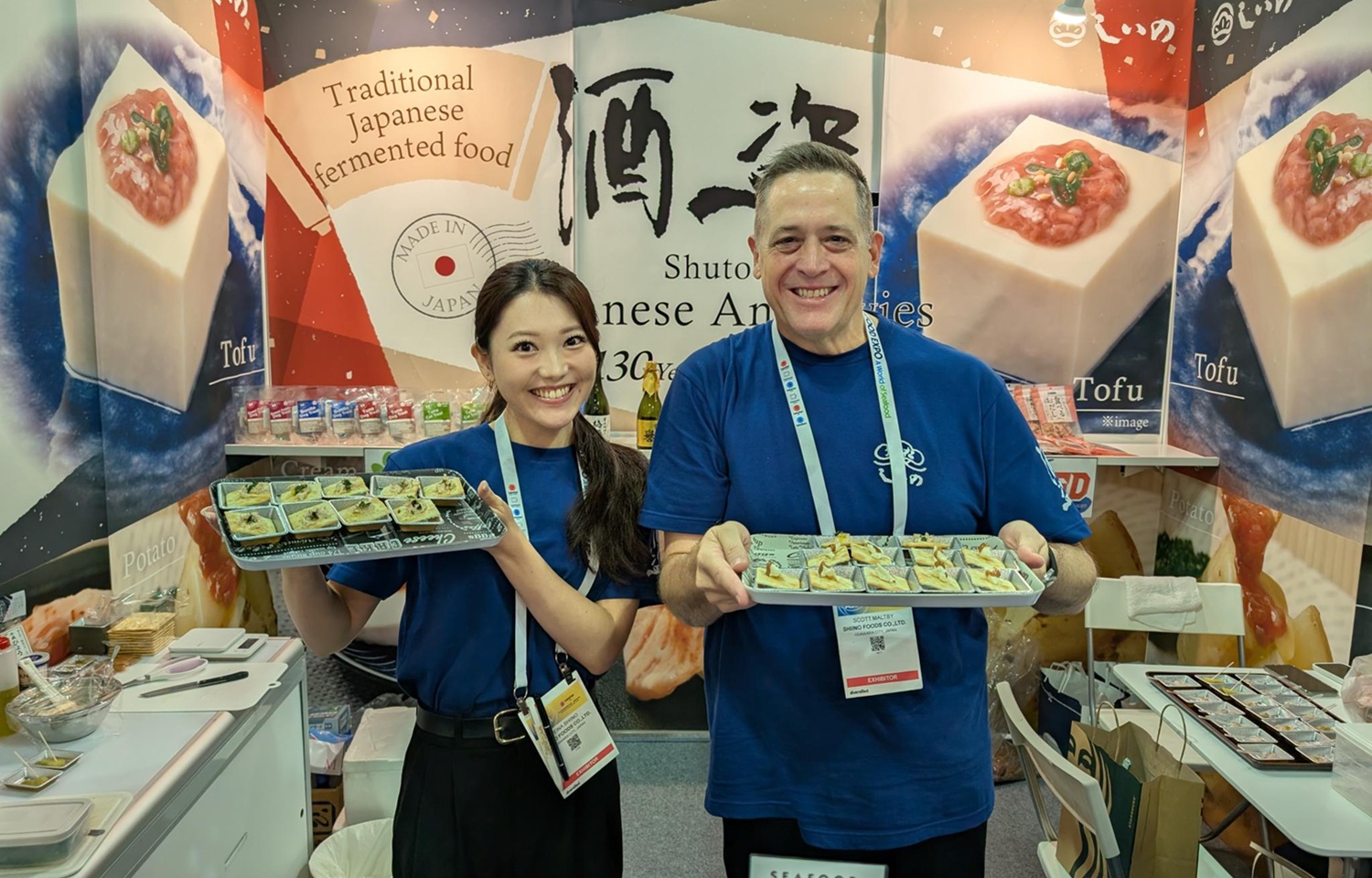
Shiino Foods is aiming to raise the profile of its signature product, shuto – a traditional Japanese seafood product – around the globe, exposing chefs and consumers in Asia, Europe, and beyond to the salty, fermented specialty.
“Even though our company is 130 years old, I guess shuto has been a well-kept secret in many ways because it’s mostly been a domestically sold product,” Shiino Global Division Manager Scott Maltby told SeafoodSource. “It’s the kind of thing that has that saltines to it that’s going to appeal to some markets but maybe not necessarily for others.”
The Odawara, Kanagawa Prefecture, Japan-based company has been producing shuto for over a century, but the dish’s history in the country dates back even further.
“Shuto has over three centuries of history in Japan, and our company has over 94 percent of the market share – so we’re the big players for shuto,” Maltby said. “There are two varieties. You’ve got tuna shuto, which is made from a yellowfin tuna, and bonito shuto, which is made from skipjack tuna. Both of them are made from the stomachs; that’s where it gets unusual. Our company’s ethos is a lot about procuring rare parts of seafood to use and have done so for many decades.”
The company sources the tuna stomachs – which are usually discarded or turned into fishmeal otherwise – from suppliers all over the world.
“They’re quire happy to work with us,” Maltby said. “Basically, we get the raw material, and we chop it up, we salt it, and it’s matured – so it’s fermented for six months to one year.”
That fermentation brings out most of the flavor in shuto, Maltby said, so it’s only seasoned at the end of the process.
Shuto has an extended shelf life – it can sit dry on a shelf for up to a year – making it somewhat unusual for a processed seafood product. The company can also export the shuto frozen, in which case it has a shelf life of up to two years.
One of the primary features of shuto, according to Maltby, is its flexibility for use within a wide variety of dishes.
“For me as a sort of outsider looking in, it’s a really good example of Japanese cuisine in how it combines both the traditional and the contemporary,” said Maltby, who is Australian. “What I mean by that is traditionally, shuto is served simply as a garnishing on rice.”
But shuto has also been incorporated into all sorts of modern Western and Asian dishes – pastas, pizzas, fried rice, and sushi, for example. Shiino Foods has more than 80 recipes that utilize shuto on their website that customers can download for guidance and inspiration, Maltby noted.
According to Maltby, domestic demand for shuto in Japan has been steady; sales did dip during the Covid-19 global pandemic but have since returned to pre-pandemic levels.
“The challenge for us as a producer is it takes a year to make, so we’ve got to plan ahead,” Maltby said. “But, we’ve got our heads around that. We’re getting increased demand, and we’re exporting directly overseas now.”
Now, Shiino Foods is exploring new markets for its shuto, seeking out countries that already have some familiarity with similar salty fish products.
“We’re looking to expand all around the world, not just to Japanese consumers,” Maltby said. “Mainly Asia is the target, but we’ve been to Europe, and we’re going to try and target countries such as France, Italy, Spain, Portugal, and Sweden.”
“Italy and France have got similar approaches to cuisine as Japan,” Maltby said. “Both are open-minded to fusion concepts, and they also incorporate things such as anchovies into their dishes a lot.”
Anchovies have a similar flavor profile to shuto, meaning chefs in those countries might be better prepared to adapt shuto into their cooking. Pickled herring, which is popular in Sweden, could play a similar role in helping chefs in that country utilize shuto, Maltby said.
“I think the concept in theory would work, so we’ve explored compliance and all sorts of things with Europe and we’re hoping to enter those markets within the next year or so,” Maltby said.
Expanding into the Oceanic and North American markets is also on Shiino Foods' radar.
“We’re looking anywhere and everywhere,” Maltby said.
Shiino Foods’ shuto was named as a finalist in the Seafood Excellence Asia Awards, a competition held annually at Seafood Expo Asia in Singapore. Shiino Foods exhibited at the show in what Maltby called “our first official launch outside of Japan.”
“We’re quite proud of our product, and we’re quite proud that we’ve been recognized as a finalist this year,” Maltby said. “Our motivation being here has been to not only raise the brand awareness of Shiino Foods – which is well-known in Japan but not as much outside of Japan – but also our key product: shuto.”
