





The New England Fishery Management Council (NEFMC) has approved a new multispecies fishery management plan, officially splitting the management areas for cod in the Northeast U.S.
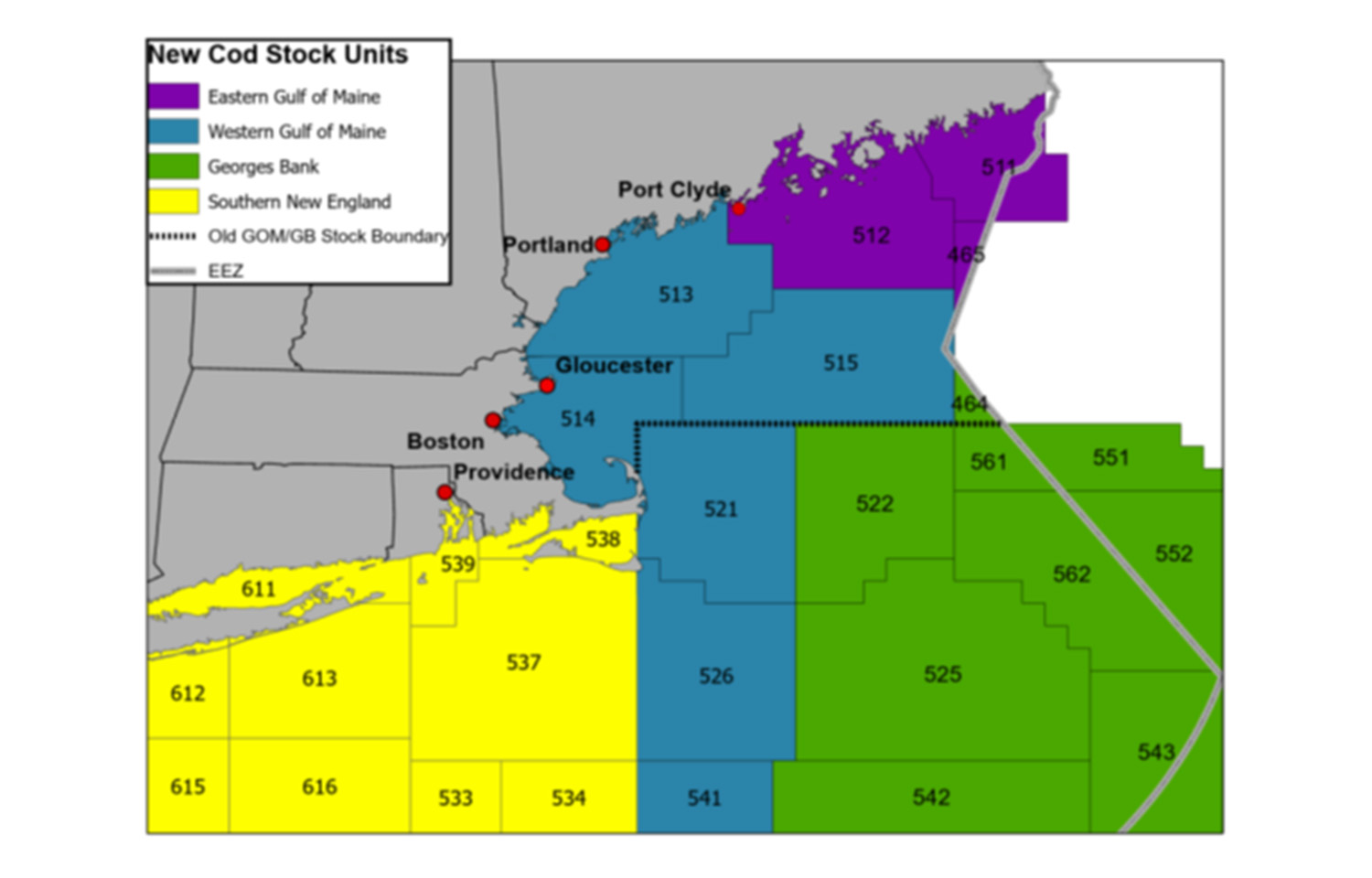
Amendment 25 has separated the management of Atlantic cod in New England into four distinct areas – Eastern Gulf of Maine cod, Western Gulf of Maine cod, Georges Bank cod, and Southern New England cod.
While the total geographic area available to fish for the species remains unchanged under the amendment, NEFMC has revised the stock units of the individual cod stocks.
The new management rule, effective 30 June, has implemented measures including status determinations for the four stocks, specifications for the cod stocks, management uncertainty buffers for the four stocks, recreational measures for Southern New England cod, and more.
“This action is necessary to respond to updated scientific information and achieve the goals and objectives of the fishery management plan,” NOAA Fisheries’ summary of the action said. “The measures are intended to help prevent overfishing, rebuild overfished stocks, achieve optimum yield, and ensure that management measures are based on the best scientific information available.”
The four separate stocks will each get their own annual catch limit (ACL) in 2026. Eastern Gulf of Maine cod will receive a total ACL of 37 metric tons (MT), Western Gulf of Maine cod will receive a 436-MT ACL, Georges Bank cod will receive a 101-MT ACL, and Southern New England cod will receive a 34-MT ACL, which combines into 608 MT overall, according to NOAA.
The recreational fishery will also receive an ACL in the Western Gulf of Maine and Southern New England areas. Western Gulf of Maine has an 118-MT recerational ACL, while Southern New England will have an 18-MT ACL.
The new quotas replace the quotas it had been operating under since 1 May, according to NOAA Fisheries.
NEFMC has been working on the change for multiple years and was prepared to vote on the amendment in 2025 but, ultimately, had to vote to delay the project after the U.S. federal government rejected it.
U.S. Secretary of Commerce Howard Lutnick rejected the plan to split up the New England cod stock, saying it did not adequately demonstrate how the action is consistent with required provisions of the Magnuson-Stevens Act.
The decision was also being made under pressure from New England fishers, who said the changes would have a devastating impact on the industry.
“These restrictions are going to be the end of the trawlers and anyone else buying fish,” Jerry Leeman, the former CEO of the New England Fishermen’s Stewardship Association, said at the time.
Northeast Seafood Coalition Policy Director Vito Giacalone told SeafoodSource that the latest management decision has been anticipated by many in the fishing sector for some time, which means the decision by the council has helped move things forward in the fishery.
“We kind of needed it because it was screwing up the leasing,” he said. “Everybody held off on any large amount of leasing.”
Giacalone added, though, that many fundamental issues that the fishing sector has with the way cod management is approached still remain, regardless of whether the stock is split into two pieces or four pieces.
He said the management decisions are currently being made with a heavy bias toward annual trawl surveys while ignoring fishery-dependent data when it comes to abundance. While fishery-dependent data will be used to determine the number of fish being extracted from the system, it doesn’t factor into the abundance of the resource; only the trawl surveys do that, he said.
Giacalone explained that means the scientists are getting an incomplete picture of the stock, as the stocks are seasonal both spatially and temporally and the trawls aren’t always accounting for those changes, which is why there are instances of fishermen saying the species is abundant while the trawl surveys indicate the opposite.
“There’s no chance we could be getting an accurate signal of abundance on an annual or biannual basis,” he said.
The issue he said he has is that the trawl survey is by definition random, which can result in it missing the cod biomass entirely some years and ending up directly in the center of it in others. If the trawl misses the stock one year but gets lucky the next four, managers could get a false view of what the stock looks like.
“They are relying on an 80-year-old trawl survey series,” Giacalone said.
He said the fishery has concerns about the new four-stock methodology, unrelated to whether the DNA science is accurate in determining the stocks.
Meanwhile, the cod fishery has 100 percent observer coverage and extremely accurate catch data that has zero impact on determining what the abundance of the stock is.
“They’ll monitor our catch, that will be perfect, but that doesn’t seem to matter on the size of the pie,” Giacalone said.
