



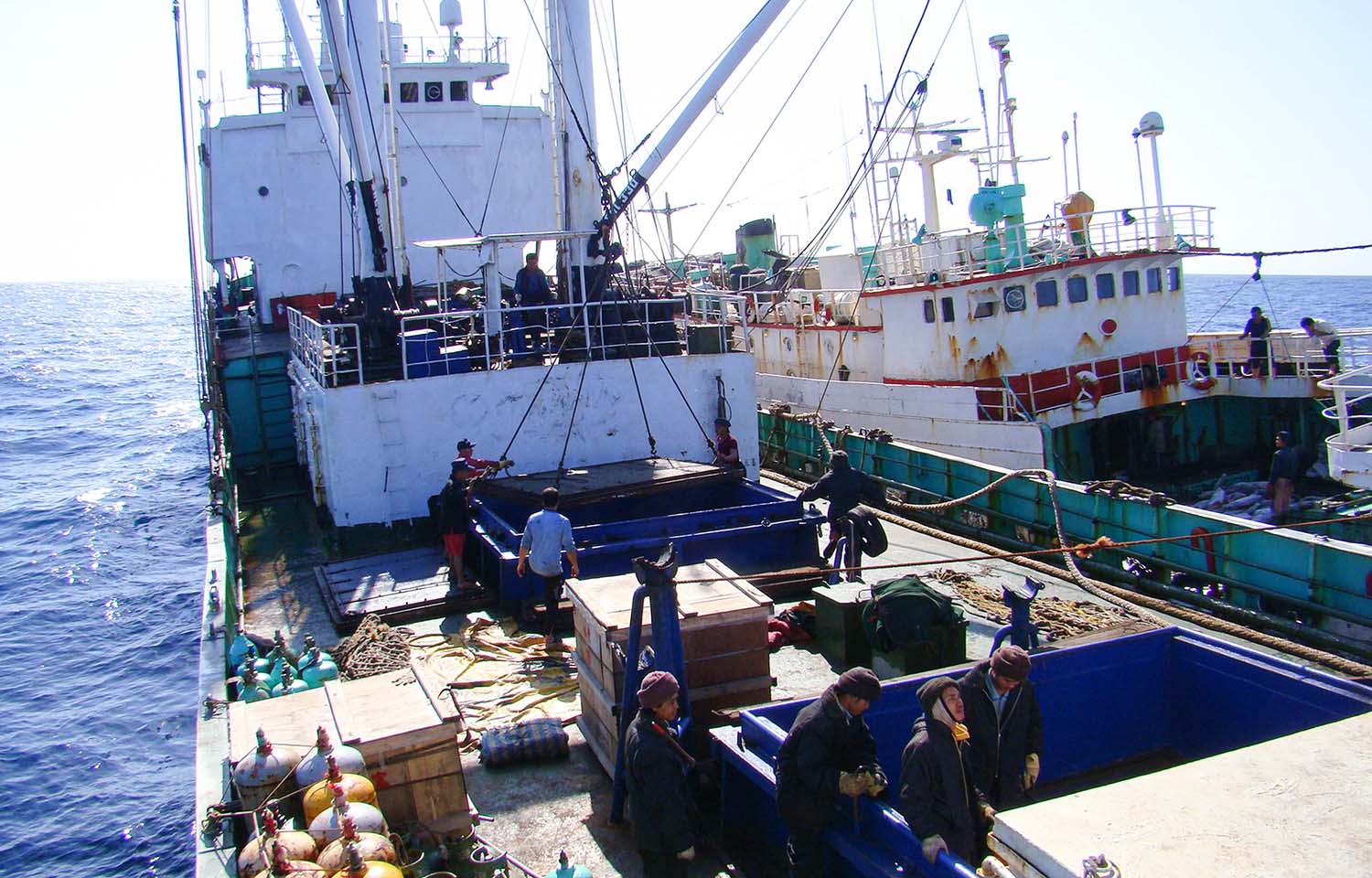
A new study has found multiple instances of high-seas transshipment performed in spite of growing evidence those efforts were economically impractical.
The Marshall Islands Marine Resources Authority, Sharks Pacific, and Starboard Maritime Intelligence published the study, which created a new method of determining what it calls the “impracticability assessment” of transshipment. Using metrics created as part of the study, the assessment found that over 40 percent of instances of transshipment were done in ways that were economically impractical, meaning vessels were using transshipment even when it was easier to head a suitable port.
In fact, the study found that in 19 percent of the examined events, fishing vessels were making journeys to transship that were three times longer than the journey to a suitable port.
“This means that vessels routinely make uneconomic trips to transship in the high seas as a means of economic commercial choice, rather than because of economic hardship,” Marshall Islands Marine Resources Authority Oceanic Division Chief Fisheries Officer Beau Bigler told SeafoodSource. “In almost half of the high seas transshipments, a port would have been closer.”
Bigler said the study looked at 1,600 transshipment incidents across six years of data and examined some of the most influential carrier vessels across multiple nations. Bigler said it was likely the first paper of its kind to use vessel tracking data to identify and assess the claims of impracticability in transshipment on the high seas.
The study is primarily centered on the economic cases made for transshipment because this rationale is often provided for why transshipment is still permitted by regional fishery management organizations (RFMOs) like the Western and Central Pacific Fisheries Commission (WCPFC).
Bigler said for over two decades, distant-water fishing companies have claimed that restricting transshipment would do harm to their economic feasibility, making it difficult to sustain fishing activity.
Bigler said that the paper also created its own definition of impracticability that could be applied to more than the fisheries it examined. That definition includes some basic assumptions, like assuming fuel costs are a factor in transshipment decisions. If fuel costs were the real justification for transshipment, it’s likely vessels would transship closer to their fishing grounds when fuel is expensive; however, the research found that there was no direct relationship between marine gas oil prices and the impracticability of vessels engaging in transshipment.
The reasons for that could be more complicated, as some member states examined can provide fuel subsidies and may purchase discounted fuel from Russia, which is subject to sanctions from many countries. But, it also lends evidence to the inaccuracy of claims that transshipment is an economic necessity.
Sharks Pacific Founder and Executive Director Jessica Cramp told SeafoodSource RFMOs have been trying to constrain the practice of transshipment for decades, without success. She said the WCPFC hasn’t allowed transshipment for the last 17 years but allows the practice as an exception if vessels claim that their fishing activity would be impractical without using it.
“What’s happened is that entire fleets are skirting that without an agreed-upon definition of impracticable, and they’re using this as the rule rather than the exception,” Cramp said. “This report really set out to prove that the impracticability claims were bogus.”
Transshipment can prove problematic for fisheries managers. Past research found the practice has been underreported and poorly managed and the risk of illicit activities increases with the practice.
“It’s something that happens outside the purview of the coastal states, so it gives [fishing vessels] an opportunity to engage in any number of illicit activities,” Sharks Pacific Policy Director Alfred Cook told SeafoodSource. “It could be just run-of-the-mill illegal, unreported, unregulated [IUU] fishing via transfer of catch in such a way they obscure the actual amount or species.”
A U.N. report found the practice can hide more than IUU practices, with fishing vessels engaging in transshipment also engaging in practices like trafficking people, weapons, and drugs.
“In the South Pacific right now, there’s been an epidemic of methamphetamine use across a few of the islands, particularly Samoa and Fiji. There’s only one way that these drugs are getting into these countries, and it’s either by a boat or by a plane and the planes are pretty locked down,” Cook said.
Transshipment also allows fishing vessels to remain at sea for extended periods of time, some for as long as two years. The U.S. State Department has repeatedly documented human rights issues in commercial fishing, and organizations like Global Labor Justice have launched campaigns fighting for better enforcement of labor rights for migrant fishers and for companies to push for amenities like Wi-Fi on fishing vessels to allow crew to communicate any issues in real time. Without access to any form of communication, transshipment allowing vessels to stay at sea for longer means migrant workers can be at sea for years without any ability to report abuse.
Bigler said that many vessels have argued that there are no ports suitable for offloading their catch as a means of justifying transshipment, but he explained the Marshall Islands has already been accommodating hundreds of tuna purse-seine vessels adequately and is often a port that is skipped over in favor of impracticable transshipment.
Bigler said looking forward, the paper and the methods it used to arrive at its impracticability definition can be used by RFMOs to begin curtailing the practice of transshipment and identify which companies are using it as a means of avoiding ports, rather than saving money.
The ultimate goal, Cramp said, is to greatly reduce transshipment.
“This report is another step toward the reform, and I think it’s quite an important one: to try to debunk those impracticability claims, to finally get to the reform that is required, which really is banning transshipment on the high seas," Cramp said.
Failing a ban, full documentation, observation, and traceability of high-seas transshipment would help illuminate why vessels are engaging in the practice even if it costs more money.
“Consumers shouldn’t have to wonder whether they’re eating shark or swordfish; they shouldn’t have to wonder where their fish is caught, how it is caught, and by whom it is caught and under what conditions,” Cramp said. “These are issues that are exacerbated by high seas transshipment, and it’s something that is eminently very fixable.”
