
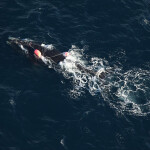


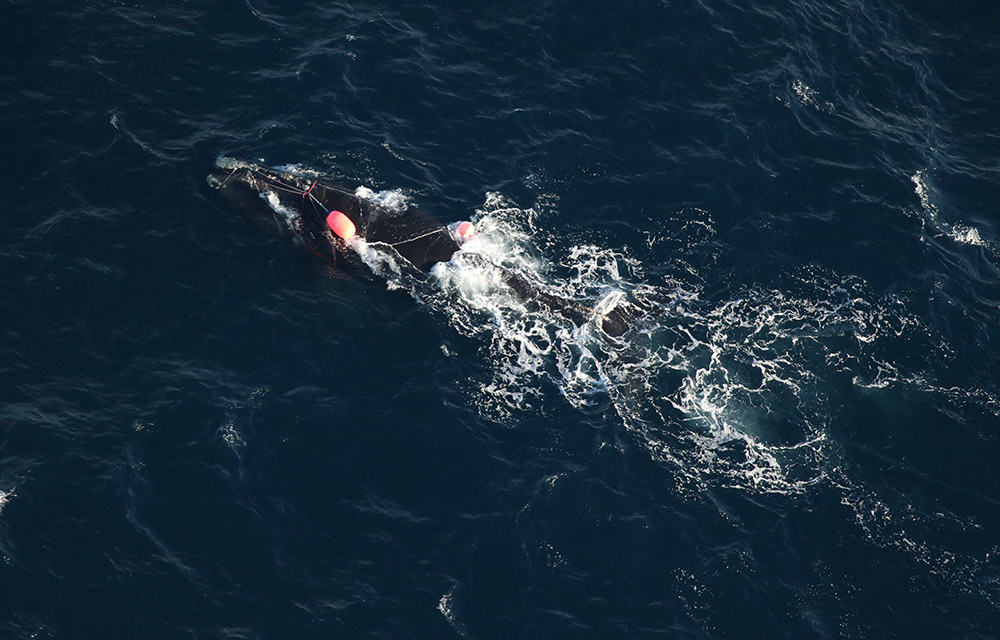
NOAA Fisheries has decided to delay a December in-person meeting of its Atlantic Large Whale Take Reduction Team (ALWTRT), suggesting that new scientific findings in development could support commercial fishers.
In a release, NOAA Fisheries said the delay was necessary to ensure the team “has the best science available to inform discussions,” noting that “several scientific analyses are still being finalized and reviewed before they can be used to inform ALWTRT deliberations.” The agency hinted that the new data and analysis could be good news for commercial fishers, showing that U.S.-origin commercial gear was responsible for fewer entanglements than previously estimated.
“Based on a preliminary review of this latest information, NOAA Fisheries expects the estimated mortality and serious injury incidental to U.S. commercial fixed gear fisheries to be substantially lower than estimated in 2022,” NOAA Fisheries said. “A new scientific method for apportioning entanglements by country based on the latest gear identification data available indicates the U.S. proportion of entanglements is around 25 percent, which is less than previously estimated.”
However, that analysis is still undergoing peer review and would not be ready for the planned December meeting.
The team is also waiting on other data to be finalized to inform its decision-making, including a Population Viability Analysis model, 2025 population totals, and 2024-25 mortality estimates. The latter is expected to be released by the North Atlantic Right Whale Consortium in mid-November. In October 2025, the consortium estimated that the species' population had gradually recovered from 358 individuals in 2020 to 384 individuals.
“We appreciate the hard work of fishermen to reduce the entanglement risk, as well as all ALWTRT members, researchers, stranding responders, and interested parties who have worked tirelessly to understand and reduce right whale entanglements over the years,” NOAA Fisheries said in its announcement. “While entanglements are still occurring, [but] we are in a very different position than we were in 2019 when the right whale population was in a steep decline.”
The planned in-person meeting will now take place in March 2027, while NOAA Fisheries will host a virtual information session for the ALWTRT and the general public on 2 December. NOAA Fisheries said it could hold another ALWTRT meeting in the summer of 2027 if needed.
The ALWTRT meeting is critical for informing NOAA Fisheries rulemaking around North Atlantic right whales and the Maine lobster fishery, which has been on pause for years due to a Congressional prohibition on new regulations until 31 December 2028. The U.S. House voted in September to extend that moratorium through 2035, though the U.S. Senate has yet to take action on the legislation.
“Extending the pause through 2035 will give scientists the time needed to build a meaningful body of data so future whale regulations are based on sound science, not assumptions, while protecting fishing families and coastal communities from needless economic harm,” Maine Lobstermen’s Association Executive Director Patrice McCarron said in a release.
U.S. President Donald Trump has backed the moratorium extension legislation and has generally pushed to reduce regulations put in place to protect the endangered whales. Earlier this year, NOAA Fisheries announced plans to take “deregulatory action” around vessel speed limits in seasonal whale management areas, and the White House asked the New England Fishery Management Council to deprioritize any efforts to introduce ropeless gear for commercial lobstermen.
