






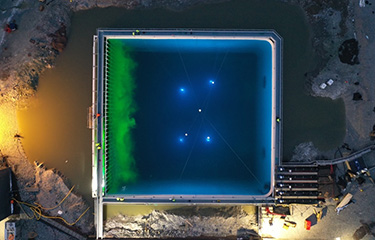
Andfjord Salmon, a land-based salmon farming start-up operating in northern Norway, is on track to harvest its first fish by mid-2023, with high survival rates giving the company hope it will maximize revenue from the harvest.
In its Q3 2022 results, Andfjord Salmon CEO Martin Rasmussen the design of the company’s land-based system, which produces a laminar flow in the square-shaped pool, had helped maintain survival rates of its farmed salmon at 98.7 percent. The flowthrough design combines the benefits of traditional and land-based aquaculture, while removing the risk of sea lice infestation, harmful algal blooms, and interaction with other fish, he said. Andfjord Salmon’s initial proof-of-concept pool at Kvalnes on Andoya is sunk below sea level, which minimizes the amount of energy required to pump in sea water, which is taken from 160 meters of depth in winter and 40 meters of depth in summer, ensuring a stable temperature in the farm at a minimum of energy use – the farm’s energy consumption is currently averaging 1 kwh/kilogram salmon produced.
“The salmon are growing well and they reached an average weight of one kilogram at the end of October, which was well ahead of our late December forecast. At 30 November, 2022, the average weight was 1,350 grams,” Rasmussen said. “Fish health, growth, and survival rates are all interconnected. Good biological conditions and a pool ecosystem sustained as close as possible to the salmon’s natural habitat are key.”
The company has a licence for 10,000 metric tons maximum allowable biomass, giving a potential production volume of 19,000 MT head-on gutted (HOG) at Kvalnes. Expansion at this location, plus planned production at two other sites, gives a total projected output of 90,000 MT HOG per year.
Andfjord Salmon reported a Q3 2022 operating loss of NOK 14.7 million (USD 1.5 million), compared to a loss of NOK 11.4 million (USD 1.2 million) in Q3 2021. Rasmussen said the company expects to generate its first operational revenue via its first harvest, expected in mid-2023.
Andfjord’s Kvalnes farm currently has a production capacity of 1,000 metric tons (MT), but with its second phase of the project underway, output is expected to rise to 12,600 MT. A further increase to 19,000 MT will be achieved once phase 3 is built on adjacent land.Rasmussen said the second phase at Kvalnes is about to enter the final stages of contract discussions with suppliers, after which the build-out plan and timeline will be presented to shareholders.
The company’s cash and deposits at the end of September 2022 amounted to NOK 117 million (USD 12 million, EUR 11.3 million), not including a NOK 20 million (USD 2.1 million, EUR 1.9 million) undrawn credit facility, a remaining NOK 5 million (USD 510,000, EUR 483,000) loan facility, and NOK 5 million in unpaid grants.
It recently received approval to build a second farm in Breivik, Norway.
Photo courtesy of Andfjord Salmon
