




A recently released report, commissioned by the British Columbia Ministry of Agriculture and Food and performed by Counterpoint Consulting, has determined transitioning from net-pen salmon farms to land-based systems in the same communities isn’t economically feasible.
The report, “RAS Salmon Farming in British Columbia,” examined the current economic realities of the recirculating aquaculture system industry, and whether the technology is viable in B.C. communities. The B.C. government commissioned the report as Canada’s Department of Fisheries and Oceans has been initiating a “transition process” away from open-net-pen salmon farming in the province.
Canadian Prime Minister Justin Trudeau’s Liberal Party released a party platform in 2019 calling for a “transition [in British Columbia] from open net pen salmon farming in coastal waters to closed containment systems by 2025.” Then, in December 2020, the government started that process by suddenly announcing all salmon farming in the Discovery Islands in B.C. would be “phased out” in just 18 months, a move which drew sharp rebukes from “blindsided” communities and farmers who were forced to close hatcheries and cull fish.
While the DFO no longer appears to be proposing net-pen bans, there is still a push toward closed containment, land-based RAS salmon farms – but the new report found that in B.C. such farms would struggle to survive.
The report created an economic analysis that found that small RAS farms would not be economically viable, but medium and large farms could benefit from economies of scale.
However, even with viable farms, completely moving the salmon industry from net-pens to land would be extremely costly, according to the report. Given the sector’s current rate of production – roughly 90,000 metric tons of salmon each year – a full transition to land-based farming, based on the report’s economic model of a medium-sized RAS, would require a capital investment of CAD 1.8 billion (USD 1.3 billion, EUR 1.2 billion). The report added that its capital cost analysis should be considered “aggressive,” and that it “could be low by as much as 20 percent.”
Even supposing the industry invests the money, the communities currently farming salmon in B.C. still lose out. The report determined regardless of size, RAS farms would be “more likely to locate near their end markets; in British Columbia that means the Lower Mainland,” not in the rural island communities that currently farm salmon.
The report echoes what salmon farmers in the region have found. Cermaq Canada Innovation Director Brock Thomson, in a release from the BC Salmon Farmers Association, said the company has already determined a full transition to RAS doesn’t make sense.
“The salmon farming sector are leaders in RAS technology since our fish spend half their life on land in hatcheries,” Thomson said. “We are currently trialing new technologies such as semi-closed containment and hybrid systems to systematically reduce interactions with wild salmon and improve fish health. We understand land-based technology, but given the constraints faced, we do not see fully moving to land-based production as a viable solution in the remote, coastal communities where we farm.”
According to Thomson, developing full-scale RAS facilities that match current production wouldn’t be possible in areas that are currently viable salmon farms.
“It is likely that this sort of development could not be accommodated in existing coastal areas, which would result in serious economic impacts to families and all coastal communities up and down Vancouver Island and the Central coast,” he said.
BC Salmon Farmers Association Executive Director Brian Kingzett said that the report has reinforced the association’s stance that a full transition from net-pen aquaculture to land-based aquaculture isn’t feasible, and especially not by 2025.
“This report released by the province supports what salmon farmers have been saying for many years,” Kingzett said. “Our sector strongly supports RAS technology – in fact we are experts at using RAS to grow salmon – but to move the entire sector on land isn’t a realistic option, nor is it required to protect wild salmon. The federal government’s numerous science assessments have confirmed Atlantic salmon farms pose no more than a minimal risk to wild salmon abundance and diversity under the current fish health management practices. The challenges identified in the report need to be addressed before we could even consider this.”
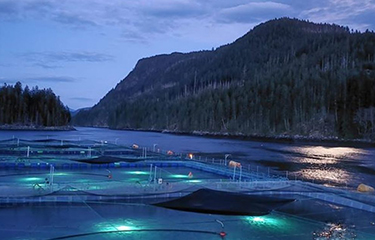
Photo courtesy of Cermaq Canada
