






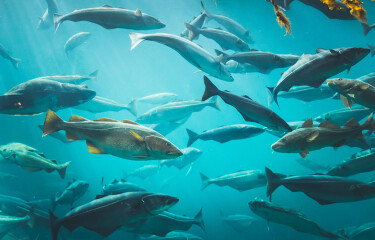
A Norwegian cod-farming firm has signed a cooperative agreement with a Chinese importer and distributor, continuing a line of recent efforts from the European country to heavily advertise and sell its fish to the world’s largest seafood-consuming market.
Trondheim, Norway-based Norcod signed the agreement with Hecheng Food, which also goes by the English name Hi Chain, at an event in Shanghai in mid-December 2023. The partnership entails launching Norcod products in China, marketing its product as “snow cod” and targeting the higher end of the Chinese consumer market.
The finalized partnership was helped along by Norcod’s Danish parent company Sirena, which has a long history in China and has established several partnerships with local processors. To effectively reach Chinese consumers, Norcod’s marketing strategy aims to align with messaging previously used by the Norwegian Seafood Council (NSC) in China, which has equated seafood that comes from Arctic waters as exceptionally healthy and safe to eat.
Recent work by the NSC to establish inroads with Chinese seafood industry players includes the company taking a large group of Chinese media and social media influencers to visit cod, mackerel, and salmon facilities in Norway.
As for Hi Chain, with a processing facility at Hengsha International Port near Shanghai, the importer is well-positioned to supply China’s prosperous east coast with premium products, which is best evidenced by the firm’s parent company – Shanghai Changxing Island Fishing Port – welcoming a 51-metric-ton delivery of live Russian king crab from Kholmsk to Hengsha in 2023, the first delivery of its kind into Shanghai.
Huang Tingting, Sirena’s regional manager for China, told those attending the Shanghai launch that with its high-quality products, Norcod offers predictability in a marketplace that too often lacks it.
“Most of the cod currently on the market is wild-caught, with large differences in quality, unstable production, and supply, as well as risks such as carrying parasites,” she said.
Besides predictability in quality, Norcod offers the supply stability Huang also said was lacking, with the company emphasizing in its financial report for the first three quarters of 2023 that “significant quota cuts for the Barents Sea cod expected from 2024 and beyond implies bottlenecks on the supply side of Atlantic Cod.”
Additionally, the collaboration fulfills goals Norcod has set in targeting foreign markets, especially as domestic consumption continues to dwindle. In a note to investors for the third quarter of 2023, Norcod said the firm is “looking toward overseas markets such as the U.S., Japan, South Korea, and China, the later of which is still considered to hold great potential in volume and price as the country values the high quality and freshness of farmed cod.”
Despite the many benefits the partnership offers both sides, there is plenty of competition for sellers of high-end cod in China. For example, French-owned seafood firm Sapmer markets “Steak de Legine Antarctique,” or cod steaks “fished from the waters of the French Antarctic,” in 100-gram packets sold by many Chinese retailers.
The marketing efforts appear to be working across all demographics.
Cod has been marketed as a premium health food for infants in China, and “real Western Atlantic cod” steaks are currently being sold across various Chinese online commerce and social media channels by Taolehu Food Education, which also trades as Tora Tiger Clubhouse – a franchise of dining and learning establishments designed for children.
At the lower end of the consumer market, China also saw an influx of Russian pollock into the country in 2023. In the first 11 months of the year, Russian seafood trade with China was up 94 percent in volume year over year, reaching 1.1 million metric tons, and up 31 percent in value, totaling USD 2.3 billion (EUR 2.09 billion).
Photo courtesy of PhotoVisions/Shutterstock
