






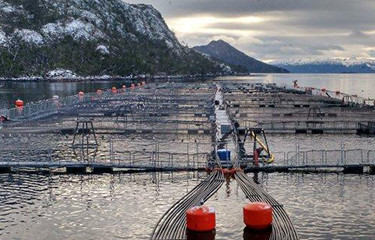
The creditors of struggling Chilean salmon farmer Nova Austral have finally approved a restructuring plan for the company, which it has been attempting to finalize ever since June 2023 when its first attempt at doing so failed.
After that failed restructuring attempt, Norwegian-owned Nova Austral – reportedly more than USD 550 million (EUR 506 million) in debt – went back to the drawing board to present an updated reorganization plan, only to have that rejected in December 2023 following six postponements from creditors.
The company’s third reorganization proposal has now been accepted, ensuring operational continuity for the struggling firm.
“Nova Austral appreciates that the judicial reorganization process has culminated in a positive way with an agreement between the parties, which restructures debt and transfers the ownership of the company to the main creditors,” the company said in a 17 January statement sent to SeafoodSource.
Nova Austral’s three largest creditors are Nordic Trustee, which has invested USD 415 million (EUR 382 million) in the company, followed by DNB Bank at USD 69 million (EUR 63 million), and Skretting at USD 23 million (EUR 21 million).
Under the agreement – reportedly approved by 92 percent of creditors and 86 percent of preferred creditors – Nova Austral’s controlling investment fund Altor will relinquish ownership of the firm.
“Undoubtedly, this is one more step in the project that seeks to make this company viable, a task in development that we hope will be consolidated so that Nova Austral can continue to contribute to the economic activity and the community of Porvenir [in southern Chile], with quality salmon production committed to respect for the environment,” the company said.
Despite the agreed-upon restructuring, Nova Austral is still facing hurdles in making the company financially viable, as it still cannot operate environmentally sanctioned farming centers and must resolve a tax situation carried over from the previous administration, according to a source close to the process.
Toward the end of 2023, the company was able to successfully appeal a sanction levied by the Chilean Superintendency of the Environment (SMA) to revoke the company’s environmental license for its Cockburn 14 grow-out center, which the superintendency issued to Nova Austral for exceeding permitted production between 2015 and 2017.
An environmental court found that the SMA’s sanctioning resolution lacked “due legal argument and, therefore, the sanction is disproportionate.” However, the SMA appealed this ruling to the Supreme Court, and the case is still pending judgement.
Appeals for another two Nova Austral sites – Cockburn 23 and Aracena 10 – are also under review, and until these cases are closed, the firm cannot operate these concessions.
Regarding the tax situation, Nova Austral’s current CEO Nicolás Larco previously reported that supplier purchases made from 2017 to 2019 are under scrutiny by Chile’s tax office (SII).
Larco said that the National Customs Service and the SII had been unable to agree on procedures for the purchase of fish feed, sentencing the company to pay value-added tax twice for a total reaching more than CLP 9 billion (USD 9.8 million, EUR 9 million). With readjustments, interests, and fines, that total now exceeds CLP 30 billion (USD 32.6 million, EUR 30 million).
Because of this tax discrepancy, the Chilean government has held back benefits under the Navarino Law, which provides incentives to companies that set up and operate in the southern Magallanes region, in which Porvenir is located.
“If they stop paying us the Navarino Law and begin to compensate the transfer with these payments, our employees – almost 900 – will be unable to collect their salaries, and the company will go bankrupt. These people are mostly located in [the town of] Porvenir, where there are nearly 2,000 indirect jobs that depend on Nova Austral. If Nova Austral closes, Porvenir will, too,” Larco said at the beginning of 2024 in an email to the national director of the General Treasury of the Republic, as reported by local media outlet La Tercera.
Nova Austral maintains that it has carried out all the pertinent procedures with the SII that are required to attain the tax credits. An appeal is currently pending to reverse the SII decision.
The environmentally sanctioned farming centers and the tax issues are not the only legal hurdles surrounding Nova Austral.
In mid-2023, a few of the company’s Chilean creditors filed a criminal suit against some of the company’s former managers and directors, accusing them of fraudulently maneuvering to obtain funding for the company.
This follows intense public scrutiny the company has been under since 2019 after Chile’s National Fisheries and Aquaculture Service (Sernapesca) began investigating the company’s alleged underreporting of mortalities – an infraction which led to criminal charges followed by fines for reported inadequate mortality and waste management.
Nova Austral has said its previous behavior was “completely misaligned” with its business ethics, and its board of directors commissioned an internal and independent investigation to detect and correct the internal problems that led to the misreporting. That effort resulted in a complete overhaul of the company’s senior management in 2019.
The SMA then revoked three concessions from Nova Austral due to overproduction, and the State Defense Council (CDE) accused the company of providing false information to the treasury and abusing the Navarino Law. Since then, the regulator has particularly targeted the company by levying consistent fines and implementing regular production limitations.
Nova Austral has cited a “tightening of the supervisory standard,” a lack of recognition by regulatory bodies of the company’s operational improvements, the inability to relocate farming concessions, and the health emergency resulting from the Covid-19 pandemic as the primary reasons for seeking reorganization.
Photo courtesy of Nova Austral
