





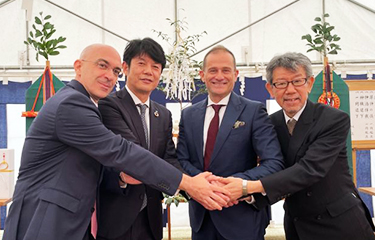
Construction on the Soul of Japan land-based salmon aquaculture facility has officially begun.
The recirculating aquaculture system (RAS) farm will be the largest of five land-based facilities either operating or currently under construction in Japan. Representatives of Shimizu a major Japanese construction company that is the general contractor for the building project, and Oriental Consultants Global, a Tokyo-based project management company, were on hand for the event, as were government dignitaries from Mie Prefecture and Tsu City, and bank representatives.
“The aquaculture facility is expected to be completed in FY2025,” Soul of Japan Representative Director Errol Emed said. “We plan to start operations from the hatching facility by the end of 2024 and ship 10,000 tons per year when fully operational.”
Construction workers and representatives of 8F Asset Management, Shimizu Corporation, Soul of Japan, and Oriental Consultants Global Co. were all present for a groundbreaking ceremony in April. 8F is an asset management company based in Abu Dhabi, U.A.E. Its managed funds own Pure Salmon, a global vertically integrated Atlantic salmon farming and processing business aiming to produce 260,000 metric tons of Atlantic salmon in RAS farms around the globe, with projects underway in Brunei, France, and the U.S. state of Virginia. In March 2023, it announced an agreement with the Kingdom of Saudi Arabia’s ministries of investment and environment, water, and agriculture to build three 10,000-ton RAS facilities in Saudi Arabia.
The Soul of Japan will be a two-story steel-framed closed aquaculture facility with a floor area of 70,000 square meters. It is being built on a 137,000-square-meter site in the New Factory Hisai Industrial Park in Tsu City, Mie Prefecture, south of Nagoya, roughly in the middle of Japan’s main island of Honshu.
“The new facility is a significant development for Japan, which has long relied on imported salmon to meet the high demand for sashimi-grade fish,” Emed said. “With this project, we are working to improve Japan's self-sufficiency and provide consumers with a fresher and higher quality product that is sustainably grown right here in their homeland.”
The product, Atlantic salmon sold under the “Soul of Japan” brand, is to be marketed by Tokyo-based trading company Itochu and seafood distributor Kyokuyo.
The facility was originally expected to become operational in 2021, and the first products were to be available from 2022. This plan was delayed due to a change in the RAS system provider and the Covid-19 pandemic. According to a previous statement from the late Martin Fothergill, co-founder and partner of 8F, the cost of production at the Soul of Japan facility will be 40 percent lower than a traditional salmon farm in Norway, as it will eliminate the cost of air freight, chemicals, and antibiotics typically used to grow product in Norway and bring it to Japan.
8F Capital Partners Partner Yoram Layani did not respond to a request for comment from SeafoodSource on Pure Salmon’s progress on its goal, and an inquiry send to Soul of Japan management received no response.
Pure Salmon had previously contracted with Israeli RAS specialist AquaMaof to design its RAS farms, but the partnership ended when 8F Asset Management bought the Norwegian RAS division of Krüger Kaldnes from French water treatment company Veolia and formed Pure Salmon Kaldnes RAS. The entity was renamed Pure Salmon Technology in May 2023 and has replaced AquaMaof as the builder of the Soul of Japan’s RAS facility, Fish Farming Expert reported.
RAS technology from AquaMaof, based in Rosh Ha’ayin, Israel is being used in another project in Japan, Oyama Fish Farm, by Bergen, Norway-based Proximar Seafood. That facility, built in Shizuoka Prefecture – where Mount Fuji is also located – went operational in October of 2022 and its first harvest is expected in mid-2024, meaning it will likely beat Soul of Japan to market. However, its annual head-on, gutted (HOG) production capacity will be 5,300 MT, a little over half the planned capacity of the Soul of Japan facility.
Other land-based salmon projects have already come online in Japan, but are on a smaller scale.
FRD Japan has operated a demonstration experiment plant with an annual capacity of 30 MT in Saitama City since 2017. The company plans to start construction of a commercial-scale plant this year with a capacity of 3,000 MT. FRD also uses an RAS system, but instead of Atlantic salmon, it raises rainbow trout, which are considered to be easier to raise. In Japan “salmon-trout” (rainbow trout grown in salt water) are treated interchangeably with salmon. FRD Japan is majority owned by Tokyo-based Mitsui & Co.
In July 2022, trading company Mitsubishi and seafood giant Maruha Nichiro (both based in Tokyo) teamed up to form land-based salmon firm Atland. The two companies hope to begin operations at a new RAS facility in Nyuzen, Toyama Prefectureb in 2025 and complete a first delivery of Atlantic salmon by 2027. Annual production capacity will be 2,500 MT of live-weight salmon. For comparison purposes, the HOG yield from this would be around 91 percent, or 2,275 MT.
Kyushu Electric Power Co., Tokyo-based seafood trader Nichimo Co, Fukuoka-based Nishinippon Plant Engineering and Construction Co., and Idouchi Salmon Farm Co., will farm salmon by utilizing the former Buzen power plant site owned by Kyushu Electric Power. The venture, called Fish Farm Mirai, will carry out the construction utilizing a sustainability-linked loan from Norinchukin Bank. The current capacity is 30 MT, and the company aims to increase this to 3,000 MT. This facility will also raise “salmon-trout.”
“Tottori Kotoura Gran Salmon,” which is silver salmon from a land-based system in Kotoura, Tottori Prefecture, has been distributed since 2018. The annual capacity is 600 MT.
In total, the annual production from all of these extant or planned facilities amounts to a little less than 24,460 MT – that is, the stated volumes minus some yield loss for those stated as live-weight, rather than HOG.
Japan’s total import volume of fresh salmon and trout in the calendar year 2022, as reported by Japan Customs, was 11,346 MT. In 2018, before Covid-19 disturbed dining and airfreight patterns, the volume was 19,133 MT. Thus, the influx of domestically farmed salmon would be quite significant, exceeding recent fresh import volume.
Comparing only Atlantic salmon, RAS would produce 17,575 MT. Japan’s imports of fresh Atlantic salmon from Norway in 2021 amounted to 13,300 MT, valued at JPY 14.2 billion (USD 123 million, or EUR 113 million, using exchange rates at the time). Atlantic salmon represents close to 20 percent of the Japanese salmon market, and close to 90 percent of the fresh Atlantic salmon imported into Japan is from Norway.
Photo courtesy of Pure Salmon
