



Rising costs, sustainability issues, and supply chain problems surrounding traditional fishmeal have pushed some Japanese researchers toward developing alternative sources of protein for use in aquaculture feed, including mushroom substrate.
Several experts have tested the substitute’s viability, including Malaysian scientists who performed a 2021 study on the effects of feeding mushroom-based, pelleted feed to African catfish for 12 weeks. Recently, a Japanese high school decided to trial the innovative feed on a large scale – and found success doing so.
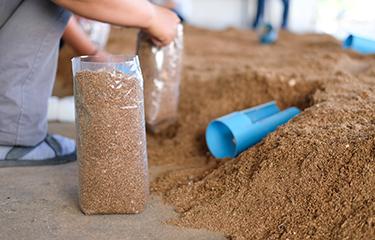
Tadotsu High School in the southern Kagawa Prefecture, a vocational high school with four engineering departments and two fisheries departments as part of its curriculum, collaborated with mushroom producer and seller Hokto, based in Nagano City, in late 2021 to develop a new feed for fish farming that utilizes spent mushroom substrate (SMS) – the biomass left over from mushroom cultivation. Hokto's Kagawa Kinoko Center mushroom production plant supplied the SMS for the experiments at the high school. The plant was previously shipping the SMS to another prefecture for agricultural compost purposes, but the high cost led the company to explore other uses.
The partnership allowed the students to actively participate in research and experimentation, and also allowed Hokto to find a practical use for its mushroom substrate, which would have been wasted otherwise. Though the company can compost or burn the material, Hokto has tried to use innovation to find ways to use its waste products. While fish feed is one possibility, the company is also exploring use in poultry and ruminant feeds as other options.
In the initial experiments at the high school, students involved in the marine production department fed red sea bream a one-to-one ratio mixture of SMS and conventional, fishmeal-based pellets for 34 days. The mix was well-accepted by the fish, aligning with other research previously conducted on SMS feed, the trial showed reduced mortality figures compared to traditional feed. However, growth was slower than with commercial feed. Assuming this was due to the naturally lower protein content of SMS, the class cooperated with Hokto to ferment the SMS for three months, which increased the protein content from 9.8 percent to 12.4 percent. They then repeated the trial production and achieved more favorable results.
The next step in the study entailed a feed company in the prefecture producing 1 metric ton of the feed, and in December 2022, the high school students began feeding it to farmed red sea bream on a larger scale.
Tsuyoshi Osaka, a teacher at Tadotsu, told Yomiuri Shimbun that there is still room for tinkering with new formulas of SMS to change the vitamin and nutrient content.
“In the future, we will continue to observe fish growth and conduct taste tests while changing the ratio of conventional feed and the mycorrhizal beds,” he said. “We will also work with universities and other research institutions to analyze the active ingredients of the mycorrhizal beds we use and produce academic research results.”
After harvesting the fish in early July, the school sent them to a fish processor near the port for an initial screening, after which they shipped them to other processors in the prefecture.
Substrate can comprise many different materials, such as sawdust, straw, bran, or corncobs, and its subsequent uses vary depending on the substrate type and the type of mushroom grown to produce it.
“It seems to have various uses, but since it has not been patented, it is [still] a trade secret,” Maeda said.
Mushroom substrate is not the only alternative protein currently undergoing experimentation throughout Japan. Other options such as insects, single-cell organisms, and citrus byproducts are all increasingly popular deviations from traditional fishmeal that allow the fishing industry to promote sustainability and maintain the health of fish stocks.
Photo courtesy of 88studio
