






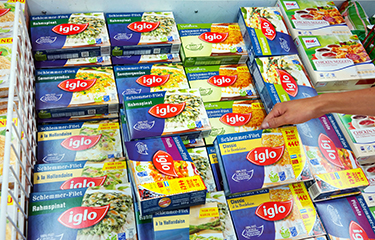
Feltham, England-based Nomad Foods has received a show of support from financial firm Goldman Sachs, which upgraded its rating of the food manufacturer after it posted solid Q4 2022 results.
Nomad, which owns frozen seafood brands Birds Eye, Findus, Iglo, Ledo, and Frikom, is one of Europe's largest frozen food companies. Its quarterly and full-year 2022 results, released on 23 February, 2023, showed Nomad boosted revenue 6.6 percent to EUR 750 million (USD 793 million) in Q4 2022 and, for the year, raised revenue 12.8 percent to EUR 2.94 billion (USD 3.11 billion). Its profit in Q4 2022 was EUR 37 million (USD 39.1 million) and its adjusted earnings before interest taxes, depreciation, and amortization (EBITDA) was up slightly to EUR 113 million (USD 119 million), while for the year, its profit reached EUR 250 million (USD 264.4 million) – up from EUR 181 million (USD 191.5 million). The company's adjusted EBITDA also increased 8 percent, hitting EUR 524 million (USD 554 million).
"We are pleased to report that 2022 was another year of record revenue … again proving the resilience of our operating model in a challenging macro environment,” Nomad Foods CEO Stéfan Descheemaeker said in a release. “Our organic sales returned to growth, we expanded adjusted EBITDA and adjusted EPS [earnings per share] by 8 percent, and we extended our debt maturities at competitive rates. Most importantly, we adjusted our business model in response to extraordinary changes in the market, especially in raw material sourcing and portfolio pricing. Looking ahead to 2023, the frozen food category remains great value for consumers, and we have exciting plans in place to deliver strong operational results to build value for our shareholders."
The company issued guidance for 2023 predicting a slight decline in earnings per share, with “mid-single-digit revenue growth and cash flow conversion in the range of 90 to 95 percent.”
“We enter 2023 with sales momentum, strong underlying cash generation, and financial flexibility providing the opportunity to prudently deploy capital to create value for shareholders,” Nomad Foods Co-Chairman and Founder Noam Gottesman said. “In addition to our ability to return capital to shareholders, we believe we have the right operational and financial plans in place to drive sustainable growth to compound value into the future."
The positive report encouraged Goldman Sachs to issue an upgraded rating for Nomad Foods stock, moving it from a “Neutral” to a “Buy” on Monday, 27 February. Goldman Sachs Equity Analyst Jason English said the company’s results and guidance amounted to a “reset of expectations.”
“As we had anticipated, management issued a below consensus EPS outlook which we welcome as a clearing event,” he said. “We believe estimates have now bottomed and we believe its robust sales momentum has the potential to flow through to higher EPS through the year, even after contemplating higher reinvestments and interest expenses. With potential upward revisions on horizon, we see [Nomad’s] near-trough valuation levels, both in context of its history and relative to broader food peers, as an attractive investment opportunity with favorable risk-reward ahead.”
Goldman Sachs has set a 12-month price target of USD 21.00 (EUR 19.85) for the stock, which was trading at USD 17.92 (EUR 16.94) on the New York Stock Exchange as of Tuesday, 28 February. English wrote in an equity research report that “expected upward revisions are likely in 2023, leaving the stock as an attractive investment opportunity as compared to peers.”
“While continued inflationary pressure is expected, pricing moves are expected to offset this impact. As such, gross margins are expected to remain stable in the year,” he said.
English said he was fortified by hearing that Nomad’s leadership expected “pricing and revenue growth management initiatives to help offset the pressure” from higher costs. Nomad has locked in 50 percent of its raw-material costs for 2023 and expects its gross margins to remain stable in 2023, he noted. And with “ample balance sheet flexibility for its capital allocation strategy going forward,” Nomad is actively evaluating share buybacks and debt paydowns as a means to maximize shareholder return, English wrote.
English warned Nomad could be overly confident in its ability to bring back sales lost as more customers chose cheaper private-label brands over the past year as the company raised prices to cover inflationary costs, but nonetheless wrote that he expected the company to post annual sales growth at or above 3.4 percent, with increased sales coming from Nomad’s willingness to “lean in more heavily on promotions to preserve volume share.”
Despite those specific challenges, plus general concern about the impact of a possible recession harming the European economy overall, Nomad is showing “attractive valuation levels relative to its historical levels and relative to the [food] group at large,” English wrote.
Photo courtesy of defotoberg/Shutterstock
