






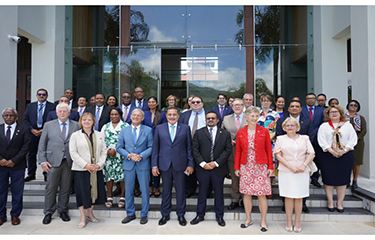
The European Union and Seychelles have reaffirmed their commitment to prevent, deter, and eliminate illegal, unreported, and unregulated (IUU) fishing that threatens the long-term sustainability of the island nation’s fisheries.
The two countries have had fishing agreements for over a decade, and recently renewed their six-year Sustainable Fisheries Partnership Agreement (SFPA) after delays. At the conclusion of the ninth European Union Political Dialogue, co-chaired by Seychelles Minister of Foreign Affairs and Tourism Sylvestre Radegonde and E.U. Ambassador Vincent Degert early this month, the parties said the SFPA would continue to contribute to sustainable fisheries within the Indian Ocean Tuna Commission (IOTC).
“Our engagement, covering a wide range of political, environmental, and socioeconomic issues, allows for an extensive dialogue reaffirming our mutual interests and values. It promotes sustainable development and climate action, encourages development cooperation and strengthens strategic partnerships in key priority sectors,” Radegonde said in a release.
The two countries expressed support for the EUNAVFOR Operation Atalanta, an executive E.U. military maritime operation for Somalia that was established by the Council of the E.U. in 2008 to boost efforts to deter, prevent, and repress acts of piracy and armed robbery off the Somali coast. They also lauded the latest extension of the scope of EUNAVFOR operations to include tackling other maritime threats such as drug and arms smuggling and IUU fishing. This, the representatives said, elevates the role of the E.U. in ensuring maritime security along the coast of the Indian Ocean.
The Seychelles has called on the E.U. to strengthen its working partnerships with Indian Ocean and Eastern African coastal states to identify areas of collaboration on matters concerning the Indian Ocean Tuna Commission (IOTC). Both the E.U. and Seychelles are among the 30 contracting parties of the commission.
The E.U. and Seychelles delegations said the SFPA has enhanced their cooperation in the areas of maritime security, sustainable blue economy, trade, investment, and the environment and climate change. The agreement allows an E.U. fleet of 40 tuna purse-seiners and eight longliners to continue fishing in Seychelles waters in return for with an annual financial contribution of EUR 5.3 million (USD 5.1 million).
The recently concluded BlueInvest-Africa initiative in Seychelles, both parties said, had strengthened the E.U.-Africa cooperation and contributed to the promotion of Africa’s blue economy.
“The E.U.-Seychelles partnership is clearly a strategic one,” Degert said. “It has grown over the years and allows us to pursue a broad and fruitful cooperation in many key areas of common interest like peace and security; sustainable economic growth; health and resilience; climate change and governance and human rights.”
Photo courtesy of the Seychelles Ministry of Foreign Affairs
