


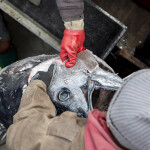

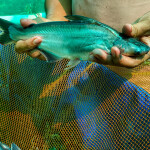

Russian Pollock Association (PCA), a client member of the Marine Stewardship Council for Russia, has successfully obtained MSC certification for the Eastern Sakhalin fishery subzone in the Sea of Okhotsk.
The Eastern Sakhalin subzone was not covered by the certification PCA successfully obtained when it was first accessed to the MSC standard in 2013. Unlike other subzones in the Sea of Okhotsk – the Northern Okhotsk subzone, the Western Kamchatka subzone, and the Kamchatka Kuril subzone – specialized fishing of pollock is not prohibited here from April to October.
PCA President Alexey Buglak told the Fishnews media agency that the process for certification was launched in late 2019, following a decision by members of the association.
“All necessary scientific surveys were carried out,” he said.. “This allowed us to get the positive results without any condition before the start of the pollock season.”
The total allowable catch (TAC) for the subzone for 2021 is 126,000 metric tons (MT). According to the PCA, nearly 100,000 MT of this volume has been certified.
Overall, the TAC for pollock in Russia for this year is 1.996 million MT. The share of the Sea of Okhotsk is 1.186 million MT, and the recommendation for TAC for the sea in 2022 is less than one million MT.
The milestone was reached as Russian pollock catchers face unprecedented challenges due to the ongoing COVID-19 pandemic. Among the worst of the problems they're facing is China's imposition of a near-total stoppage of all seafood imports from Russia. Prior to the restrictions, 61 percent of the country’s seafood exports were sent to China, with Russia’s pollock exports to China representing USD 580 million to USD 600 million (EUR 480.7 million to EUR 497.3 million).In response, Russia has tried to find solutions for the sudden market closure, including expanding investment quotas.
Russia's Federal Agency for Fisheries said that as of 28 March, the nation's total pollock catch was 720,000 MT, 17.1 percent less than in the corresponding period of 2020.
Of that total, 438,200 MT was caught in the Western Kamchatka and Kamchatka Kuril subzones, a decrease of 23.1 percent over 2020. That includes 1,000 MT in the Eastern Sakhalin subzone, a decrease of 88.9 percent; 23,000 MT in the South Kuril subzone, an increase of 19.8 percent; 211,100 MT in the Northern Okhotsk subzone, an increase of 1 percent; 23,200 MT in the Eastern Kamchatka zone, a decrease of 2.9 percent; and 21,200 in the Petropavlovsk Komandor subzone, a decrease of 9.4 percent.
Overall, approximately 650,200 MT of pollock has been caught in the Sea of Okhotsk, a decrease of 17.9 percent over the total caught in 2020, as of 28 March.
Photo courtesy of the Russian Fishery Company
