


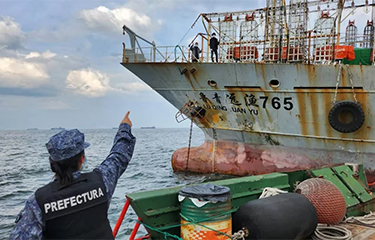
On 29 June, a woman walking along the coast of Sauce de Portezuelo, near Uruguay's famed beaches of Punta del Este – found a bottle containing a handwritten message in a foreign language that she didn't comprehend, but which ended in three letters that she did recognize: "SOS." Recognizing it was a request for help, she immediately notified local authorities, who referred the matter to the regional prosecutor's office.
Uruguayan press reported an expert was hired to translate the text from what ended up being Chinese. The message read: “Hello, I am a crew member of the ship Lu Qing Yuan Yu 765, I was locked in the company [sic]. When you see this paper, please help me call the police! Help help.”
Authorities then consulted Milko Schvartzman, an expert in Chinese fishing maneuvers in Latin America, and on 2 July, he managed to locate the vessel near the port of Uruguay’s capital, Montevideo, Infobae reported. The following day, armed with a court order, Uruguayan authorities who were accompanied by a translator were able to board the vessel for an inspection that lasted an hour and a half, according to the El Observador.
Aboard the ship, authorities found 15 Chinese crew members. In statements to local media, prosecutor Diego Perez said the inspection party did not encounter anything especially out of the ordinary, although there was “a particular work regime and claims for wages” – the crew had been at sea for two years without touching land, their work contracts had expired on 29 June, and they had been advised they would not be receiving pay for the rest of the time they remained on the ship. The crew intended to change ships.
The other prosecutor in the case, Leonardo Morales, told Telemundo news that all the crew members appeared to be in good health and that the inspection party uncovered no crimes. None of the crew members claimed authorship of the message in the bottle, and so the Uruguayan prosecutor’s office closed the proceeding.
The event, however, served to shine a light on the questionable practices often surrounding China’s distant-water fleet.
In 2021, China claimed it had 2,600 flagged vessels operating in distant waters, based on data collected by the country’s department of agriculture, which licenses Chinese firms to operate in international waters. The country has also pledged to cap its distant water fleet at 3,000 vessels.
However the London, United Kingdom-based Overseas Development Institute published a white paper in 2020 estimating China has more than 15,000 distant-water vessels in operation.
Many distant-water vessels from China have been accused of engaging in illegal, unreported, and unregulated (IUU) fishing practices around the world, including in Ecuador’s Galapagos marine sanctuary. A Global Fishing Watch list of IUU-connected fishing vessels operated globally has also featured many Chinese vessels.
However, Latin American governments do not always have the means or the political will to fight against IUU practices.
“All the activity of the foreign fishing fleet in the port [of Montevideo] is covered up by complicity of the authorities. There is no willingness on the part of the Uruguayan government to fight illegal fishing or human rights abuses on board,” Schvartzman told Infobae. “The Uruguayan state benefits from the illegal activities of these vessels because it provides services to vessels denounced for human rights abuses.”
Schvartzman has studied the actions of foreign fishing fleets in the region for more than 20 years. The fleets are mostly composed of Chinese vessels operating within the limits of the exclusive economic zones of Argentina, Brazil, Ecuador, Peru, and other Latin American countries.
The port of Montevideo, Schvartzman said, is the “main support to the South Atlantic fleet,” and according to his investigations, at least one deceased crew member per month is offloaded at the port. Schvartzman said human rights abuses are often overlooked by state authorities and the media, which usually concentrate on the environmental damage caused by IUU fishing.
“Crew members have died of starvation, suffered various types of human rights abuses, been beaten, have not received food, received no medical treatment, or have been refused to be brought to port by the captain or air evacuated for medical attention,” he said. “There are cases of crew members who have denounced these abuses to Uruguay’s courts of justice and the navy. They have denounced that they have been beaten [or] chained but these vessels have not received any sanctions and have continued to operate through the port of Montevideo.”
Despite the widespread cases of abuse, Schvartzman said, there’s little political will to stop it. Data he collected indicates that in 2019, the Uruguayan government inspected only 33 vessels out of the more than 320 that operated in the port of Montevideo that year. Of those analyzed, only one was Chinese.
“I have been in the port and I have seen the inspections they do – they ask the crew what they have in the hold without even getting on the boat,” he said.
States tend to look the other way, he said, because China exerts pressure on the country – or simply because they have an ideological affinity with China. Even then, Uruguay is not solely to blame for the lack of enforcement.
“None of the countries in the region is 100 percent responsible or 100 percent victim of illegal fishing,” Schvartzman said. “Everyone has a responsibility, including Argentina or Brazil or Uruguay … we also have the case of the assistance provided by Panama by flagging the reefer ships that support this fleet.”
Shortly after the “message in a bottle” incident, the president of the Committee for the Sustainable Management of the Giant Squid of the South Pacific (CALAMASUR), Alfonso Miranda Eyzaguirre, expressed concern about the unusual entry of the Chinese vessel Han YI 3 into Peru’s 200-mile exclusive economic zone.
Noting that this event coincided with the recent incident in Montevideo, Uruguay, he questioned the vessel’s presence in Peruvian waters.
“We want to know if the government has duly registered the entry of this vessel, if the reasons behind its entry have been verified and if the inspections established in the Agreement on Port State Measures and the formats defined by the South Pacific Regional Fisheries Management Organization have been carried out,” he said. “The countries of the region must unite to confront the problems arising from illegal, unreported, and unregulated fishing.”
Photo courtesy of the Uruguay Prefecture
