






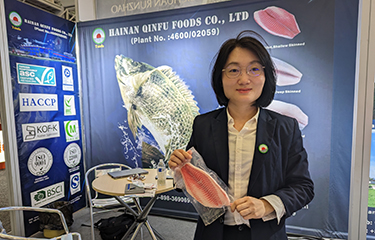
It has been three years since Chinese companies were able to exhibit at Seafood Expo North America due to the Covid-19 pandemic, and Hainan Qinfu Vice Sales Manager Linda Gao said it was good to finally be back at this year's expo.
“It’s so great to see that everything is back to normal,” she told SeafoodSource at the show, which ran from 12 to 14 March in Boston, Massachusetts. “The moment we heard the news that the show will be open this year, we thought, ‘Wow, we missed it.’ During the past few years, we were always pessimistic about actually getting to see our new clients. During phone calls, we would make jokes about when we would ever be able to see each other.”
Hainan Qinfu, based in Wenchang City, Hainan, China, is a tilapia producer and exporter. Gao said the U.S. is one of the company’s most-important markets, buying around 40 percent of total production.
Demand may have been steady during the pandemic, but logistics became extremely complicated – and expensive. Shipping a container of tilapia from Hainan to the U.S. city of Los Angeles used to cost around USD 2,000 (EUR 1,862), Gao said, but during Covid-19 the price tag hit USD 10,000 (EUR 9,313).
Despite the complications, Gao said the company did steady business throughout the pandemic. While the company’s representatives had trouble conducting face-to-face meetings with clients, and its sales to restaurant fell as lockdowns forced closures worldwide, it made up the difference with a pick-up of retail business.
“I would actually say the orders [were] quite good, especially for the supermarket [sector]” Gao said. “So generally speaking, it hasn’t seriously affected the demand.”
Now, emerging from the worst of the Covid crisis, Hainan Qinfu has launched a new product and, at Seafood Expo North America, introduced it to the U.S. market. The product, which Gao called “crisp” tilapia, is new enough to the U.S. that she has yet to come up with a name for it in English.
“We developed this two years, ago, but this is the first time we’re bringing it to the United States,” Gao said.
The product has more-robust flesh than the red tilapia it normally sells – after cooking, instead of flaking or falling apart, it stays relatively firm. That texture and property lends itself to different types of cooking. Because of its firmer texture, Gao said, the tilapia holds up well to being slow-cooked, allowing Hainan Qinfu to get its product into a wider array of restaurants and capitalize on the growing global popularity of hot pot.
“It is quite popular in China, especially for the hot pot,” Gao said.
Photo by Chris Chase/SeafoodSource
