






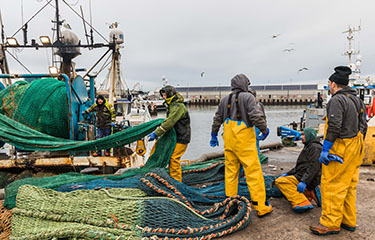
Large sections of the United Kingdom’s seafood economy continue to struggle in their efforts to build up and maintain the workforces necessary to optimize their operations, despite efforts from the government to ease labor burdens.
According to a March survey of 1,330 companies involved in the U.K. seafood industry by U.K. public body Seafish, recruitment challenges exist in both the fisheries and processing sectors, and on the catching side, a majority of vessel owners reported struggling to recruit workers and fill vacancies.
The survey, which contacted companies representing nearly 20 percent of the sector, found firms with larger vessels and companies operating more than one fishing vessel are those most frequently short of labor. Overall, though, there remains a shortage of deckhands across all vessel types and sizes, Seafish confirmed to SeafoodSource. The Seafish survey found 62 percent of respondents are reporting more deckhand vacancies this year versus three years ago, and 70 percent of respondents said it now takes much longer to recruit deckhands than in 2020.
The perception of the seafood industry as having poor pay, unsociable hours, and challenging working conditions has contributed to a persistent decline in domestic workers joining the industry, Seafish found.
Working with seafood is not perceived as an attractive industry by the public, and the seafood industry is seen as “an employer of last resort,” Seafish said. “Perceptions are that working onboard a vessel is difficult, cold, and wet. These perceptions can be difficult to shift. The processing sector faces similar challenges – working in a seafood factory is not as desirable as other employment opportunities.”
In some parts of the country, hiring challenges are compounded by a lack of available affordable housing – a particular problem in Cornwall in southwest England and the west coast of Scotland. Also, there’s often limited public transport options in rural fishing communities, which makes it particularly difficult for shift workers. Some U.K. seafood businesses have begun providing transportation and lodging in a bid to retain staff, according to Seafish.
For foreign laborers, which constitute a significant percentage of labor in the U.K. seafood industry, the country has become a less desirable place for E.U. nationals to work since Brexit. For the processing sector, Seafish research shows that between 2017 and 2019, E.U.-sourced labor accounted for between 6 percent to 70 percent of workers at seafood companies, with northeast Scotland the most reliant on E.U. labor prior to Brexit. This challenge, however, is not specific to the seafood sector, Seafish said. The impact of Brexit and new immigration rules limiting recruitment have worsened longstanding labor shortages in the sector.
“The U.K. has low unemployment levels and a shrinking labor pool [after its] E.U. exit. This, in turn, increases the level of competition between industries and within industries to recruit adequately skilled staff,” Seafish said. “In such an environment, companies have to work harder to secure the talent they need. Market forces are working in favor of the employee rather than the employer.”
During the Covid-19 pandemic, many seafood workers chose to look for other sources of employment have not returned to fishing post-pandemic, according to Seafish. The sector has remained under significant financial pressure due to the combined impacts of the pandemic, the U.K.’s E.U. exit, and the impacts of the global inflationary crisis, which has resulted in increased business operating costs, including fuel price rises.
“This creates further challenges in terms of wider perceptions on the long-term viability of the sector,” Seafish said.
The seafood industry is also facing stronger competition from other industries that often provide more attractive career opportunities. And low levels of local unemployment in certain regions are a particular barrier for businesses trying to recruit, Seafish said, adding that the vacancies reported in 2022 were particularly high in northeast Scotland and in the Highlands and islands of Scotland.
“Fishing has traditionally been viewed as a family business heavily rooted in local coastal communities,” Seafish said. “However, societal changes such as increased education opportunities and more attractive career options, including in competing maritime industries such as oil and gas, offshore renewables, and aquaculture, have reduced dependency on the fishing sector.”
All of these factors have resulted in labor shortages, which are creating shifts in how the seafood sector operates. Vessel operators have been forced to get by with fewer crew members by making shorter trips, allowing fewer crew breaks, and reducing crew pay. But that, in turn, has made the industry additionally less attractive.
There’s also the looming challenge of an aging workforce, with the Seafish survey “Employment in the U.K. Fishing Fleet 2021” finding the average age of fishing crew was 40. Deckhands were the youngest workers in the sample, with an average age of 34, while the average age of vessel owners was 50, and 43 for hired skippers. Other countries are also facing this demographic issue.
To alleviate some of the industry’s employment and recruitment problems, Seafish has developed a range of information packs, case studies, and display materials to promote the wide range of jobs and careers available in the seafood sector. Its “The World is Your Oyster” initiative made these assets available free to employers and training providers. More recently, its “Sea a Bright Future” campaign, delivered in partnership with the Scottish Seafood Association, piloted a social media campaign recruiting campaign for seafood processors in northeast Scotland.
Seafish is also conducting research it hopes will be used in the U.K. government’s decision-making process on work visas and the recruitment of overseas workers. And as a skills and training body, Seafish is also collaborating with employers to develop a range of new entrant training programs, ranging from a three-week introduction to commercial fishing course to apprenticeships for a variety of seafood job roles. To help identify and develop potential, it has also established a Young Seafood Leaders Network.
Photo courtesy of Seafish
