






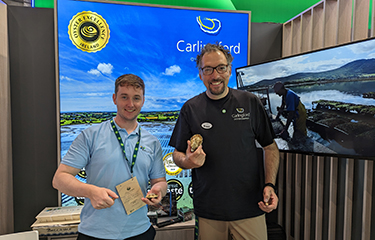
Irish firms Carlingford Oyster Company and Bells Isle Oysters have increased their competitiveness within the European market through a partnership with Zeebrugge, Belgium-based Vlaamse Visveiling (VLV).
Carlingford raises oysters in Northeast Ireland, producing roughly 250 metric tons of oysters each year in the bay that gave it its name. A few years ago, the company began working with VLV and partnered with Tullyearl-based Bells Isle Oysters to begin transporting full palettes of oysters to the country – a method that saved money over shipping smaller containers. At the time, Carlingford had trouble competing in Europe against the quality and local provenance of French oysters, Carlingford Director Kian Louët-Feisser told SeafoodSource.
French oysters have a longer shelf-life than Irish oysters in Continental Europe thanks to the lack of transit time from Ireland, typically giving them three extra days of freshness. That meant customers had additional costs if they wanted to carry Irish oysters, according to Louët-Feisser.
“If you make life difficult for your customers, they go somewhere else,” Louët-Feisser said.
Roughly 12 months ago, VLV, Carlingford, and Bells Isle embarked on a program to reimmerse the oysters, giving an additional three days of shelf-life to the product.
“The idea is we can send 1,000 kilograms of oysters to VLV really efficiently,” Louët-Feisser said. VLV then re-immerses the oysters, and the company can then send out individual packages to the customers that need them.
“We’re saving two or three days of shelf-life,” Louët-Feisser said. “There’s no way to deliver them fresher. It’d be impossible unless we had drones flying out from the farms.”
Looking forward, he said that Carlingford is planning to continue to grow its presence in Europe by increasing the quality of its oysters, rather than producing higher volumes. The company is also shipping its oysters to Asia, a market that Louët-Feisser said demands quality.
“They’re looking for really high quality, so when they’re looking for that, we have to up our game to meet their expectations,” Louët-Feisser said.
Photo by Chris Chase/SeafoodSource
