






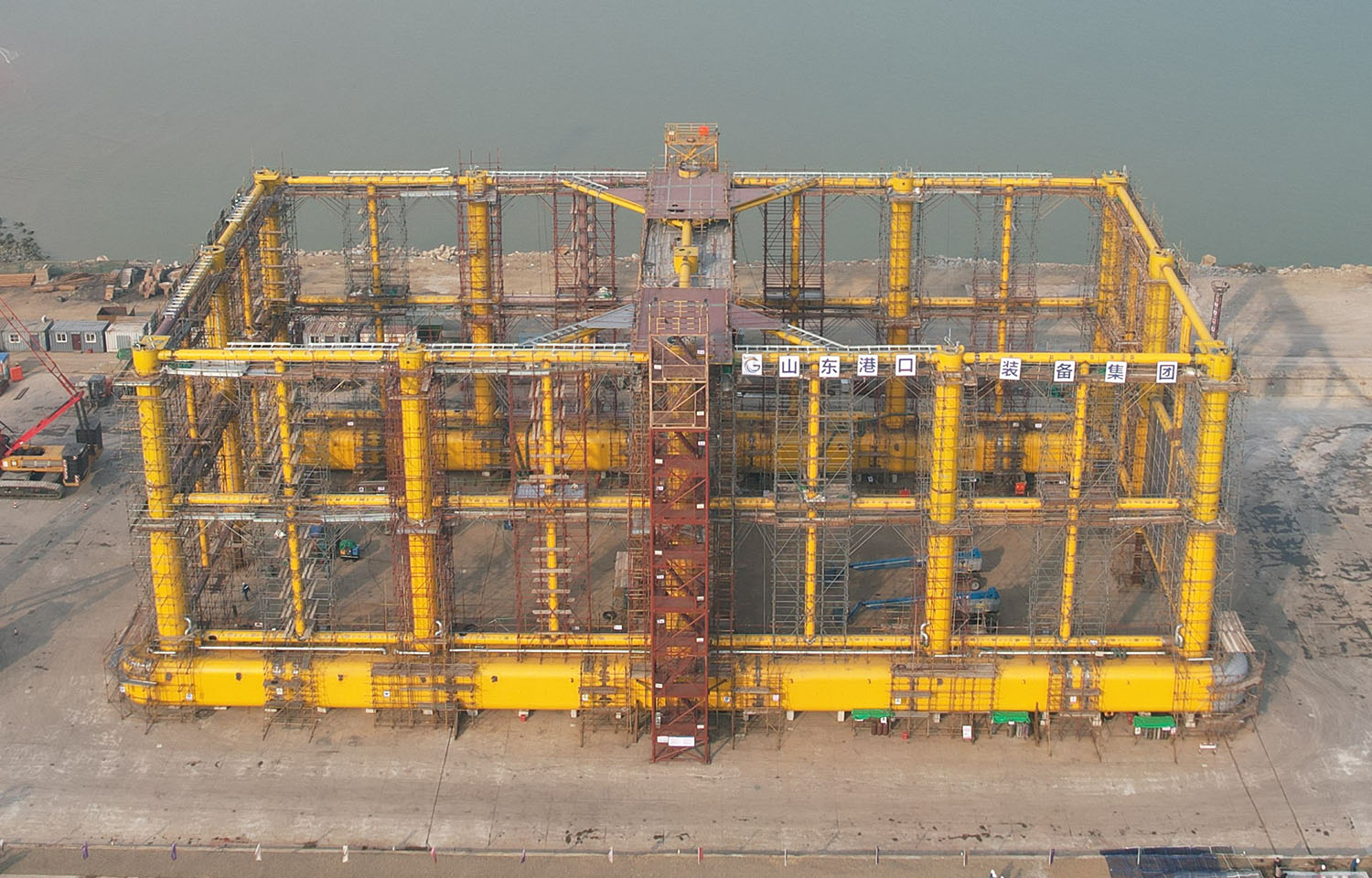
A Chinese city on the country’s east coast has outlined plans to construct a complete salmon industry value chain – from cage making to fry farming to processing – that has drawn skepticism on whether the city can pull off such an ambitious venture.
The plan, announced recently by the municipal government of Rizhao, involves an investment of nearly CNY 1 billion (USD 140 million, EUR 130 million) from Wanzefang Fishery Company to be used in constructing a research and development center, salmon-processing factories, deep-sea cages, and marine farms at an industrial park in the city.
Rizhao’s municipal government said the project should produce 20,000 metric tons (MT) of salmon annually at full capacity, and inject CNY 8 billion (USD 1.1 billion, EUR 1 billion) into the local economy by 2025.
Wanzefang already operates a few salmon-farming ventures in China, including a 1,400-ton platform designed for farming salmon off the coast of Rizhao and a separate fish farm that features tourist facilities and a hotel.
Wanzefeng CEO Li Ze Ming said that through these combined operations, his company aims to create “China’s number-one salmon brand,” aligning with China’s larger push to spur investment in offshore aquaculture.
That push is being aided by the provincial government of Shandong, the province in which Rizhao is located, setting a framework to encourage offshore aquaculture in the province. And national fishery officials at the Chinese Department of Agriculture and Rural Affairs have pushed policies that prioritize the future development of offshore aquaculture, boosted by subsidies.
Fan Xubing, the CEO of Beijing-based seafood marketing firm Seabridge, said the idea behind the Rizhao venture is sound, as the high price of imported Norwegian-origin Atlantic salmon has led consumers to seek out alternatives.
“Recently, locally farmed freshwater trout took over part of the Atlantic salmon market in China, mainly due to the extremely high price of Norwegian farmed Atlantic salmon,” he said. “I think Wanzefeng also noticed this opportunity.”
However, Fan said the project may be a bit too ambitious, and he questioned whether Atlantic salmon can thrive in China’s offshore waters. Fan warned that even if Wanzefang can pull off the Rizhao plan, consumer demand might not move away from the lower-priced alternatives. An influx of lower-priced Pacific wild salmon from Russia and Alaskan wild salmon in 2023, as well as farmed Chilean coho salmon that has entered the country since 2022, has created plenty of competition, according to Fan, who said a “salmon war” will commence in China starting in 2024 as the market grows oversaturated.
“I feel China will soon become another U.S. and Japan,” he said. “Farmed Atlantic and coho salmon and large-sized trout will take two-thirds of the market, and wild salmon will take another third.”
Tightening competition even further for companies like Wanzefang, state-owned airline China Eastern signed an agreement at this year’s China Fisheries Expo in Qingdao, which took place in late October, to expand salmon freight flights from Santiago, Chile, to Chengdu.
Also at the Qingdao expo, Chinese e-commerce site JD.com signed a memorandum of understanding with Norwegian salmon-farming giant Mowi and the Norwegian Seafood Council (NSC) allowing for the placement of an NSC quality guarantee label on salmon products sold on the platform. The move partly aims to assuage consumers worried about quality in the wake of the ban China placed on Japanese seafood imports.
Nevertheless, salmon remains a relatively minor category in overall Chinese seafood imports. Chinese salmon imports climbed 25 percent in 2022, reaching USD 700 million (EUR 658 million) in value, but import categories such as shrimp and cod dwarfed the value of salmon sales. Shrimp imports rose 55 percent in 2022, totaling USD 6.2 billion (EUR 5.82 billion), while cod imports leapt 54 percent to reach USD 1.9 billion (EUR 1.8 billion).
Photo courtesy of Shandong Wanzefeng Fishery
