






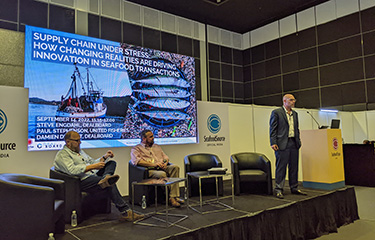
As the COVID-19 pandemic kicked off, in-person meetings between seafood producers and seafood buyers abruptly became impossible.
Suddenly, the industry was forced to change how it did business and adopt technical solutions, according to DealBoard Director Steve Engdahl. Speaking during a panel at Seafood Expo Asia – which ran from 14 to 16 September, 2022, at the Suntec Singapore Convention and Exhibition Centre – said his company wanted to find out how members of the seafood industry did business through the pandemic, and what had changed in its wake.
Earlier this year, DealBoard surveyed 350 companies over a span of several months, and discovered the majority of the seafood industry isn’t using just one method do communicate between buyer and seller. Roughly 8 percent of respondents indicated they work either via face-to-face interactions, or via phone calls, exclusively with no use of tech. At the other end of the spectrum, just 2 percent of the industry indicated it does its business entirely through e-commerce solutions like Alibaba.
“The results look like a normal distribution curve,” Engdahl said.
Most of the industry is using some combination of a variety of communications and tech tools to do business, Engdahl said.
“Everyone else is finding parties to negotiate with, and finding ways to negotiate through a whole slew of generic technologies,” Engdahl said.
Those technologies include an array of email clients – including Outlook and Gmail – a slew of messaging clients, and video-chat client technology. Engdahl said each individual seafood company has different ways of interfacing with clients, and oftentimes, each company and even each salesperson within a company is using its own unique combination of technological sales tools, even within a single conversation.
“A common theme that came out in the conversations that we had is people in the seafood industry telling me, ‘I’m not a technologist, I’m not familiar with technology,’” Engdahl said. “I think that the industry is selling itself by saying, ‘We’re not really technologists,’ because you can’t make this work if you’re not a technologist.”
Engdahl said the industry was quick to jump onto technology like Zoom or other video-chat services to bridge the gap as in-person meetings went on hiatus due to COVID. That 8 percent of people still doing business exclusively through face-to-face or phone calls, he said, is likely smaller by virtue of the pandemic forcing rapid change.
“This is an industry that’s a lot better at technology than it might have been,” he said.
However, with the proliferation of new technology came problems, Engdahl said. He highlighted a case of seafood theft that totaled USD 1.3 million (EUR 1.31 million) perpetrated due to abuse of messaging services.
Engdahl used the example of texting with his son as an example of how the use of software can lead to communications problems.
“If I want to just get together with my son on Thursday for dinner, I'll send him a note saying, 'Hey, are we still on for dinner Thursday? You want to go to that place down the street [or] you want to [pick a] place?'” Engdahl said. “And somewhere along the line, he’ll just say, ‘Yes.’ And I have no idea what we just agreed to.”
A lot of times, communication will break down or become endlessly complicated if it’s left purely to strings of messaging apps or email, which inevitably brings people back to relying on old-fashioned phone calls or in-person meetings.
Paul Stephenson, national sales and import manager for New Zealand-based United Fisheries, said his experience during the COVID-19 pandemic pretty much mirrors Engdahl's findings – and that it highlighted the need for in-person meetings, even with the availability of a range of technological communications solutions.
“We’re only small country, a small factory, and we’ve bought 20 containers from one supplier who I’ve never met until today,” Stephenson said. “When you miss these shows, after three years, you’re going, ‘I need to get on a plane and see people.’”
Photo by Chris Chase/SeafoodSource
