






The Norwegian seafood industry exported a record NOK 82.3 billion (USD 7.6 billion, EUR 7 billion) worth of seafood in the first half of 2023, according to the latest data from the Norwegian Seafood Council (NSC), a record-breaking number and an increase of NOK 12.3 billion (USD 1.1 billion, EUR 1 billion) over the same period of 2022.
The value increase, however, is in large part thanks to currency exchange rates and price inflation. Norwegian Seafood Council CEO Christian Chramer said that of the value increase, the majority of it is due to a weaker Norwegian krone.
“Of the total increase in export value of NOK 12.3 billion in the first half of the year, about NOK 8 billion [USD 742 million, EUR 682 million] can be explained by the weak Norwegian krone,” Chramer said.
The country exported NOK 70.1 billion (then USD 6.9 billion, EUR 6.8 billion) worth of seafood in the first six months of 2022. That same value in krone now exchanges for USD 6.5 billion (EUR 5.9 billion), highlighting how the weaker currency has inflated export values.
“A combination of a weak Norwegian krone and high global food inflation has resulted in a sharp rise in prices for our most important seafood species,” Chramer said.
Volume, meanwhile, dropped in the first half of 2022. The country exported 1.3 million metric tons (MT) of seafood, down 75,000 MT, or 5 percent, compared to H1 2022. Herring and cod had a reduced export volume explainable by poor fishing conditions and reduced quotas, while salmon had lower production volumes, the NSC said.
“The export figures emphasize that seafood from Norway is a sought-after product around the world. At the same time, it is important to be aware that it is currency, and not volume, that has been the major driver these last six months,” Norway Fisheries and Oceans Minister Bjørnar Skjæran said. “This is not positive, even when set against a generally good six months for seafood exports. The government is therefore keen to facilitate more activity and increased value creation along the entire coastline.”
Overall, June represented a turnaround compared to prior months, when almost the entirety of the value increases were attributable to a weaker krone. Norway exported NOK 14.9 billion (USD 1.3 billion, EUR 1.2 billion) in seafood in the month, an increase of NOK 2.6 billion (USD 241 million, EUR 221 million), or 21 percent, from June 2022. That figure was large enough to represent an increase even with the weaker krone taken into account.
“While in April and May, there was a decline in the value of Norwegian seafood exports measured in euros and dollars. This trend reversed in June,” Chramer said. “Then the increase in value was 7 percent measured in euros and 9 percent measured in dollars. Volume growth from salmon contributed to June being the third best single month of all time for Norwegian seafood exports measured in Norwegian kroner.”
On the horizon, the NSC said that food inflation, while still high, may have peaked, which could have mixed results for the seafood industry. While consumers will have more purchasing power, the price growth of Norwegian seafood – which has largely been responsible for the industry’s gains in 2023 – could slow, Chramer said.
In terms of markets, the U.S. saw the biggest growth in H1 2023. Norway saw its export value to the U.S. increase by NOK 1.7 billion (USD 157 million, EUR 145 million), or 34 percent, compared to the first half of 2022.
“Measured in value, 8 percent of seafood exports in the first half of the year went to the U.S.A.,” Chramer said. “The value share has grown steadily over the past 10 years, so here we are talking about a success story for Norwegian seafood exports. The U.S. market has also had the greatest growth both this year, the last 5 years, and the last 10 years.”
During the last 10 years, according to the NSC, exports to the U.S. increased from NOK 688 million (USD 63 million, EUR 58 million) in H1 2013 to NOK 6.9 billion (USD 640 million, EUR 588 million) in H1 2023.
That increase, Chramer said, is largely thanks to salmon’s dominance.
“Salmon is the export engine to the USA,” he said. “In the first half of the year, it accounted for 79 percent of the value, but trout, king crab and snow crab are also important species in the American market.”
For June, Denmark was the strongest growth market, with a 36 percent, or NOK 382 million (USD 35 million, EUR 32 million) increase in value for the month. However, volumes sent to Denmark decreased by 22 percent to 20,354 MT in June – further highlighting how price growth has driven value growth.
By species, salmon made up the largest export species by value for Norway in H1 2023. The country exported NOK 58.5 billion (USD 5.4 billion, EUR 4.9 billion) worth of salmon in the period, an increase of 21 percent, or NOK 10.3 billion (USD 956 million, EUR 878 million). Volume, however, decreased by 2 percent to 524,000 MT.
Fresh whole salmon and fresh salmon fillets reaching record prices were big reasons for the value increase.
Across other species, trout saw an increase in value of NOK 177 million (USD 16.4 million, EUR 15 million), or 8 percent, to NOK 2.3 billion (USD 213 million, EUR 196 million), with a volume decrease of 12 percent to 20,900 MT. The market for the species, NSC Seafood Analyst Paul T. Aandahl said, has shifted due to the war in Ukraine.
“Before the war, Belarus was one of the most important markets for trout from Norway. Now this market has completely disappeared,” he said.
Fresh cod exports increased in value by NOK 124 million (USD 11.5 million, EUR 10.5 million), or 6 percent, to NOK 2.1 billion (USD 195 million, EUR 179 million), while export volume fell by 12 percent to 36,500 MT. The decreased volume, NSC Seafood Analyst Eivind Hestvik Brækkan said, is related to lower cod quotas and landings.
“A doubling in the export volume of farmed cod helped to moderate the decline,” Brækkan said.
Frozen cod value fell by 15 percent, or NOK 373 million (USD 34 million, EUR 31 million), to NOK 2.1 billion (USD 195 million, EUR 179 million). The volume fell by 27 percent to 36,800 MT, which Brækkan also attributed to lower cod quotas.
The value of herring exports also increased by 5 percent, or NOK 85 million (USD 7.8 million, EUR 7.2 million), to NOK 1.9 billion (USD 176 million, EUR 162 million), despite a volume decrease of 16 percent to 121,000 MT.
NSC Pelagic Species Manager Jan Eirik Johnsen attributed the decline in volume to challenging fishing conditions.
“Here, northerly winds, low sea temperatures and scattered deposits have made fishing challenging,” Johnsen said. “In the first half of the year, around 48,000 [MT] were landed, compared to 95,000 [MT] in the same period last year, a decrease of 50 percent.”
Mackerel, meanwhile, was one of the few fisheries that saw volume increases. Norway exported 97,800 MT of mackerel in H1 2023, an increase of 16 percent. Value also increased by 23 percent, or NOK 377 million (USD 35 million, EUR 32 million), to NOK 2 billion (USD 185 million, EUR 170 million).
Prawns, snow crab, and king crab also saw export volume increases in H1 2023,.
Prawn export volumes increased by 22 percent to 9,710 MT, and the export value increased by 26 percent, or NOK 129 million (USD 11.9 million, EUR 11 million), to NOK 633 million (USD 58 million, EUR 53 million).
Snow crab exports increased in volume by 67 percent to 4,750 MT. However, the value decreased by 11 percent, or NOK 58 million (USD 5.3 million, EUR 4.9 million), to NOK 480 million (USD 44.5 million. EUR 40.9 million). NSC Shellfish Manager Josefine Voraa attributed the decline to continued uncertainty in global snow crab catches.
“The reason is that last year's problems have followed into this year. All supplier nations then had large inventories from the previous year,” Voraa said. “In addition, there have been challenges in Canadian fishing, which has contributed to more uncertainty.”
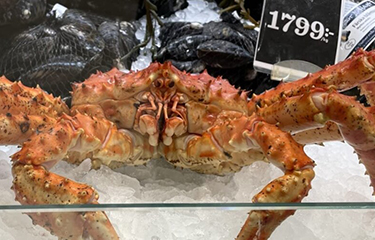
King crab export volumes increased by 50 percent to 914 MT, and increased by value by NOK 85 million (USD 7.8 million, EUR 7.2 million), or 22 percent, to NOK 474 million (USD 44 million, EUR 40 million).
“The reason for the growth is good demand for live and frozen king crab in all our core markets,” Voraa said. “Growth in the restaurant markets in Asia after the reopening, improved logistics to Asia and sanctions against Russian crab in the U.S. and Europe are among the reasons for the volume growth in the first half of the year.”
Photo courtesy of the Norwegian Seafood Council
