






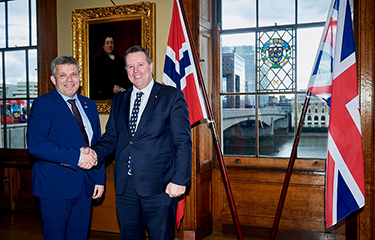
Strengthening the longstanding seafood ties that exist between Norway and the United Kingdom can help many commercial players and the wider value chain weather the severe headwinds that they’re continuing to face, Norwegian Seafood Council (NSC) CEO Christian Chramer said at the 2023 edition of the annual Norway-UK Seafood Summit, held in London’s Fishmongers’ Hall on 27 February.
Framing the current economic landscape as “very difficult,” after almost three “long and hard Covid years,” the seafood economy is now being heavily disrupted by a war in Ukraine that’s now entering its second year, which is in turn contributing to much higher energy and cost-of-living expenses.
Collectively, these and other challenges are leading to crises in key seafood markets, Chramer said. At a consumer level, there’s both a decrease in purchasing power and growing competition from other protein sources and food sectors.
“These are challenging times for many companies,” he said. “Many of the factors that we all thought would be stable, long-term situations have become more unpredictable than ever before.”
But as difficult as the situation is, these are also fascinating and important times for seafood, Chramer insisted.
“These are times when we must unite to survive and work hard for future solutions,” he said.
Though Norway continues to see earnings from its seafood exports soar, with 2022’s total earnings of NOK 151.4 billion (USD 14.7 billion, EUR 13.8 billion) smashing the previous year’s record, Chramer said he sees the Norway-U.K. cooperation as being more important than ever.
“The challenging year 2022 is behind us, but still we saw a record year for Norwegian seafood exports and the U.K. is leading the way among our main consuming markets around the world,” he said. “The fact exports are still doing so well shows us seafood is able to overcome its challenges and also that the value chain and the people working in it are able to work together and find new ways to meet the market’s demand.”
Norway Minister of Fisheries and Ocean Policy Bjørnar Selnes Skjæran told the summit the Norway-U.K. free trade agreement (FTA) that came into effect in December 2021 has already been and will continue to be crucial for the seafood sector moving forward – providing a “predictable framework for trade,” and enabling companies and exporters on both sides to lower costs and explore new opportunities.
“It’s more important than ever to strengthen our ties,” Skjæran said. “Luckily, the United Kingdom and Norway have a strong and long-held partnership – we are close allies, partners, and friends in peacetime and in times of crisis.”
In 2022, Norway exported around 146,000 metric tons (MT) of seafood to the U.K. market, valued at GBP 625 million (USD 756.3 million, EUR 712.3 million). Skjæran said the seafood partnership between the two countries is growing and that there’s a lot more scope to further expand trade, including through retail, since U.K. consumers are currently only eating around half of the recommended weekly amount of fish.
“In Norway, we also have much room for improvement in this regard,” he said. “The recent, positive development in the seafood trade between the United Kingdom and Norway strengthens our relationship today and helps create security for the future – for people in the U.K. and for people in Norway. My ambition is to strengthen that good cooperation.”
U.K. Minister of Food, Farming, and Fisheries Mark Spencer said the country’s post-Brexit status as an independent coastal state will take its relationship with Norway on to a “whole new level,” and that the two countries can grow together by sharing experiences, collaborating to overcome challenges, and promoting shared ambitions.
“Strong international bonds such as ours are even more important now as we look to address global events, most importantly Russia’s invasion of Ukraine,” Spencer said. “While we are committed to increasing the domestic consumption and export of our own seafood, we recognize the significant contribution of imported seafood, particularly from Norway.”
Maintaining these supply chains is of as much importance to U.K. industry and government as it is to Norwegian stakeholders, Spencer said.
“The U.K. is in the process of reshaping and improving our border to make it as effective and as streamlined as possible,” he said.
According to data shared by NSC Seafood Analyst Eivind Braekkan, the United Kingdom is currently Norway’s fifth-largest seafood export market by value, with the country accounting for 6 percent of its overseas salmon sales, 13 percent of its cod trade, and 55 percent of its haddock.
Photo courtesy of
