




Global seafood supply is likely to rise next year, with key aquaculture production sectors returning to a period of growth after a turbulent 2023, according to new analysis compiled by the RaboResearch unit of Dutch financial services company Rabobank.
Summarizing key takeaways from Rabobank’s annual production survey with support from the Global Seafood Alliance, the report, “What to Expect in the Aquaculture Industry in 2024,” anticipates worldwide shrimp production will recover in the year ahead after a modest 0.4 percent decline in output in 2023. At the same time, global salmon harvests are likely to rise after two years of flat or declining yields, and various farmed whitefish sectors are expected to see an upturn.
Compiled by Rabobank seafood analysts Novel Sharma and Gorjan Nikolik, the report forecasts shrimp production will grow by around 4.8 percent in 2024, surpassing 2022’s peak volumes, but Ecuador’s shrimp production will grow at a lower year-over-year rate. Sharma said El Niño effects could “pose downside risks,” with the potential for heavy rains to increase flooding risks and cause possible damage to the country’s pond infrastructure.
Elsewhere, the survey found that Asian shrimp producers are optimistic about returning to a growth level of around 4 percent next year after seeing its first decline in a decade in 2023.
According to the report, Indian shrimp production will recover and deliver 2 percent growth in 2024, following a sharp 12 percent contraction this year, with Vietnam likely to follow a similar trend by posting 6 percent estimated production growth next year that would reverse 2023’s contraction of around 15 percent. Rabobank said growth in both regions will depend on improvements in demand in U.S. and European markets, as well as sufficient price recovery that would incentivize farmers to increase the stocking of their ponds.
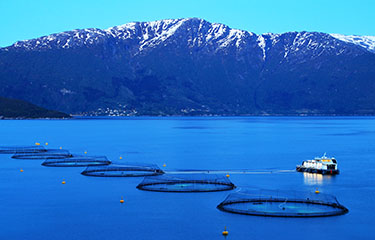
The global salmon-farming sector, meanwhile, experienced an “inflection point” in Q3 2023 after two consecutive years of weak production growth, offering signs of structural recovery. The 2024 and 2025 harvests of Atlantic salmon for the sector could grow by 4.3 percent and 3.9 percent, respectively. As such, it would cross the 3 million metric ton (MT) annual mark.
Norway is expected to lead the increased production, with predicted production totals of 1.58 million MT and 1.67 million MT over the next two years, respectively, provided that biological issues remain limited and the benefits reaped from smolt stocking that the industry realized in 2023 continue.
Nikolik told SeafoodSource the main reason for the uptick is the expected recovery of harvest weight in Norway.
“In 2023, [harvest weight] was depressed well below normal due to issues with diseases and pathogens,” he said. “Indications are that the conditions are better now, and we can see a normalization in harvest weights.”
In regard to farmed whitefish, Rabobank’s report expects increases in the overall production of tilapia, pangasius, and sea bass and seabream, while warning that El Niño again poses potential downside risks for some species and regions.
It anticipates that tilapia harvests will grow 5.3 percent this year, and then by 5 percent in 2024, to exceed 7 million MT. Strong growth is likely in Asia, particularly in Indonesia, where production of the fish is expected to grow at 5 percent and 3.7 percent this year and next, respectively.
China is expected to hold on to its position as the top producer of tilapia in the near term, but Nikolik said if Chinese consumers continue to favor premium species and supply continues to fluctuate too dramatically, domestic farmers could change the species they produce – potentially decelerating tilapia production growth to 1 percent or 2 percent annually over the next few years.
Global pangasius production is estimated to experience year-over-year growth of 2.8 percent in 2024, Rabobank found, as long as demand is stronger than in 2023 and inventory levels diminish, especially in China. Comparatively, 2023 pangasius production is likely to reach 3.1 million MT, which would represent an increase of just 0.5 percent year over year.
The world’s Sea bass and sea bream production is expected to accelerate at a rate of 3.9 percent in 2024 and 4.7 percent in 2025, respectively, with Turkey’s continued expansion being a primary driver. The country’s harvest is on course to surpass 250,000 MT in 2025, and Greek and Spanish production is also likely to pick up.
“The supply growth in the future is a result of relatively good prices in 2022 and 2023 as well as supportive government policies,” Nikolik said.
Heading into 2024, the seafood industry is mostly concerned with market prices, Rabobank discovered during its survey. It is also worried about uncertainty surrounding persistent inflation and the recovery of seafood demand. Additionally, elevated costs and stagnating household disposable income remain challenges for consumers across major markets, as consumers may look to trade down when purchasing food – either staying within the seafood category or switching completely to lower-priced protein options.
Photo courtesy of Terje Aase/Shutterstock
