






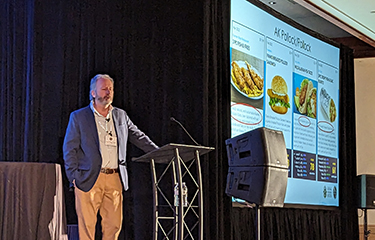
A lower Alaska pollock quota in 2022 didn’t dent the production of deep-skinned pollock fillets and pinbone-out (PBO) fillets.
According to data shared during the National Fisheries Institute's Global Seafood Market Conference – held from 15 to 19 January in La Quinta, California, U.S.A. – producers actually increased the amount of deep-skinned and PBO fillets produced in 2022. That production was in spite of a relatively low catch of the species – fishermen caught only 1.255 million metric tons (MT) of pollock in 2022, significantly lower than the 1.479 million MT caught in 2021.
The quota, Genuine Alaska Pollock Producers Director of Industry Relations, Partnerships, and Fishery Analysis Ron Rogness said, was down by roughly 19 percent, and that lack of supply was shifted to surimi production.
“All of that was absorbed by surimi,” he said. “Production was down from 193,000 MT to 161,000 MT.”
That drop in surimi, Rogness said, was not as large as it may seem at first glance. Surimi production in 2021, he said, was significantly higher than 2020, when production was around 177,000 MT.
“So it’s a big decline from 2021, but it’s not necessarily that much of an outlier from what we’ve seen over history,” he said.
The production of fillets, however, was a “big surprise.”
“The big surprise to me, and a pleasant surprise, was the production of fillets. If you look at just the deep-skin fillet and PBO fillet category, it actually went up about 200 MT in 2022, despite that 19 percent reduction in quota,” Rogness said.
Rogness credited the increased production of fillets to producers wanting to secure the market.
“Clearly, the producers were protecting that fillet market in 2022 and shielding it form the quota decline,” he said.
Looking ahead, 2023 will likely be a positive year for the U.S. pollock industry. The quota for the species has increased, and fish will be bigger, Rogness said.
“We’re also dealing with a fish size that’s going to be very favorable for production,” Rogness said. “The Alaska pollock resource at any given time largely consists of a single-year class or maybe two year-classes adjacent to one another. The majority of this product is from 2018, that’s going to be a five-year-old fish in 2023. That really enters the sweet spot for processing production and yields.”
That sweet spot may even mean that the amount of usable material from Alaska pollock production could actually increase at a rate higher than the quota increase, he said.
“It wouldn’t surprise me if we see production out of the U.S. fishery for Alaska pollock increase at a higher rate than what we see in the increase in overall quota,” Rogness said.
Photo by Chris Chase/SeafoodSource
