



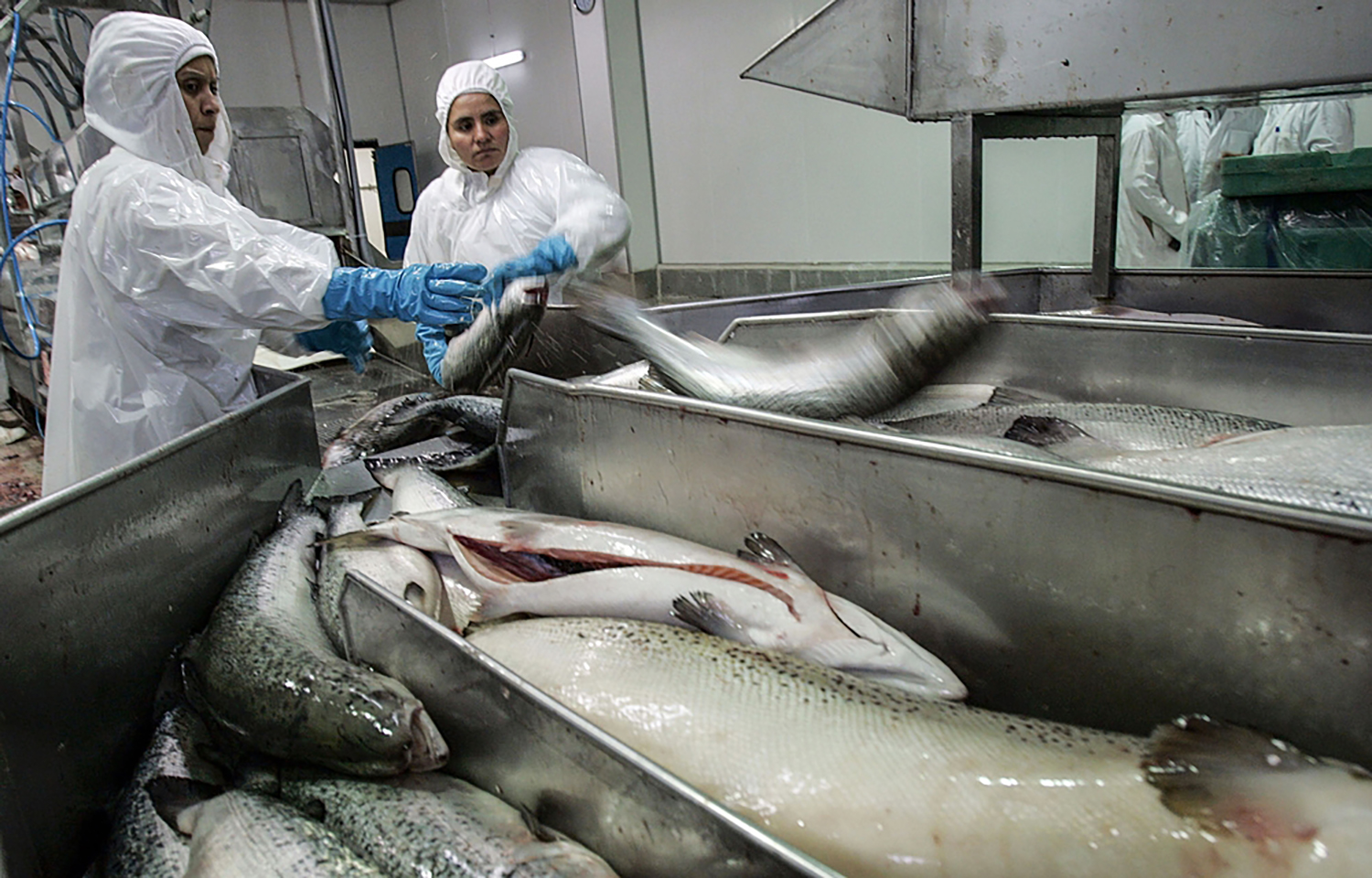
Chile's salmon industry registered exports of USD 6.55 billion (EUR 5.63 billion) in 2025 – a 3 percent increase from 2024, according to SalmonChile's Quarterly Export Bulletin, which referenced information from the country’s Central Bank.
The bulletin stated that the sector accounted for 6 percent of Chile’s total exports and salmonids were the country’s second-most exported product behind copper. Additionally, it found that four salmon-farming firms accounted for 50 percent of Chilean salmon exports last year, while the top 10 firms in the nation accounted for 78 percent of exports.
During this period, Atlantic salmon represented 72 percent of exports, coho represented 23 percent, and trout made up 5 percent. The top exported format of salmon was fresh Atlantic salmon fillets, comprising 25 percent of the goods sent abroad, followed by frozen Atlantic salmon fillet at 18 percent, fresh whole Atlantic salmon at 16 percent, and frozen headed/gutted coho at 14 percent.
SalmonChile also presented information from Chile’s National Customs Office, which currently has figures from January through November 2025. During this 11-month time frame, Chile exported 982,840 metric tons (MT) whole fish equivalent (WFE) of salmonids, which was up 14 percent from the same period in 2024. The main species exported was Atlantic salmon at 657,139 MT WFE, followed by coho salmon at 271,584 MT WFE, and trout at 54,117 MT WFE.
The U.S. consolidated its position as the main market for Chilean salmon, buying up 40 percent of exports by value, followed by Japan at 17 percent and Brazil at 13 percent.
The U.S. bought 357,035 MT WFE of salmon products totaling USD 2.4 billion (EUR 2.1 billion) – a 6 percent increase by volume and 1 percent spike by value. Meanwhile, Japan received 197,793 MT WFE of Chilean salmonid exports, which was up 2 percent year over year, worth USD 1.04 billion (EUR 89.3 million), marking 11 percent growth by value.
Shipments to Brazil experienced mixed results in 2025, with exports by volume increasing 2 percent year over year to 134,054 MT WFE but the value of those shipments falling 6 percent to USD 796 million (EUR 684 million), reflecting greater price pressure on whole fresh Atlantic salmon – the preferred format in Brazil.
Elsewhere, salmon exports to Russia grew 43 percent by value, reaching USD 287 million (EUR 247 million), and 39 percent by volume to 45,486 MT WFE, largely driven by shipments of whole frozen Atlantic salmon. Chile also increased the volume of salmonids exported to China by 2 percent to 39,329 MT WFE but saw an 8 percent drop by value to USD 230 million (EUR 198 million), reflecting price adjustments and changes in format demand.
Last year, Chile and Norway accounted for 76.9 percent of the world's salmon production, with respective shares of 30.5 percent and 46.4 percent respectively, according to figures from Kontali. While Norway increased its harvest by 12 percent from 2024, Chile saw 14 percent growth. However, over the last five years, Chile has seen an average harvest growth of 2 percent per year, while that figure in Norway has totaled 4 percent annual growth.
Stakeholders within Chile’s salmon-farming industry have been calling for the nation’s government to more clearly define its stance on the future of the aquaculture sector, seeking a countrywide vision to better compete with Norway.
The current lack of a unified plan for aquaculture in Chile has been a source of consternation in the industry, but salmon-farming stakeholders in the country – including companies, associations, government authorities, industry workers, and academia – have begun working on a 50-year plan to help drive sector development.
Further, Chileans recently elected José Antonio Kast of the far-right Partido Republicano de Chile as their next president in a runoff election. Kast has proposed “substantial deregulation” of the nation’s aquaculture sector, criticizing previous state bureaucracy affecting the sector. He presented a series of proposals aimed at strengthening the salmon industry, highlighting the need to eliminate obstacles and generate a more favorable environment for productive growth without compromising environmental standards.
Kast will take office in March.
