


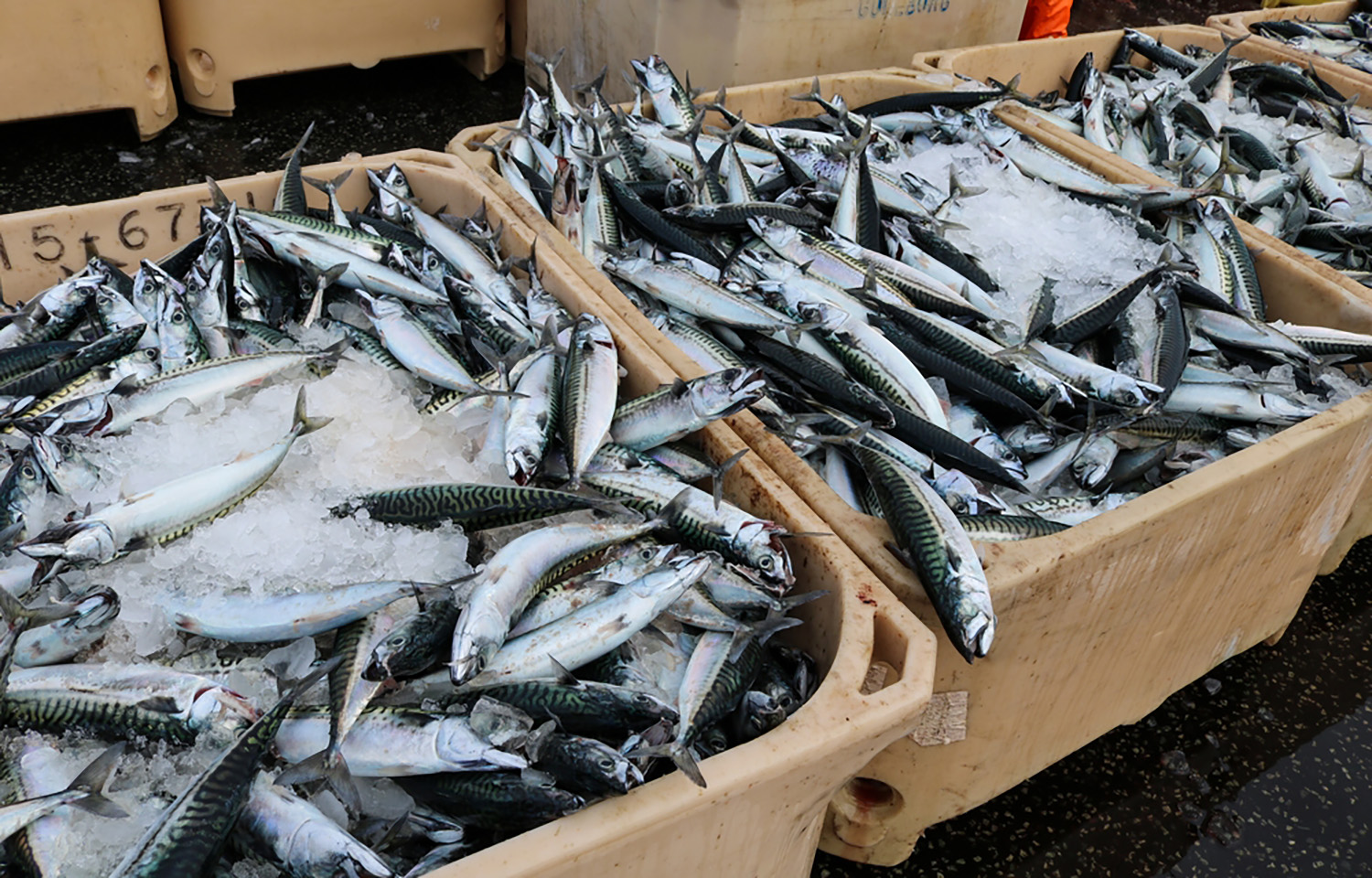
Four Northeast Atlantic coastal parties reached a quota-sharing deal in December 2025 for this year’s mackerel-fishing season in the region: the U.K., Norway, the Faroe Islands, and Iceland, the latter of which has been included on a mackerel quota-sharing deal for the first time.
Some within Iceland have hailed the country’s first-ever inclusion in a mackerel-fishing deal as historic and a responsible action that will help ensure sustainability of the plummeting stock, but others, including some within the Icelandic fishing industry, have argued that the nation gave up too much to be part of the deal.
The agreement has set the 2026 total allowable catch (TAC) for mackerel in the Northeast Atlantic at 299,010 metric tons (MT), marking a 48 percent year-over-year reduction. Though the TAC has decreased nearly 50 percent year over year, the cuts are still not as dramatic as the 70 percent cuts the International Council for the Exploration of the Sea (ICES) called for to halt the effects of overfishing.
Nevertheless, after taking into account bilateral agreements between the involved parties, the deal gives the U.K. 30.55 percent of the quota, Norway 26.4 percent, the Faroe Islands 12 percent, and Iceland 10.5 percent, leaving 20.55 percent for the E.U., Greenland, and Russia, which are not part of the agreement.
Icelandic Foreign Minister Katrín Gunnarsdóttir celebrated the deal as a sign of sustainable collaboration.
“Iceland has a strong financial interest in getting an agreement for the regulation of mackerel so the stock can be rebuilt after years of overfishing,” Gunnarsdóttir said. “Iceland is taking responsibility for sustainable fishing with our neighbors,” she added.
Others in Iceland, however, were not pleased with the outcome of the agreement.
In a statement titled “Iceland’s interest sacrificed in mackerel agreement – Iceland’s share significantly reduced,” Fisheries Iceland, a federation comprising owners of fishing vessels and processing factories, criticized the agreement, pointing out that Iceland had lost one-third of its quota compared to last year’s unilaterally set quota of 16.5 percent.
“None of the other three countries has reduced their share as much,” Fisheries Iceland said while particularly underlining its disappointment that the Faroese quota was higher than Iceland’s.
The federation also expressed its disappointment with stipulations forcing Iceland to auction two-thirds of fish caught in Norwegian waters on the Norwegian fish market.
“In reality, this gives Norwegian processors an advantage in buying Icelandic fish because of their proximity to the fishing areas,” the organization said, adding that this could cost “jobs, opportunity to increase the value of the catch, and valuable tax money.” The organization said that “an important aspect of Iceland's competitiveness – the integration of fishing and processing – is at risk.”
Some within Icelandic Parliament also said that the deal was agreed upon without proper consultation, both with the government and fishermen.
“There are a lot of questions still to be answered about this agreement that was made in the dark. The result is … a historic loss, a concession for Icelandic economic interests,” Sigurður Ingi Jóhannsson, chairman of the Progressive Party, told Icelandic public broadcaster RUV.IS.
Prior to this deal, Iceland had been setting unilateral quotas for mackerel since 2007 after the fish began showing up in Icelandic waters.
