






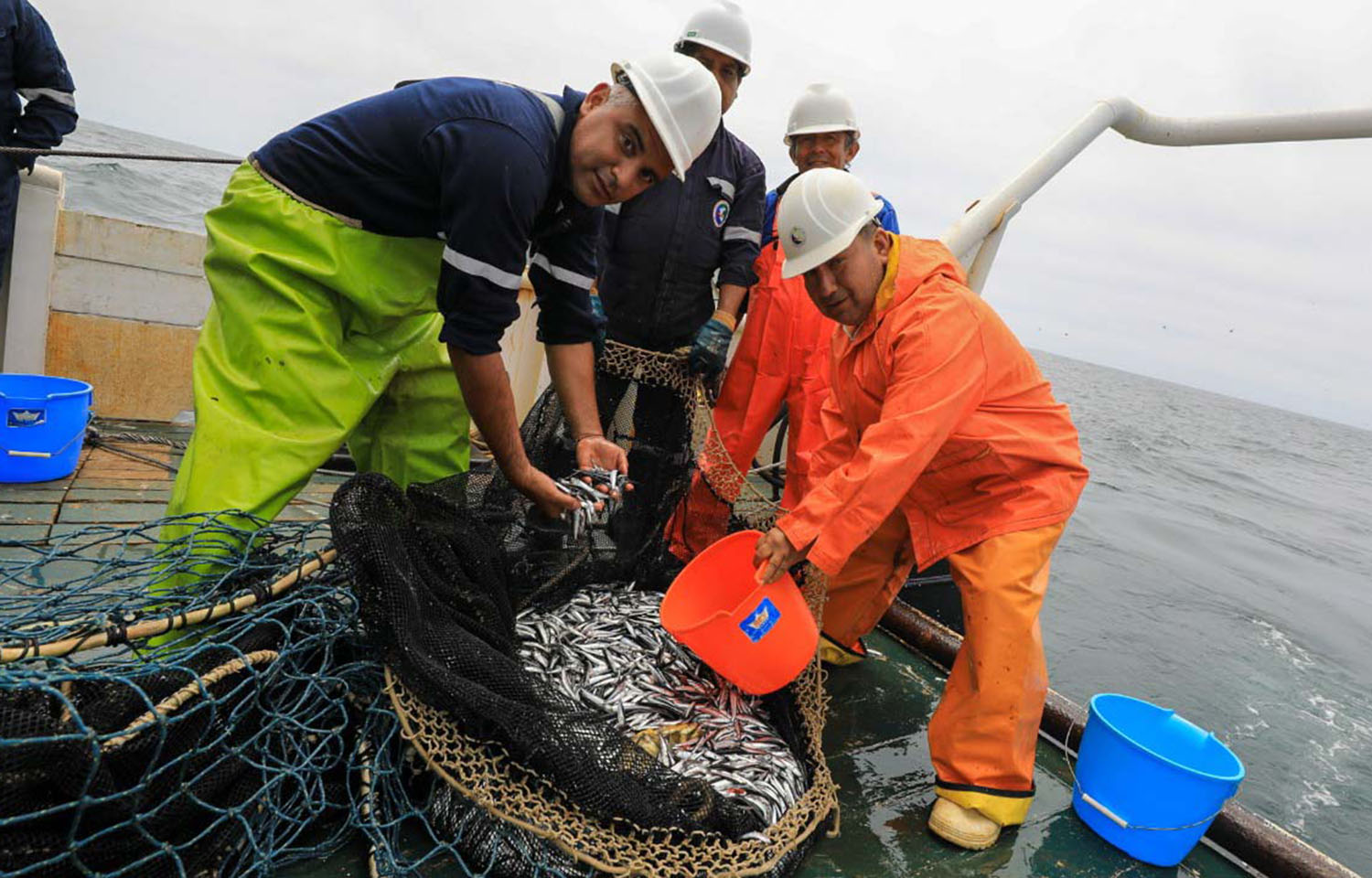
Peru’s Ministry of Production (PRODUCE) has increased the total allowable catch (TAC) for the nation's North-Central anchovy-fishing zone to 1.63 million metric tons (MT), marking a big jump from its provisional TAC.
PRODUCE established a provisional 500,000-MT TAC for North-Central zone anchovy in early November, which was a big drop from the 3 million MT TAC that it established in the first season of the year and the 2.51 million MT TAC it had in 2024. Peru’s anchovy fishery is the world’s largest commercial fishery by volume, and its highs and lows heavily influence global fishmeal and fish oil prices.
The revised higher quota comes after new scientific reports issued by the Peruvian Marine Institute (IMARPE), which confirmed biological conditions that allowed for a higher quota than first anticipated.
“At the beginning of November, we established a provisional quota of 500,000 MT to begin the fishing season, while IMARPE completed its studies verifying the state of the resource,” Peru Minister of Production César Quispe Luján said in a release. “Today, based on that scientific evidence, PRODUCE has set the final quota at 1,630,000 tons, reflecting a healthy anchovy population and responsible fisheries management.”
The earlier lower quota was set based on oceanographic conditions like increased thermal anomalies, fluctuations in coastal winds, and the intrusion of subtropical surface waters that are more saline.
To verify these conditions, PRODUCE said IMARPE carried out “Operation EUREKA LXXVII” between 4 and 6 November with the participation of vessels equipped to collect both oceanographic and biological data on the stock. The latest expedition confirmed “neutral environmental conditions” for the resource, which resulted in the bump in TAC over the provisional quota.
“Each fishing season in Peru is based on rigorous scientific studies carried out by our IMARPE researchers. Thanks to them, the State can define responsible quotas that ensure the sustainability of the resource and the ecosystem,” Luján said.
IFFO – the Marine Ingredients Organization said the increased quota will mean global production of fishmeal and fish oil is likely to be steady to round out 2025.
“This quota is well above the provisional quota set on 1 November and signals a science-based approach for the world’s largest single species fishery, which produces 20 percent of global fishmeal in an average year,” IFFO Market Research Director Enrico Bachis said. “The biological survey completed a few days ago places the quota in line with the one granted for the last quarter in 2023 but below the one authorized in Q4 2024. Our projections for the 2025 global production remain at 5.6 million MT of fishmeal and 1.2 million to 1.3 million MT of fish oil.”
IFFO said cumulative fishmeal production through September 2025 has been up 8 percent over the same period of 2024, largely due to higher fishing output in most regions aside from the North Atlantic. Cumulative fish oil output is up 6 percent through September 2025, with most countries recording positive trends with the exception of Spain and Peru.
