




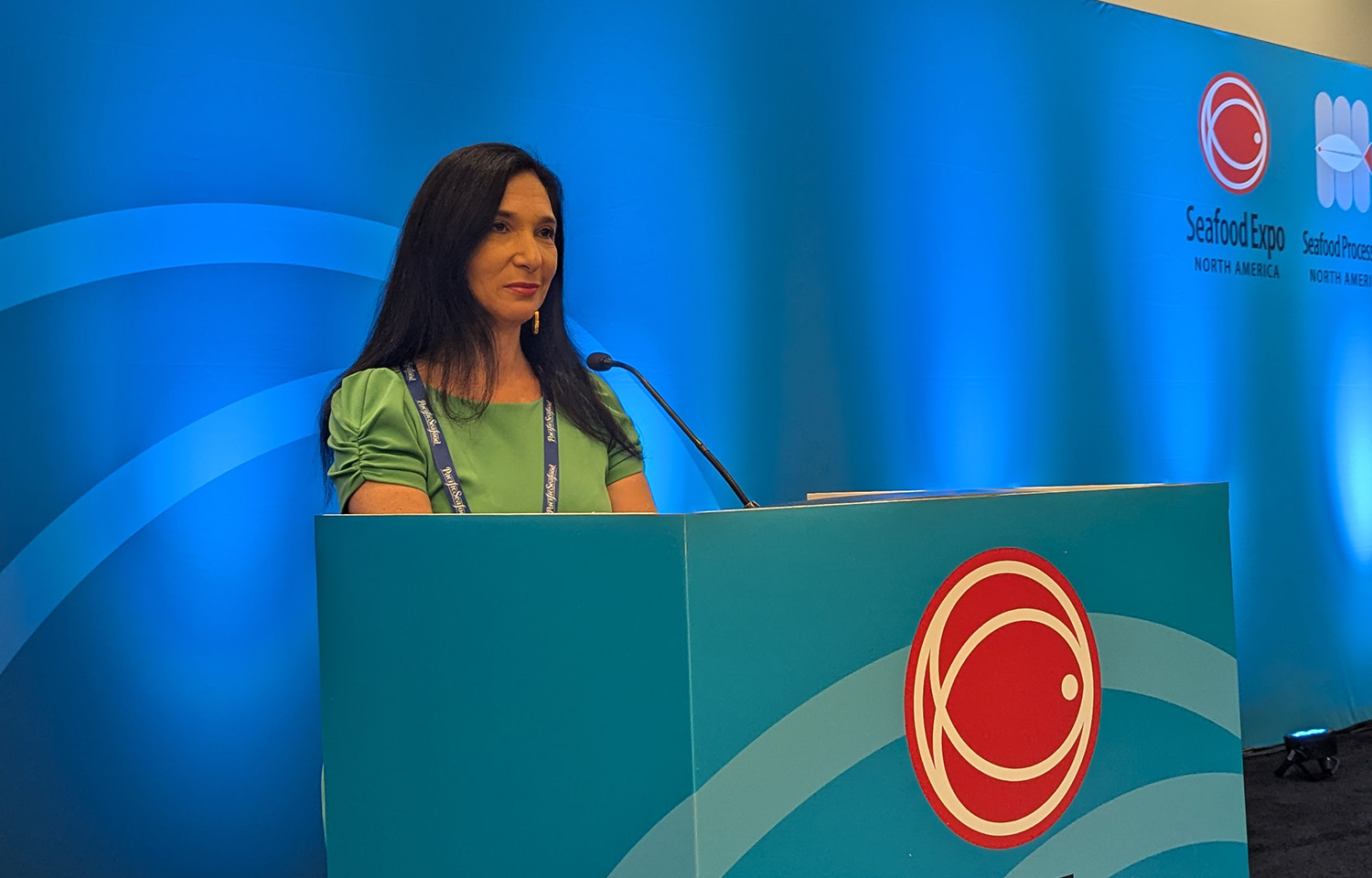
The current trading environment in the seafood industry is incredibly complicated and unpredictable, but Nomi Prins, the keynote speaker at the 2025 Seafood Expo North America (SENA), said the long-term trends are still positive for seafood.
Prins, a macro-economist, geopolitical finance expert, and best-selling author, kicked off SENA’s conference program by highlighting the many different headwinds the seafood industry had to grapple with in 2024.
“There's a lot of headwinds that are accumulating right now, and there’s a lot of dynamics that are changing because of the globality of it and because of geopolitics,” Prins said. “Anything that I’m going to say about tariffs right now could change in 30 seconds; that’s just a fact right now.”
A key factor in how tariffs are affecting the market, as well as the resulting headwinds, is the perception of the tariffs rather than their actual impact.
According to Prins, a lot of the movement in the market has been caused by overreactions when considered in the historical context of the last time similar tariffs were launched in 2018.
Those first tariffs, first launched by U.S. President Donald Trump during his first term in office and, in some cases, either reinstated or ceased by the following presidential administration under Joe Biden, had lasting impacts on the seafood industry in terms of where product is sourced from – and how the supply chain is leveraging tariff loopholes.
The growing number of imports from Vietnam or India instead of China is one example of the changes that have arisen from those tariffs, and the current round of on-and-off tariffs will likely just accelerate the trends that were started by that first trade action, Prins said.
“These tariffs, whatever happens, are going to really expand that trend, and that’s mostly because of the financing,” Prins said. “Right now, the U.S. economy is still growing, but it’s growing at a slower rate than it has been since the post-Covid spike and even the couple years after that. A lot of that is impacting consumer choices. It’s impacting how banks finance businesses.”
The new bunch of tariffs have given the global economy “a bit of tariff PTSD,” Prins said, especially given the uncertainty on which markets are going to be hit, and how hard, by the tariffs.
Prins said the impact on trade between the U.S. and China – given the 45 percent tariff some goods are facing – is likely to affect change, but moving trade away from China was already in motion before the latest round.
“The trend of China in general trading with other partners that are not the United States and the United States trading with other partners that are not China is simply going to continue no matter what the level of tariffs actually are,” Prins said. “That’s one of the big changes in the world; it’s one of the things that actually impact the globality of seafood.”
India and South America are filling the gap, and that trend will likely continue, Prins predicted. Additionally, many of the countries that are increasingly trading with the U.S. aren’t being targeted by tariffs, she said.
“There’s a history of where tariffs are coming from, where they’re going to, and where there’s more calm relative to being able to set up longer-term business strategies, where no matter what happens in the next few days or months with regard to tariff battles or trade wars, certain things are going to continue to trend that way in terms of the consumer side,” Prins said.
Prins acknowledged that consumer headwinds are present, and in the U.S., consumers are purchasing lower volumes of seafood; spending habits are also shifting in new ways that the seafood industry can and will adapt to.
Though a slowing economy will likely continue, Prins said, the longer-term macroeconomic trends will bend toward positive movement.
The seafood industry in particular is well-suited for weathering headwinds, given its institutional knowledge and the length of time many companies in the industry have operated, Prins said, which means they’ve often faced similar or worse issues.
“We’re in this interesting, potentially frustrating environment, but there are these opportunities with the consumer,” Prins said.
Prins added that the tariff anxiety and noise won’t be enough to hold back the trends, especially given the relatively minor impact of the tariffs compared to the overall economy. Prins said tariffs as they are now would comprise 0.3 percent of the U.S. GDP and be much less impactful than other factors on the economy.
“The U.S. GDP is like USD 28 trillion (EUR 25 trillion), tariffs on everything; all products, all together, are one-third of a percent of that. They’re about USD 80 billion to USD 90 billion (EUR 73 billion to EUR 82 billion); they don’t really move the needle on the U.S. economy,” Prins said. “Tariffs themselves make up a tiny part of U.S. revenues, so they’re not making a dent in the budget.”
Once some of the current chaos passes, overall trend points toward growth in seafood, Prins said.
“It’s one of the fastest projected growth industries that has sustainable growth,” she said.
