

The Chilean branch of aquaculture technology company AKVA group is working to bring its deep-farming technology to Chile to help salmon farmers in the country address sea lice issues.
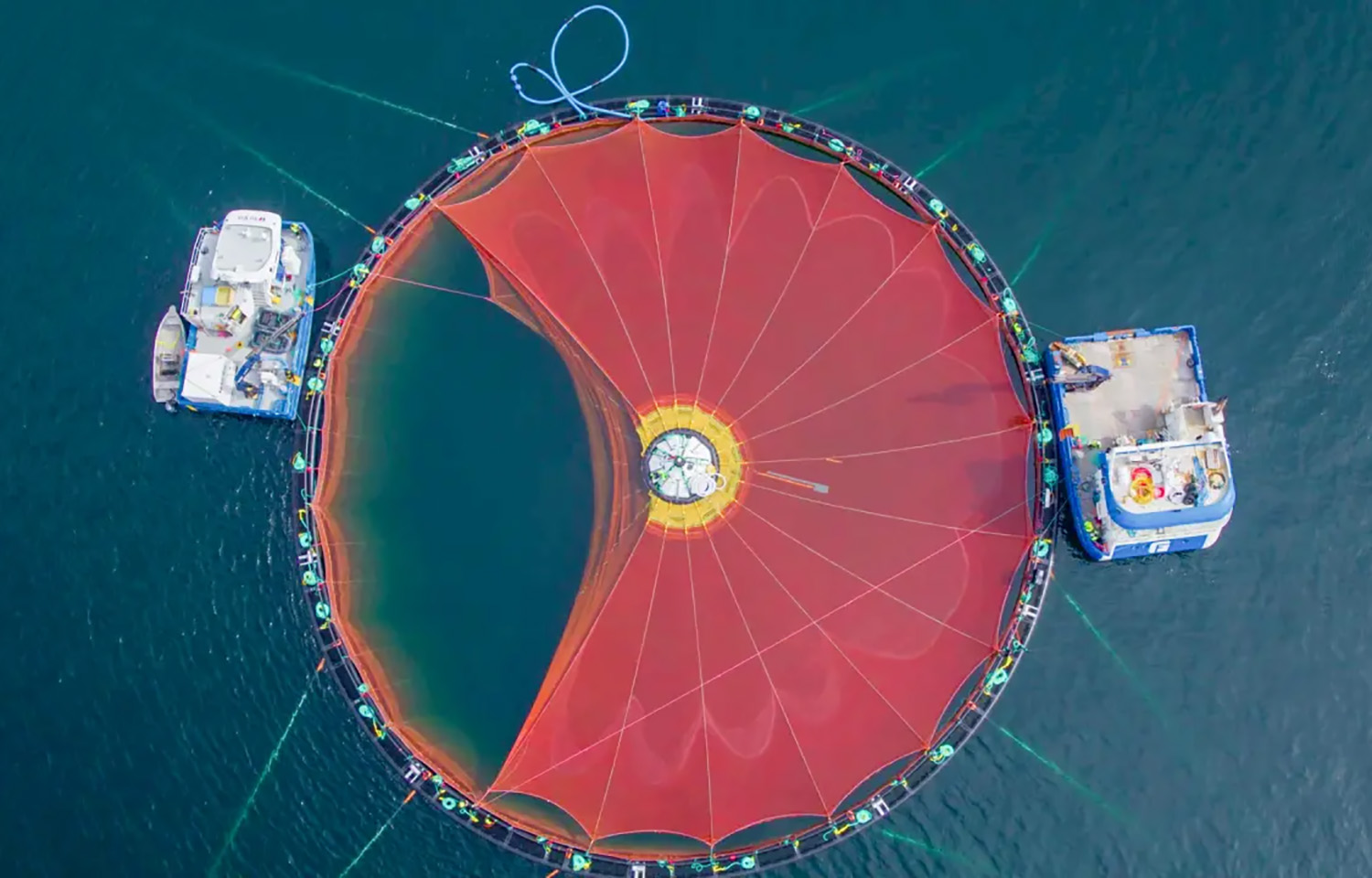
AKVA’s deep-farming methodology moves fish about 30 meters below the surface – beyond the depth at which caligus, a genus of parasitic sea lice that dwells mostly near the ocean surface, thrive. The cage on the surface has 30-meter cables that connect down to a 5-meter dome containing an air bubble through which feed is delivered.
To date, there have been more than 400 AKVA deep-farming cages sold in Norway, where farmers have been able to reduce their sea lice treatments by 80 to 90 percent, AKVA Chile General Manager Christian Schäfer told SeafoodSource.
However, the technology is not an “off the shelf” solution that can be directly copied from Norway, as Chilean waters have specific conditions to which AKVA’s deep-farming methodology needs to adapt.
“Currently, we are designing all this technology to be applied in the Chilean industry to also be able to achieve the reduction of treatments against caligus, which is as big a problem in Chile as in Norway,” Schäfer said.
One issue that Chilean farmers have to deal with is sea lions, which are entirely absent from the North Atlantic Ocean and other polar regions where salmon is farmed.
“In Chile, one of the main day-to-day concerns in a farming center is predators – sea lions, which are a big challenge,” Schäfer said. “As such, we have to use large structures of sea lion nets in addition to the salmon pens.”
Other issues that AKVA needs to consider in Chile include the availability of oxygen below 30 meters, as compared to Norway, where deepwater is richer in oxygen than surface water. The opposite is true in Chile, according to Schäfer. There are also physical limitations; geologically, Chile’s salmon-farming centers often lack the depth that is readily available in Norway.
“Today, deep farming is technically possible, but we are addressing several limitations that make this progress not as fast as we saw in Norway,” he said.
The adjustments make the structures more complex and require AKVA to consider safety conditions with all of those unique factors in mind, he explained.
“When you have the biomass at a depth of 30 meters, it’s not so easy to send a diver down to solve a problem you may have in the infrastructure, whether that be a sea lion net or a fishing net. There is a higher risk compared to the situation in Norway, which is why this is being approached more carefully in Chile,” Schäfer said.
Issues outside of the water include legislative speed bumps. Technically, in Chile, authorities may not consider deep-farming technology to be the same as surface-area cages, but Schäfer said this will probably be the final hurdle to address on the regulatory front.
“We still have to check in detail if the authority is going to require something specific for this type of harvest. Since we don't yet have it [available in Chile] today, we haven't gone into so much detail. Defining this is pending – if it’s to be allowed under the current legislation or if some special permit may be needed,” he said.
Once those issues are resolved, AKVA will be able to implement its water-powered feeding systems for deep-farming centers.
The push to introduce deep-farming technology comes soon after Schäfer said AKVA has been making progress rolling out low-emission farming projects in Chile.
The firm recently announced it is working in conjunction with Norwegian energy firm Alotta and fellow aquaculture technology company Fjord Maritime to implement solar-powered salmon cages and pontoons in the South American country. It has already installed one such solution at a Mowi Chile farm and is currently wrapping up the assembly of a second cage that will be installed at one of Salmones Austral’s farming centers.
“We have several more projects that are in the process of closing contracts so that we can continue to scale this commercially,” Schäfer said, noting that the company has the capacity to develop five to 10 such projects per year. “Everything we are developing today has to do with an improvement from the point of view of sustainability and better efficiency."
