


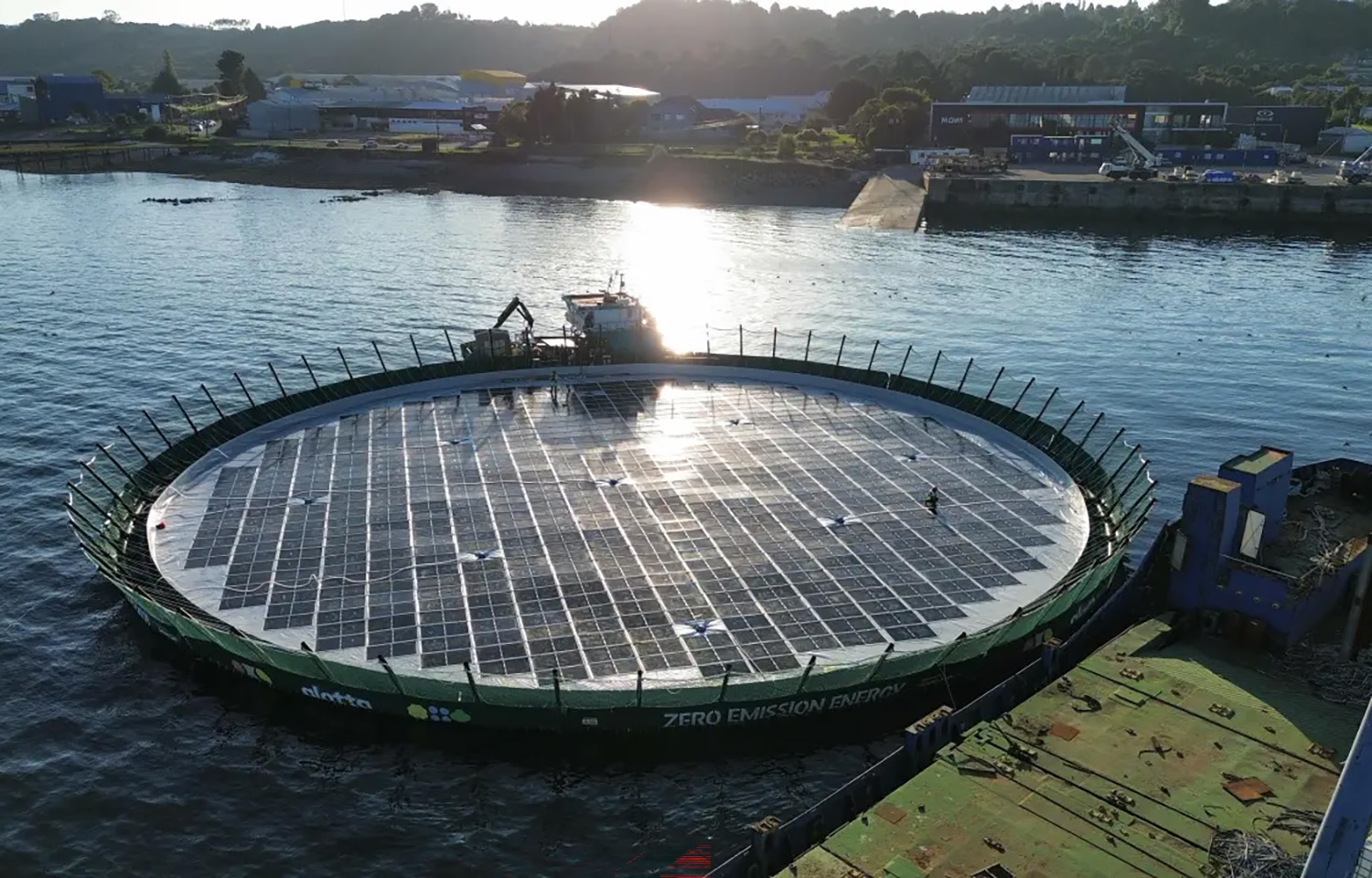
The Chilean branch of aquaculture technology company AKVA group has continued rolling out low-emission farming projects in the South American nation, including solar-paneled cages and vessels that the firm said have significant business potential.
AKVA is working in conjunction with Norwegian energy firm Alotta and fellow aquaculture technology company Fjord Maritime to implement solar-powered salmon cages and pontoons. The team has already installed one such solution at a Mowi Chile farm and is currently wrapping up the assembly of a second cage that will be installed at one of Salmones Austral’s farming centers, AKVA Chile General Manager Christian Schäfer told SeafoodSource.
“This is a very interesting project, and today, it is one of the concrete solutions that goes directly to [reducing] Scope 1 emissions, so it’s been very well received,” he said.
According to the Greenhouse Gas Protocol, which helps companies measure, manage, and report their internal operations’ and value chain’s carbon footprints, Scope 1 emissions are greenhouse gases emitted directly into the atmosphere by sources owned or controlled by a company. In the case of fish farming, lowering emissions brings down the overall environmental footprint of the end product, which consumers are increasingly seeking on a global level, according to AKVA.
The current pen installed for Mowi incorporates a floating solar plant on the cages, capable of generating renewable energy to replace part of the diesel consumption at the farm. The structure includes a cage 50 meters in diameter that has 650 solar panels and is capable of generating 350,000 kilowatt-hours (kWh) per year, which is equivalent to approximately 40 percent of the energy that a farming center of that size needs per year. Depending on the size of the center, an AKVA low-emission farming project can save between 100,000 and 150,000 liters of oil per year, bringing down the center’s carbon footprint by about 200 metric tons of CO2 equivalent.
The time when the system is most efficient is when more solar radiation is available during the summer months, Schäfer explained. The inter-connected system relies on solar energy when available and the batteries get charged; when the batteries go low on power, there is an automatic switch for the generator to kick in. As such, CO2 emissions decrease during the summer and increase in the winter, when diesel-powered generators are used more.
“We have several more projects that are in the process of closing contracts so that we can continue to scale this commercially,” Schäfer said, noting that the company has the capacity to develop five to 10 such projects per year.
AKVA’s capacity, according to Schäfer, will vary depending on whether the company will have to continue redesigning the system to adapt to metal cages, which are the types of pens most used in Chile. Currently, the technology comes from Norway, where there are already such systems implemented and where cages are typically made of plastic. Therefore, in bringing the solution to Chile, the project needs to be redesigned and the technology adjusted to fit local needs.
“It will be faster to implement if we could do it in metal cages because we wouldn’t have to anchor a structure that is external to the farming center. Today, these plastic cages have to be installed as a third system, apart from the pontoon and the pen itself. It's a third system that's independent, with its own anchoring system, which makes everything a little slower. If we manage to develop this system in such a way that it uses the existing infrastructure at the center, it will be much faster and we could scale it faster,” he said.
In Chile, between 60 and 70 percent of the market share of metal cages are designed, manufactured, and installed by AKVA group, Schäfer estimated.
“Everything we are developing today has to do with an improvement from the point of view of sustainability and better efficiency,” he said.
Its positive performance in Chile helped the company turn in record financial metrics for the opening three-month period of the year.
AKVA revealed its Q1 income rose 13 percent, or NOK 293 million (USD 31.8 million, EUR 27 million), year over year to NOK 1.14 billion (USD 123.7 million, EUR 105.1 million). The firm also reported a strong order intake of NOK 1.49 billion (USD 161.7 million, EUR 137.4 million) and a NOK 2.83 billion (USD 307.1 million, EUR 260.9 million) order backlog at the end of the period.
At the same time, its EBITDA of NOK 153 million (USD 16.6 million, EUR 14.1 million) and EBIT of NOK 91 million (USD 9.9 million, EUR 8.4 million) also marked new quarterly bests.
