






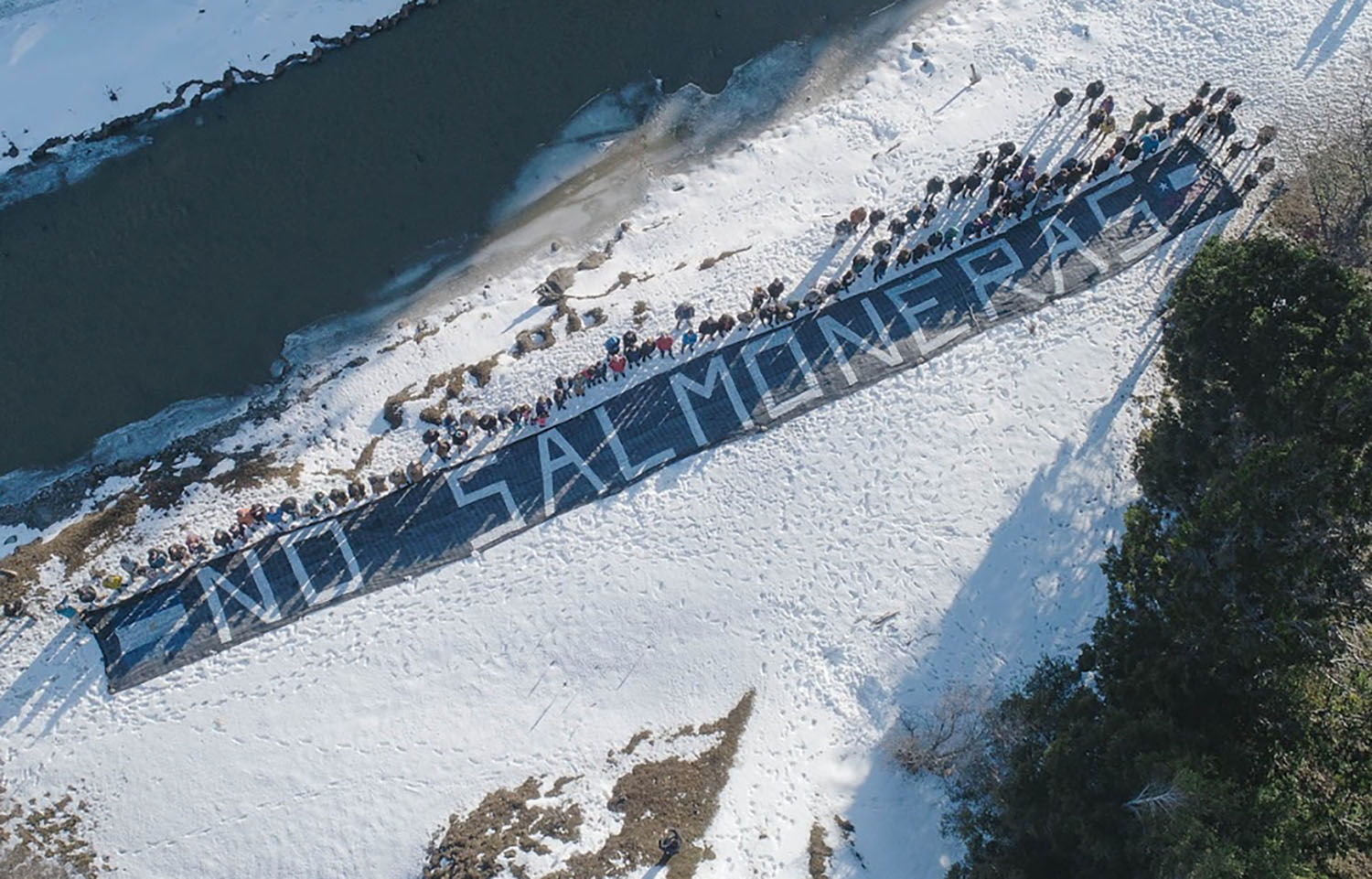
In an effort to jumpstart the sluggish economy in Argentina’s southernmost province of Tierra del Fuego, government officials are considering removing the region’s ban on salmon farming.
In 2021, the local government in Tierra del Fuego unanimously approved a bill prohibiting salmon farming.
Environmentalists and other NGOs celebrated the move as a “historical precedent,” hailing it as a safeguard for one of the planet’s biodiversity hotspots.
Others, however, lamented the impact it was set to have on the economy.
Daniel Schteingart, the director of sustainable productive development and data curator at local sustainable development thinktank Fundar, said at the time the ban was announced that Argentina has “enormous aquaculture potential,” highlighting statistics from the Interdisciplinary Center for Studies in Science, Technology, and Innovation (Ciecti), which is a local NGO, that showed exports from a fully operational sector could reach anywhere from USD 68 billion (EUR 58 billion) to USD 606 billion (EUR 517 billion) over the next 20 years.
Therefore, he cautioned against celebrating a ban on productive activity.
“I think it is good to discuss how to regulate it, scale it, zone it, and [run] pilot tests and modes of production. But, don’t prohibit it out of hand,” Schteingart said while acknowledging the environmental issues neighboring Chile has faced in the development of its salmon-farming industry.
The ban has now lasted four years and counting.
Since that time, Chile’s yearly salmon exports have continued to grow – surpassing USD 6 billion (EUR 5.1 billion) annually – and Argentina now has a president in Javier Milei who is openly friendly to private development and who favors deregulating the nation’s industries.
Meanwhile, tourism in Tierra del Fuego has slowed, and its manufacturing sector, which mainly produces electronic devices, is facing increasing pressures.
Considering the current landscape, Tierra del Fuego legislator Agustín Coto – whose Instagram profile picture shows him embracing Milei – has announced intentions to repeal the region’s 2021 ban, which would enable salmon and trout farming in provincial waters.
According to Coto, the move seeks to drive “the economic development of Tierra del Fuego and the country so that no transnational hippie NGO … tells us how or what to live on.”
The law he is looking to pass to repeal the ban would allow the Tierra del Fuego state government to employ environmental assessments to establish areas suitable for aquaculture. The proposed bill establishes that “social and economic well-being must be guaranteed without compromising the sustainability of ecosystems.”
To that end, the bill would still maintain the salmon-farming ban on the Beagle Channel – a 240-kilometer-long strait in the Tierra del Fuego Archipelago on the southern tip of South America, the eastern of which area forms part of the border between Argentina and Chile.
Tierra del Fuego Governor Gustavo Melella has come out in support of the initiative.
“We are working on the law to enable it on the entire Atlantic maritime coast,” he told newspaper Clarín in May. “We are aware of the need for environmental stewardship, but we also have to generate employment.”
The move comes as more than 25 percent of Tierra del Fuego’s 180,000 inhabitants fall under the poverty line, while Chile’s southernmost region of Magallanes, which borders Tierra del Fuego, hosts some 50 salmon centers producing about 180,000 metric tons (MT) a year in salmonids, representing exports of roughly USD 650 million (EUR 554 million), generating more than 7,000 direct jobs, and comprising a reported 50 percent of Magallanes’ regional GDP.
The possibility for Tierra del Fuego to mirror the success of salmon farming in Magallanes has piqued the interest of businessmen in the province looking to diversify investments, such as Rubén Cherñajovsky, founder of Newsan – one of the province’s largest manufacturers, importers, and distributors of consumer electronics and home appliances – who has pledged significant investment should aquaculture be allowed.
Just as in 2021, though, NGOs and other groups have come out in opposition to aquaculture in the area.
The Yagán Indigenous community of Puerto Williams, located on Chile's Navarino Island, has begun a cultural and resistance protest against the move to repeal the law.
Environmental NGO Ladera Sur have pointed to the possible conservation ramifications it would have in the region.
“Behind all those millions of dollars lurks an industry that destroys the oceans, mass-producing toxic fish, with workers constantly at risk for their lives, according to various studies, publications, and scientists. It's a system that is being questioned around the world,” Ladera Sur said.
Environmental NGO WCS Argentina said that even the parts of the bill that seem to prioritize environmental protection are hollow, as the stipulation of solely protecting the Beagle Channel “is like closing a door and leaving all the windows open.”
