


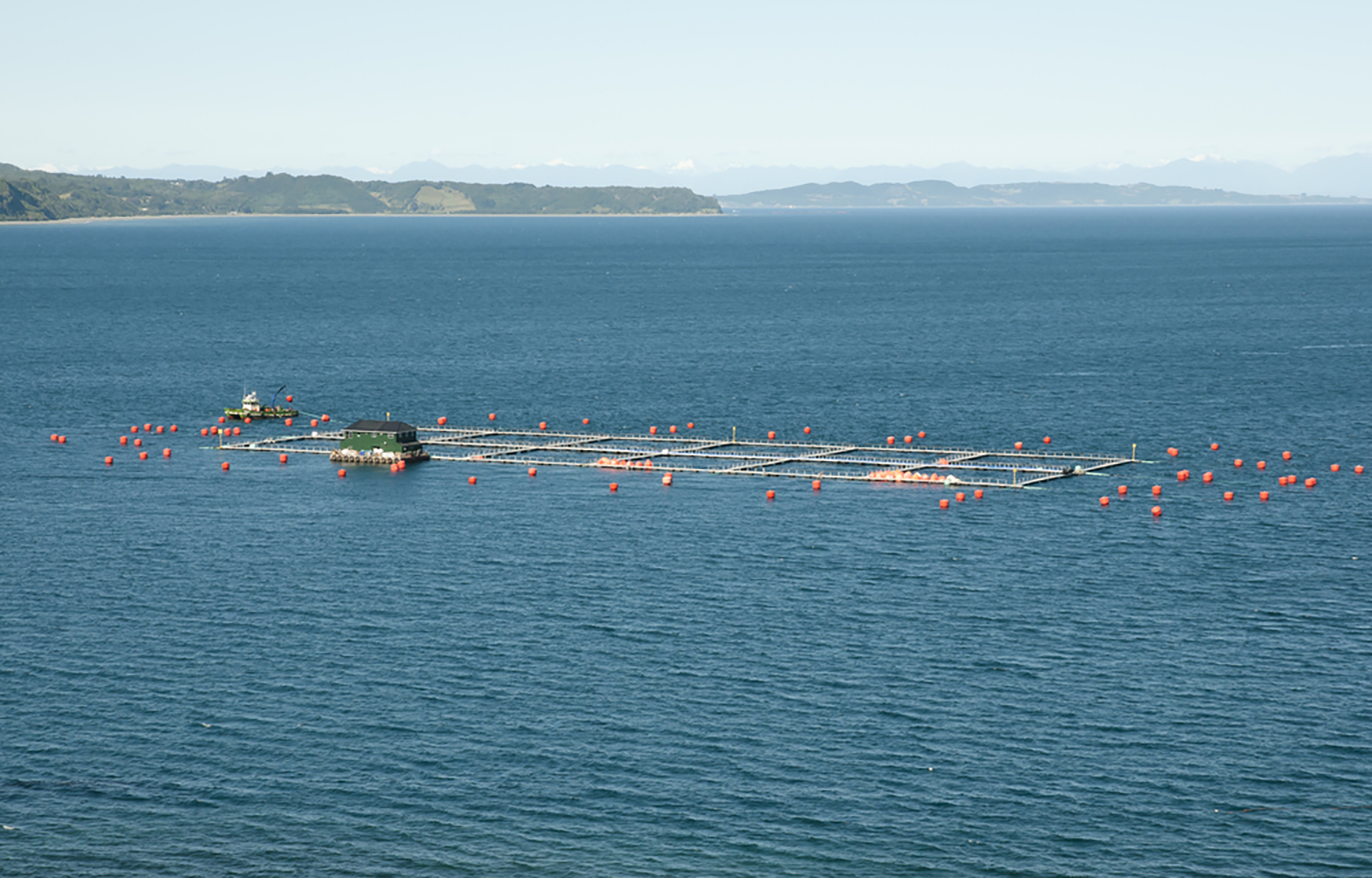
Chilean lawmakers and salmon-farming stakeholders have expressed ire over an exposé released on Chilean television that focused on possible undue Norwegian influence on the South American nation’s aquaculture sector.
The report, titled “Salmon: Cooperation on the surface, war underwater” that recently aired on Chile’s national television station TVN, asserted that a Norwegian government-financed NGO, Norwegian People’s Aid, is paying around USD 500,000 (EUR 433,000) per year to Indigenous communities in Chile.
The financing goes to communities with coastal claims in the same areas where salmon-farming operations are located, and according to the report, it is precisely those communities who have been empowered to halt salmon projects in Chile.
This represents a clear conflict of interest, according to former Chile President Eduardo Frei.
“Today, the Lafkenche Law allows a group that is no more than a few families – 80 or 100 people – to request 4 million hectares of sea,” he said. “When they ask for that concession, everything comes to a standstill and the salmon industry cannot develop there.”
The Original Peoples’ Maritime Coastal Spaces (ECMPO) Law – also known as the Lafkenche Law – was enacted in 2008 to recognize the territorial rights of Indigenous peoples in Chile.
When it was first established, the law was meant to serve as vindication of the territorial rights of Indigenous peoples in Chile, rooted in their ancestral use of marine resources that underpin their social structure and cultural practices.
However, aquaculture industry stakeholders soon complained that certain activist groups were exploiting the law for other motives, undermining its original intent. They maintain that contrary to its original purpose, the application of the law has produced uncertainty, investment paralysis, and division.
Organizations such as the Chilean Salmon Council called for the Lafkenche Law to be reviewed “to return it to its original spirit and ensure a fair coexistence between coastal areas and the development so necessary for Chile.”
The TVN exposé has now added even more fuel to the fire surrounding the law.
“This is an extremely serious situation that must be clarified. If there are compatriots here receiving money to harm the economic growth of our country, these people should even be criminally punished. We have already summoned the minister to the fisheries committee … and this is going to be one of the points that we are going to raise with him,” Alejandro Bernales, the president of the Lower House of Chile’s Fisheries, Aquaculture, and Maritime Interests Committee, told local publication EMOL. “It would also be important for us to move forward in legislating on a bill that is already in the Chamber of Deputies, which requires NGOs to make the funding they receive more transparent.”
Other lawmakers called on Chile’s Foreign Ministry to verify the veracity of the accusation and for the government to take appropriate action, including “drastic sanctions,” if confirmed. Likewise, they called for the Lafkenche law to be modified.
TVN interviewed Daniel Caiullán, chief of the Indigenous group Mapuche Lafkenche Melinka, who insisted that peaceful coexistence is possible between Indigenous peoples and salmon-farming operations.
“We’re not saying that [salmon farmers] have to leave. They occupy about 40 percent of the 720 concessions they have in [the region of] Aysén; they still have 400 concessions to use,” he said, calling on the state to define sustainable solutions for both industry and surrounding communities.
Meanwhile, Norwegian People’s Aid insisted its innocence of any wrongdoing.
“The law in Chile was approved in Chile, and we did not suggest or promote it as such. It was an initiative of the Lafkenche people,” Norwegian People’s Aid Section Leader for Latin America Beate Thoresen said, implying it is mere coincidence the organization chose to benefit an Indigenous group with coastal claims in the same areas where salmon production occurs.
TVN recognized Norway as the world’s leader in salmon production, followed by Chile. The two countries account for about 80 percent of the world’s salmon production.
“They [both] know that aquaculture is the future to feed humanity, but we cannot be deceived; behind the cooperation, there is also fierce competition. In this race for more markets, there are practices that are at least dubious,” TVN reported.
According to Marcos Godoy, a veterinarian and biologist at Chile’s Universidad San Sebastián, there was a time when Chilean and Norwegian salmon production was about equal. However, in 2007, Chile got walloped with the outbreak of ISA virus, leading to massive deaths on salmon farms that affected the industry for years.
“That virus comes from Norway. It’s a proven fact, and we have published it,” he said.
TVN reported that it is still unknown if this event was a biological accident, negligence, or owing to more sinister reasons.
“The fact is that Chile regressed, and today, Norway wants to multiply its production,” it said, interviewing Yngve Torgersen, the director general of the Norwegian Aquaculture Department, who noted that the country is aiming to increase the value of Norwegian seafood production fivefold between 2010 and 2050.
On the other hand, Chile has been limited by bureaucracy, Cermaq CEO Steven Rafferty said.
“That is a shame in my mind because Chile can grow twice as easily,” he said.
