




In an increasingly competitive industry, Chile’s salmon farmers are turning to technology to drive efficiency and sustainability.
Established in 2020, the Chilean Salmon Council works to support Chile’s growing salmon aquaculture industry – which is the country’s second-largest export by value. Members of the salmon council – AquaChile, Australis, Cermaq, Mowi, and Salmones Aysén – are incorporating AI across a number of different parts of the salmon farming industry, and Chilean Salmon Council Executive President Loreto Seguel called the adoption of the technology a “before and after” moment for Chilean salmon farming.
“This technological transformation not only improves the efficiency and sustainability of production, but also responds to the health, environmental, and labor challenges of our industry,” Seguel said in a release. “This modernization process … reaffirms the commitment of Chile's second most exported product to innovation and science.”
The council’s five member companies are implementing AI-based solutions throughout the different processes within salmon farming production. Benefits include optimized processes for greater productivity, cost reduction to drive efficiencies, and lower environmental impact.
The Salmon Council outlined specific AI-driven initiatives that each of its member companies are deploying.
AquaChile’s technological push focuses on traceability, automation of sanitary control, and fish classification. The company has implemented computer vision systems to analyze fish size, health, and behavior, as well as digital platforms to anticipate health-risk events and optimize processes. In its grow-out centers, the company has incorporated biomass estimators with underwater cameras, automated fish counting in transfer systems, and AI-assisted remote necropsy systems to identify fish conditions at sea.
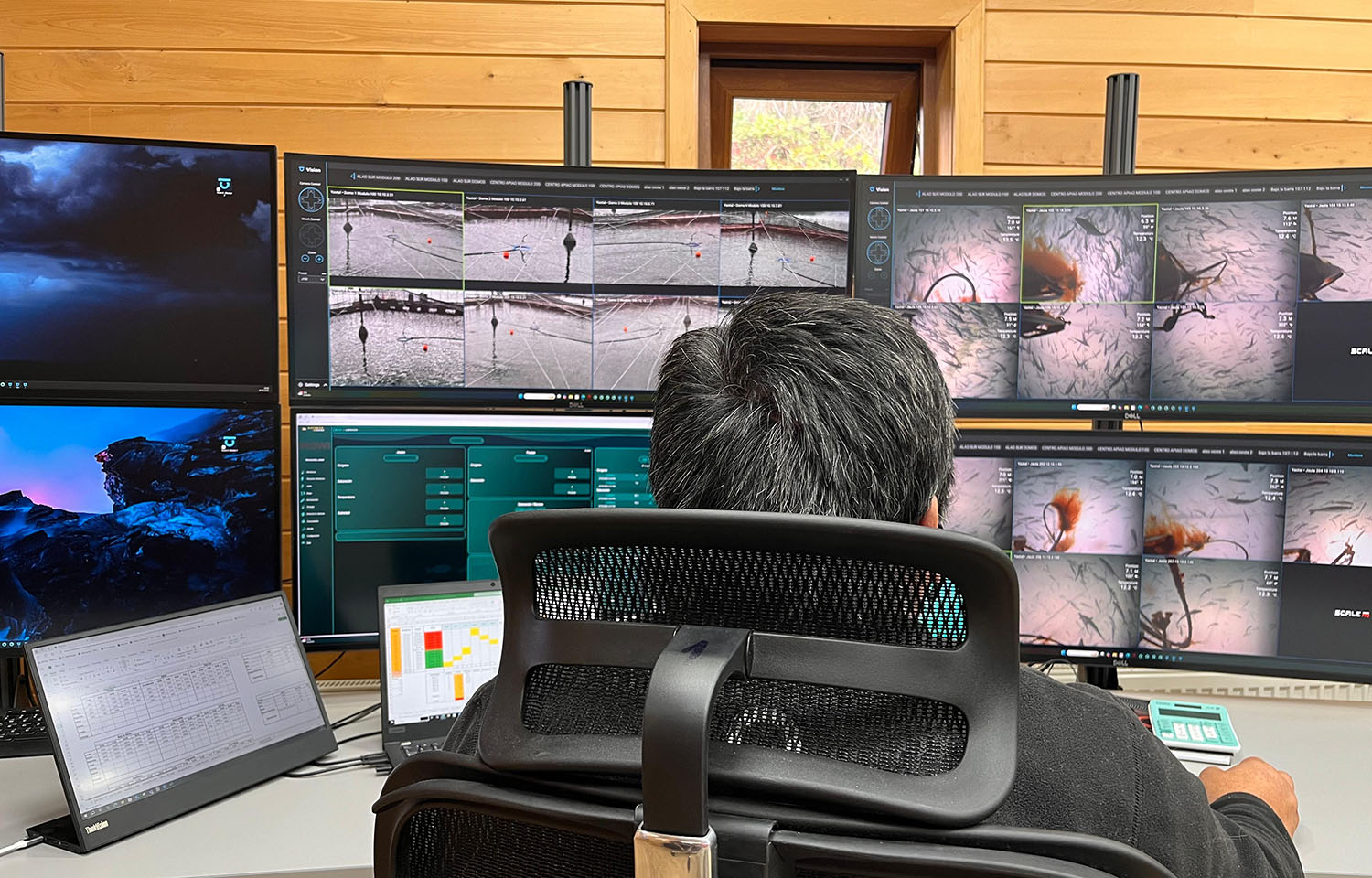
Australis Seafoods is integrating smart technologies at various stages of the production cycle, including for the early-stage identification of the sex of salmon using computer vision. The company also has a remote feeding room to feed salmon from more than 1,600 kilometers away, which also has sensors that detect falling pellets in order to adjust the feed in real time, helping to reduce feed loss, better conversion, and improve environmental stewardship by preventing uneaten feed from being deposited on the seabed.
In turn, Cermaq’s processing plants have an artificial vision system that optimizes classification and controls and monitors the quality of each of their salmon fillets. It is also evaluating other AI projects for implementation.
Mowi Chile’s “Mowi 4.0 Smart Farming” program digitizes the entire value chain, from egg production to harvest and final dispatch. Cameras, sensors, and algorithms are employed in an intelligent, remote feeding system to analyze fish behavior in real time, with feed doses automatically adjusted.
Salmones Aysén – the only salmon-farming firm in Chile that solely focuses on the production of coho salmon – recently began applying artificial intelligence at one of its centers via an advanced echo sounder prototype, identifying fish location in the water column and evaluating their behavior and welfare. The system can detect behavior patterns that a human would not normally be able to easily identify, allowing fish to be fed accurately and for farmers to recognize any potential issues early. This solution has previously been used with Atlantic salmon but not coho. In the case of Atlantic salmon, this technology has proven able to predict some pathologies based on the observation of changes in behavior.
While its members work to improve efficiencies internally, the Chilean Salmon Council has been pushing the government to modernize its salmon policies to enable more stable growth. Chile – the world’s second-largest salmon producer after Norway – exported 782,076 metric tons of salmon and trout in 2024, bringing in USD 6.37 billion (EUR 6.18 billion), according to figures from Chile’s National Customs Service.
