





The Chilean Salmon Council has partnered with government-run export promotion bureau ProChile in a drive to get French chefs to incorporate coho salmon onto their menus.
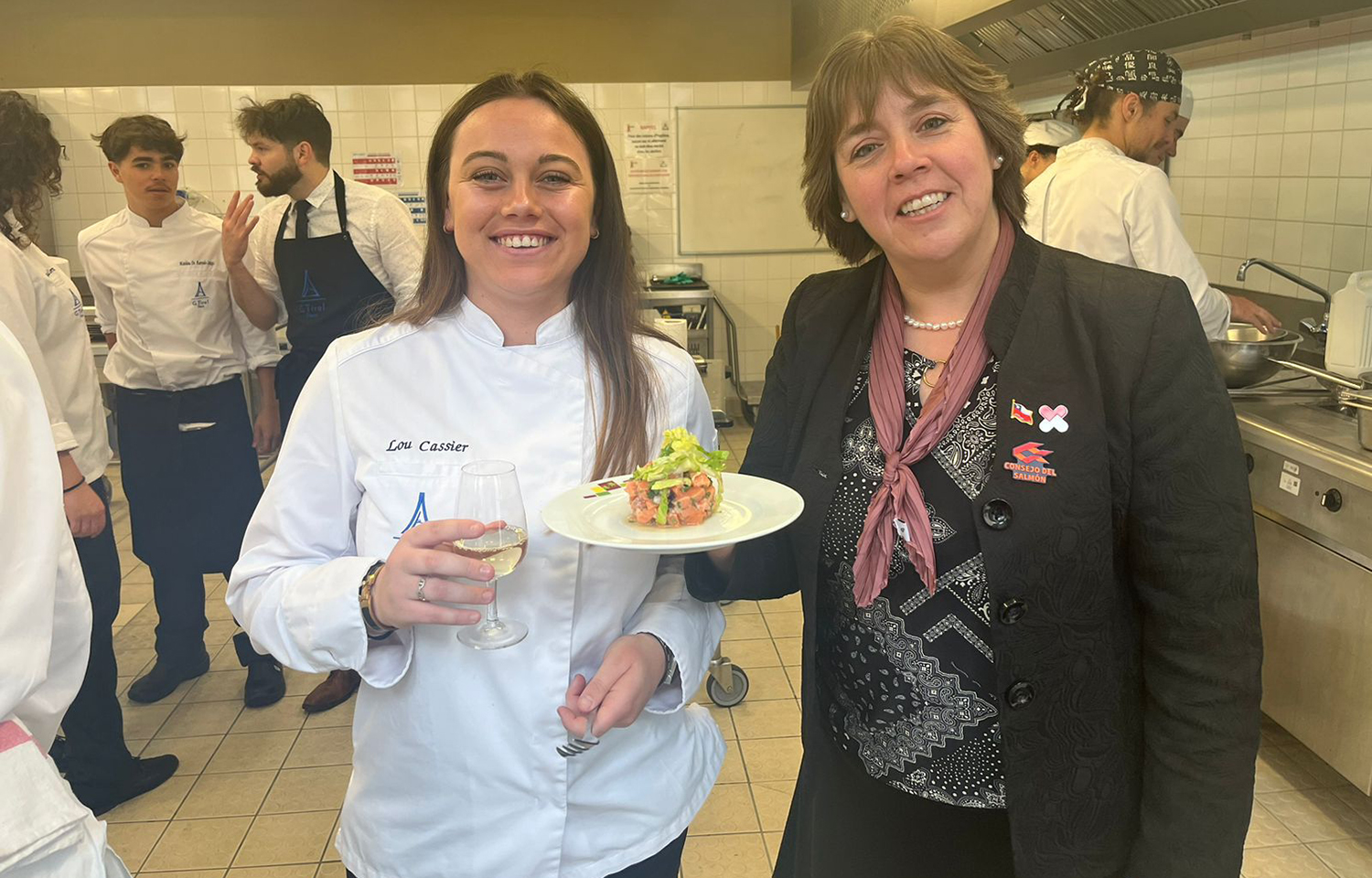
As part of the push, Chilean Salmon Council Executive President Loreto Seguel met with the Association of Master Chefs of France – an organization that brings together the country’s leading chefs – where she highlighted coho’s connection to the southern regions of Chile and that 95 percent of the world’s production of the fish takes place in Chile.
During the meeting with chefs, she also discussed opportunities to enhance the market recognition of coho salmon in the European market.
Seguel also participated in a masterclass for students attending the Paris-based Lycée Hotelier Guillaume Tirel – an educational institution renowned for training leading French chefs. There, she urged students to learn about the fish and include it in their culinary preparations.
The students were given the opportunity to prepare coho salmon for the first time in tartar and to bake it in papillote, a French cooking technique where food is wrapped in an airtight package and baked. The Salmon Council said the students expressed interest in the gastronomical and sustainability potential of the salmon, highlighting its unique flavor and different texture.
“We are practically the only relevant producer of coho salmon globally, which gives us an advantage over other competitors,” Seguel said. “With this activity, we wanted to expand the knowledge of salmon to French gastronomy – one of the most revered worldwide.”
Seguel also emphasized the importance of promoting Chile as a market open to collaborating with the global economy.
“Today, we are present in more than 100 countries around the world, but we can reach many more,” she said. “We have a high level of quality, sustainability, innovation, and projection, which is essential … [to ensuring] that Chilean salmon farming has solid support at the international level.”
Earlier this year, Chile’s Salmon Council – whose members include salmon-farming firms AquaChile, Australis, Cermaq, Mowi, and Salmones Aysén, collectively representing more than half of the salmon production in the country – launched an e-book titled “Relevant data on Chilean salmon farming: A sustainable industry.”
The publication reviews issues such as debunking industry myths, the health and environmental benefits of consuming salmon, the types of salmon raised in Chile, the salmon-farming process, and the certification processes to which Chilean salmon farming is subjected to ensure product quality and sustainability. The council said it would distribute the e-book to ProChile’s 54 commercial offices abroad, in addition to Chile’s agricultural attaché offices and embassies.
Farmed salmon and trout are Chile’s largest non-mining export product. In 2024, the nation exported 782,076 metric tons (MT) of salmonids, bringing in USD 6.37 billion (EUR 5.64 billion). The vast majority of those exports comprise Atlantic salmon.
