



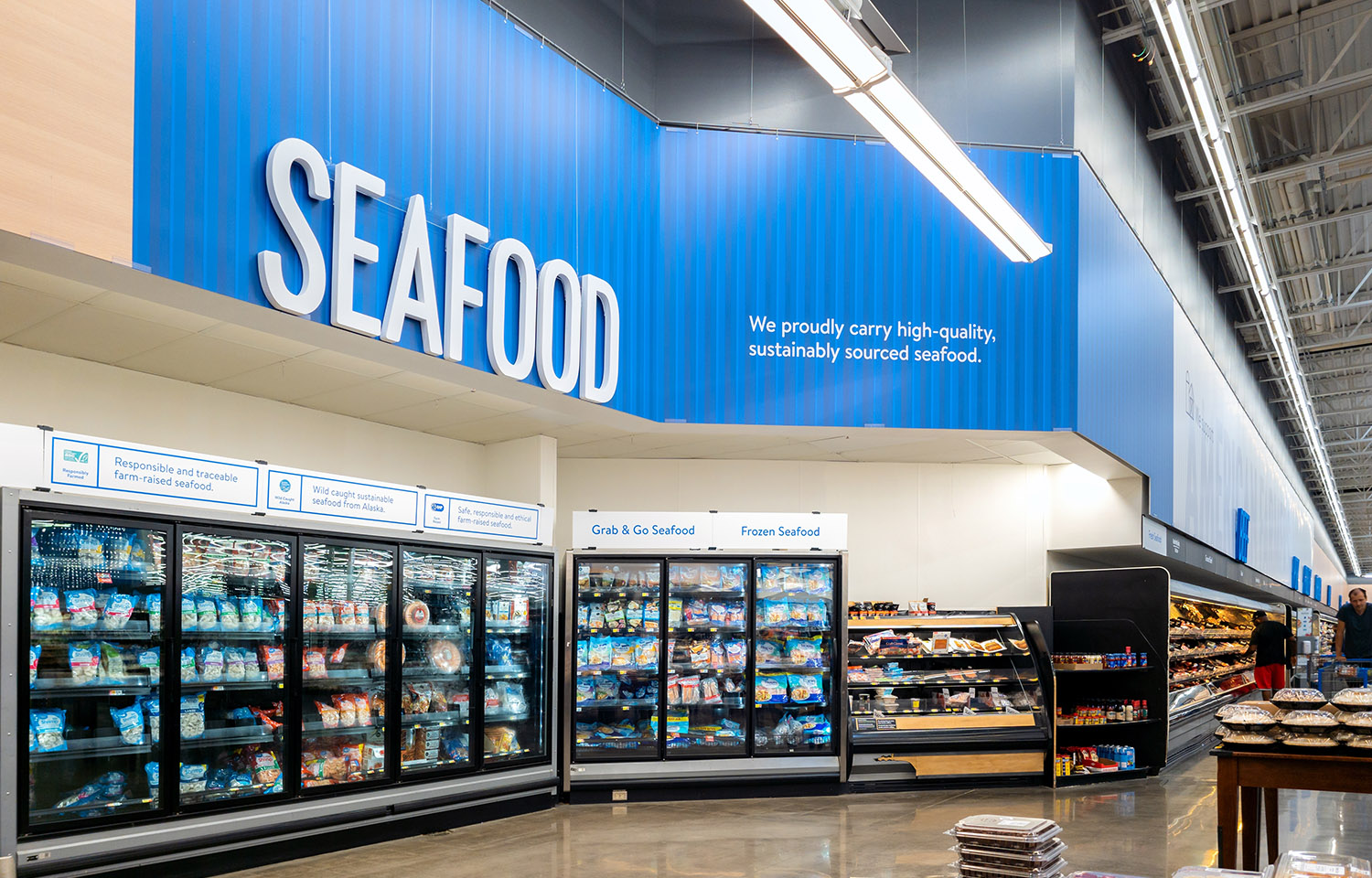
Retailing giant Walmart has announced a new North Star Program in conjunction with Ecuadorean shrimp farmer Omarsa, aquafeed firm Skretting, and NGO The Nature Conservancy (TNC) to help develop and sell more sustainable shrimp products.
The company unveiled its plans in a case study presented 22 October at the AquaExpo conference taking place in Guayaquil, Ecuador, showcasing how retailers, shrimp producers, aquaculture feed suppliers, and NGOs can come together to drive more sustainable shrimp production.
The program will drive a more thriving and sustainable shrimp industry, according to Walmart’s Frozen Seafood Merchandising Director Michael Berto. Program participants will look to test operational and economic feasibility for clean energy shrimp production, employing technology to increase efficiency, sourcing deforestation-free soy, preferring alternatives to marine ingredients and reducing reliance on wild-caught fish, Berto said.
“Walmart was seeking a product that had certified soy feed with a low carbon footprint, but this was going to increase the costs. Walmart said this is something they would be willing to take on. That was good too, because we had to make our own costs more transparent,” Omarsa CEO Sandro Coglitore said during the conference. “The project has all of the certifications that exist, even certifying that the soy used in the shrimp feed has been sustainably grown and does not come from deforested land. It will go towards strengthening our sustainability qualifications, backed by Walmart.”
The certified feed is sourced from Skretting, while the certified Omarsa shrimp will be sold to Walmart by Jacksonville, Florida, U.S.A.-based Beaver Street Fisheries.
According to TNC Global Aquaculture Project Coordinator Antonio Santa Marta, the NGO was drawn to the project because it had three elements that stood out: a supermarket that is willing to share the risk; a sustainable movement in Ecuador, with actors competing to see who is more sustainable; and economic and operational feasibility.
“We like to work with market leaders, and regarding shrimp, Ecuador checks that box,” Santa Marta said.
On the sidelines of the event, Santa Marta told SeafoodSource the first batch of shrimp has already been sold to Walmart under this four-year project, and the idea is to keep pushing for improvements.
“We started with the focus on the feed. The soy had to be deforestation- and conversion-free (DCF), and the fish oil and fishmeal used had to come from responsible sources, so that meant 100 percent monitored with people and camaras on board. The other goal is to reduce the carbon footprint, obviously, and if it is economically feasible, the idea is to also introduce algal oil,” Marta said.
TNC ran a life cycle assessment (LCA) regarding the use of alternative feed during this process and found a range of 15 to 35 percent in carbon footprint reduction to the 6.23kg of CO2 equivalent per kilogram of shrimp produced, Santa Marta said.
In the next phase, Omarsa is preparing to connect to the electricity grid.
“This may take a few years to do, because Ecuador has had a lack of rain to power its hydro generators, but under a normal situation, the grid is 80 percent renewable. The idea is to electrify the farm so you can run smart aeration – where you can just turn it on or off by just pushing a button, compared to the current situation where each aerator has a diesel engine where you need to send someone in a canoe to turn them on or off, where it is very difficult to be efficient. This would offer centralized diesel generators and with that you get around 15 to 20 percent efficiency gains,” Santa Marta said. “They’re improving the feeders as well and that can have about 20 percent efficiency savings.”
Future phases may potentially involve installing solar panels at the farms, seeing if they can lower the carbon footprint for some other byproducts, and alternatively testing insect meal.
“It’s a work in progress,” the TNC executive said.
The project has three main areas of focus: feed, on-farm practice improvements, and mangroves. Regarding the latter, project participants will dedicate 1 percent of revenues to restoring native mangroves in Guayaquil. Some 5 hectares have already been planted in the first stage, and the idea is to get to 80 hectares.
“In the meantime, we also have a number of feed companies that are signing up for this, and we have to connect them with the producers,” Santa Marta said. “But it was started by Omarsa.”
At a later phase, Omarsa will begin to transfer its technology so that small- and medium-sized companies can participate in this project as well, Coglitore noted.
Santa Marta said that TNC had launched a similar initiative with Thai Union Group in March to significantly reduce greenhouse gas (GHG) emissions within the shrimp supply chain. The Shrimp Decarbonization initiative, developed in collaboration with TNC and Ahold Delhaize USA, seeks to drive more sustainable aquaculture practices.
The pilot program aims to produce 1,000 metric tons of processed shrimp that has a lower environmental impact while also meeting high product quality standards. The shrimp will be imported by Thai Union’s subsidiary, Chicken of the Sea Frozen Foods, and will be fully traceable from hatchery to shipment.
According to TNC’s Aquatic Food Systems Director Robert Jones, shrimp is the United States’ most popular seafood, but at an average of 13 kg of CO2 equivalents per kilogram produced, the farmed crustacean has a larger carbon footprint than most other seafood products. It emits about twice as much GHGs as salmon production, for example, and can be even higher than beef production when land conversion to create new ponds is considered.
Roughly half of shrimp’s carbon footprint is related to feed production, and shrimp diets are almost 30 percent comprised of soy. This can be problematic as soybean farm expansion is one of the leading drivers of land conversion and deforestation in South America, and “sourcing soy that does not contribute to deforestation or habitat degradation is an important commitment farmers can make to reduce their carbon footprints,” Jones said on TNC’s website.
Using high-quality feed can also improve feed conversion ratios, and using less feed is another way to reduce the carbon impact.
The other half of shrimp’s carbon footprint comes from the energy used to mechanically pump and aerate water. A typical shrimp farm could cut its emissions in half by implementing smart aeration and feeding systems and transitioning to renewable energy, he said.
Finally, protecting mangrove forests is important as they are vibrant ecosystems that sequester up to four times more carbon than land forests, Jones said. In the 1980s and 1990s, the world lost about a fifth of its mangrove forests largely due to the development of rice and shrimp farms.
Participants at the conference lauded the agreement between the World Wildlife Fund and Ecuador’s National Chamber of Aquaculture (CNA), signed in 2022, to halt the conversion of natural habitat to accommodate shrimp farming in the country. That agreement marked the first national commitment for conversion-free aquaculture from any country in the world.
