


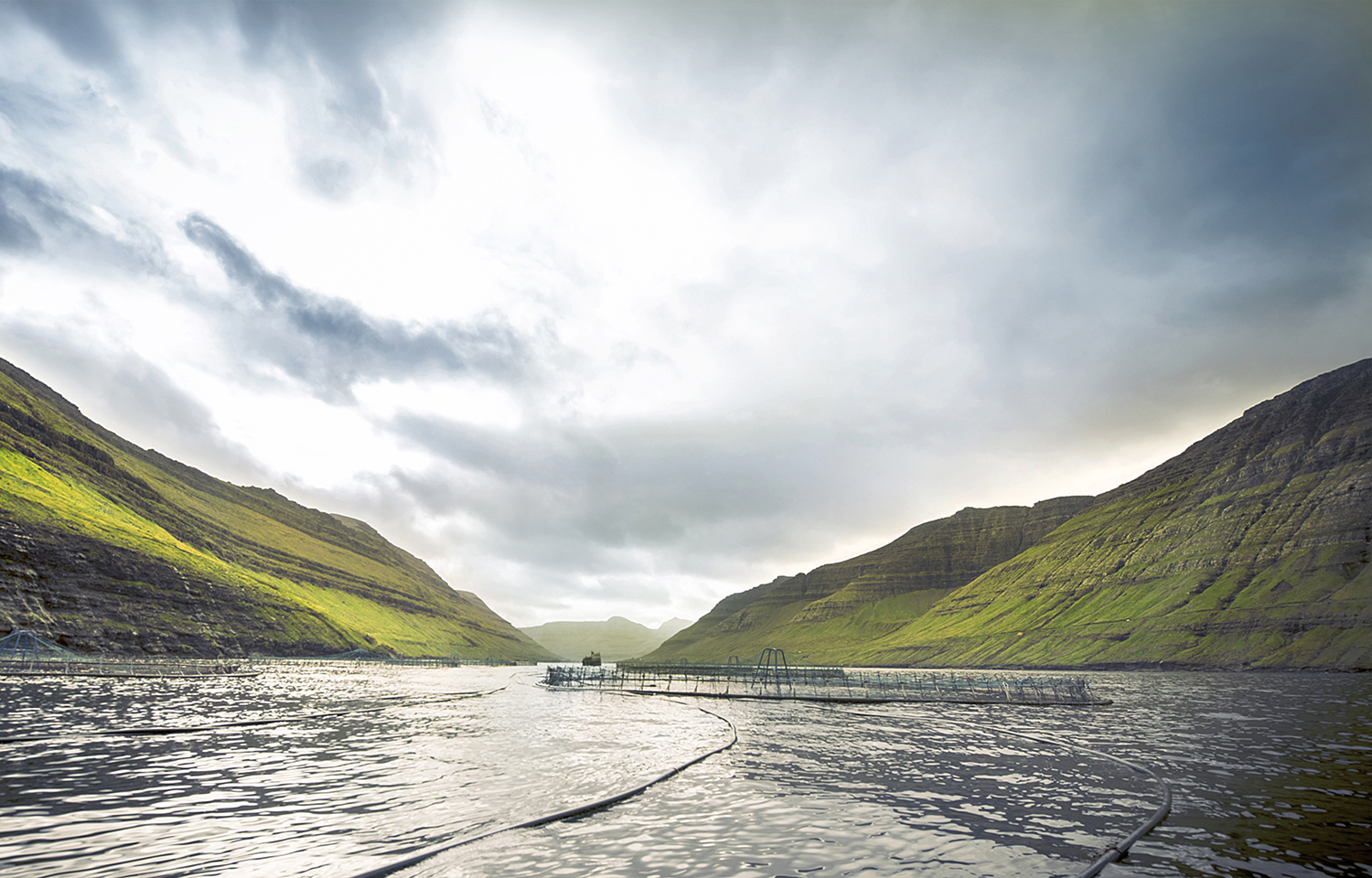
Faroe Islands-based salmon-farming firm Bakkafrost reported large gains in operational EBIT in the third quarter of this year, mostly due to higher regional earnings in the Faroe Islands and reduced operating losses in Scotland.
In Q3, the company recorded group EBIT of DKK 128 million (USD 19.2 million, EUR 17.1 million), compared to DKK 22 million (USD 3.3 million, EUR 2.9 million) in the same period last year.
This total was broken down into Bakkafrost’s Faroese operations recording operational EBIT of DKK 267 million (USD 40 million, EUR 35.7 million), up from DKK 227 million (USD 34 million, EUR 30.4 million) in Q3 2025, on the back of DKK 1.4 billion (USD 215.4 million, EUR 192.1 million) in revenue. Meanwhile, its Scottish operations recorded an operational loss of DKK 140 million (USD 21 million, EUR 18.7 million), compared to a loss of DKK 205 million (USD 30.7 million, EUR 27.4 million) a year earlier, while its revenue declined to DKK 245 million (USD 36.7 million, EUR 32.8 million) from DKK 282 million (USD 42.3 million, EUR 37.7 million).
Harvest volumes were lower for the firm in the three-month period, with all of its farming operations producing a combined 27,634 gutted weight tons (GWT), which was down around 10 percent from the 30,678 GWT reported for Q3 2025. However, the first nine months of 2026 has seen Bakkafrost’s total harvest increase by 12.6 percent to 88,865 GWT from 78,932 GWT a year earlier.
Delivering the latest set of results, Bakkafrost CEO Regin Jacobsen said his firm was satisfied with the biological performance in the Faroes during Q3, noting good growth and high biomass at sea.
Freshwater operations in the Faroes also performed strongly, with record-high capacity utilization across hatcheries. The construction of the company’s new Skálavík hatchery is progressing according to plan and is expected to be completed toward the end of 2027. According to the firm, the first two batches of eggs introduced into the facility have performed well, with the first batch expected to be transferred to sea in Q4 2027.
Scottish results, though, continued to be affected by lower harvest volumes, smaller average harvest weights, and underutilization of fixed-cost infrastructure in Q3.
“We harvested only 4,537 GWT in the quarter [in Scotland], compared with 5,286 GWT last year, a reduction of 14 percent. The average harvest weight was only 3 kilos in this quarter, compared with 4.8 kilos last year, a reduction of 38 percent. This is clearly not satisfactory,” Jacobsen said. “We harvested several challenged fish populations during July and September, which affected both harvest weights and financial results. Some of these challenges are also expected to influence the fourth quarter.”
Those challenged fish populations Jacobsen alluded to involved biological challenges affecting a batch of externally sourced smolt, causing early harvesting at two sites that continued into the third quarter.
Due to this issue, Bakkafrost has decided to discontinue external smolt sourcing in Scotland and will instead rely on its own freshwater production and broodstock partnerships, with its Applecross facility now able to supply significantly larger volumes.
Jacobsen said that while Bakkafrost’s biological and financial performance in Scotland “remain challenging,” there were signs of improvement in Q3, namely that mortality was lower than in the same quarter last year.
The company also said it is expanding its broodstock program to improve control over egg production and the genetic foundation of its farming operations.
Elsewhere in the period, Bakkafrost’s fishmeal, oil, and feed (FOF) segment delivered a particularly strong result in Q3, with its operational EBITDA more than doubling year over year. The segment reported an operational EBIT margin of 24 percent in Q3, compared to 12 percent in the same period last year.
Pointing toward an “exceptionally challenging” market for marine raw materials, Jacobsen confirmed that sourcing by the FOF segment amounted to just 9,587 MT, compared to 39,940 MT in Q3 2025. Feed sales, though, totaled 48,237 metric tons (MT) in the quarter, slightly below the 49,087 MT recorded a year earlier.
“Feed sales remained strong,” he said. “All feed sales in the quarter were to our own farming operations, and our strategic inventories have allowed us to maintain feed production and high quality despite the limited availability of raw materials.”
Bakkafrost expects increased availability of marine raw materials in 2027 following higher scientific recommendations for blue whiting quota.
As a result, the company expects higher fishmeal and fish oil production next year, alongside increased external fishmeal sales. It has also raised its expected feed production for 2027 from 170,000 MT to approximately 185,000 MT, with almost all of this expected to be supplied internally to its own Faroese and Scottish farming operations.
“Looking ahead, we see a good flexibility with our new feed factory and also by looking into raw materials utilization and feed formulations,” Jacobsen said. “Combined with our strategic inventories, this will help us manage the risk of high marine ingredient prices while maintaining our focus on high feed quality, salmon nutrition, and fish welfare.”
Outside of feed prognostications, the company expects to harvest around 97,000 GWT in the Faroe Islands and 20,000 GWT in Scotland this year. For 2027, it’s forecasting a Faroese harvest of 97,000 GWT and a Scottish harvest of 28,000 GWT, giving a combined total of approximately 125,000 GWT.
Expected smolt transfers in 2027 are 21 million in the Faroe Islands at an average weight of around 440 grams and 11.5 million in Scotland at around 222 grams. The Scottish forecast is lower than previously planned because of the decision to stop using externally sourced smolt.
Bakkafrost said the benefits of its larger smolt strategy in Scotland are expected to become increasingly visible from 2027 onward.
Longer-term planned projects include expanding Faroese freshwater and feed production capacity, developing farming sites and technology, and expanding Scottish farming and processing capacity under the group’s DKK 5 billion (USD 749.6 million, EUR 669 million) investment program for 2026 to 2030, which was announced at its Capital Markets Day in June 2025.
The program also includes DKK 245 million (USD 36.7 million, EUR 32.8 million) earmarked for energy transition across the value chain.
“We have special programs to reduce costs and target cost reduction. This will be a high priority now and going forward. Also, [with regard] to capital expenditures, some investments have been postponed slightly, but we still expect to reach our targets,” Jacobsen said.
