



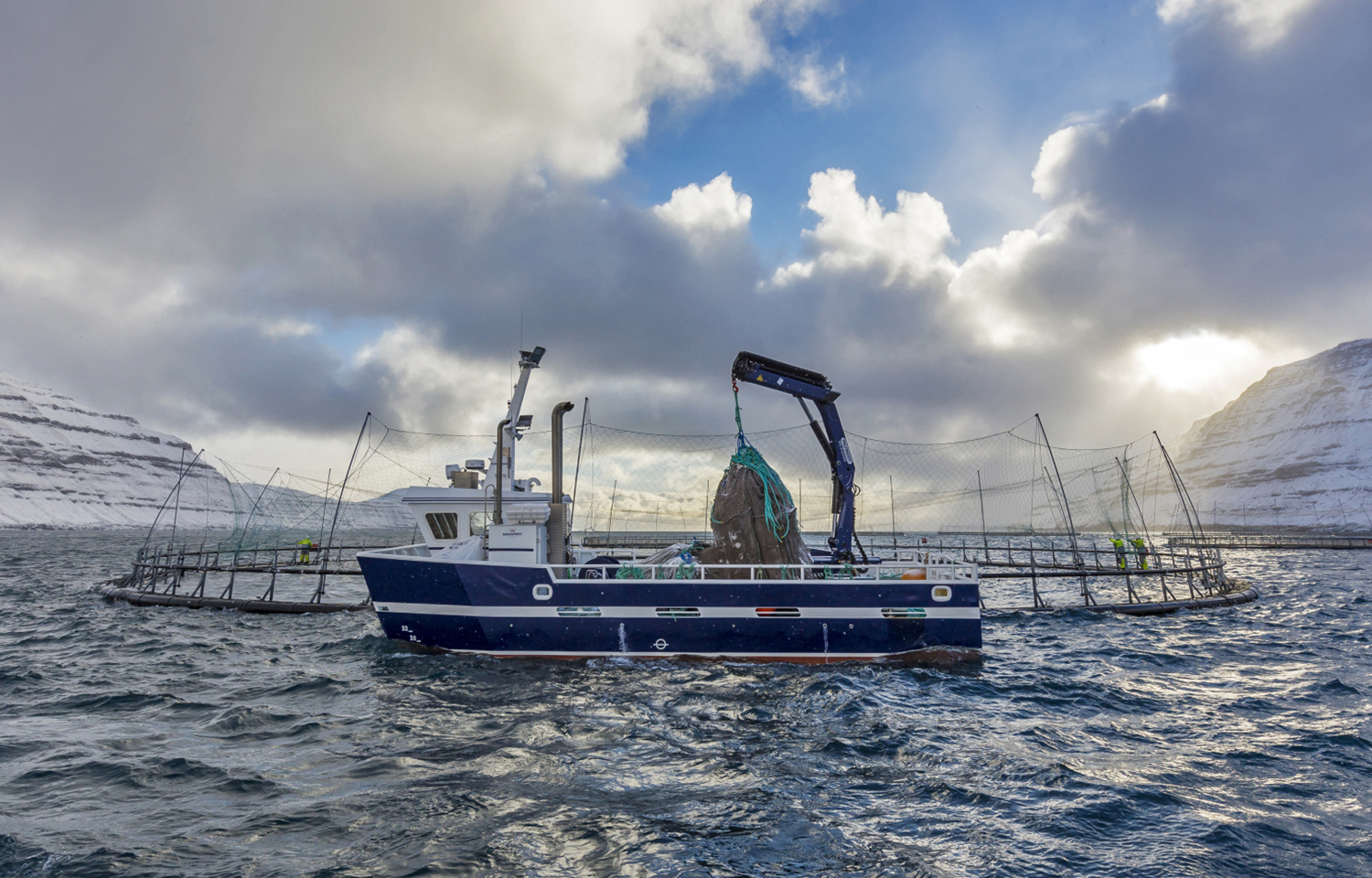
Over the next five years, Faroe Islands-headquartered salmon-farming firm Bakkafrost intends to increase its overall salmon production from 2025’s estimated output of 97,000 metric tons (MT) of head-on gutted (HOG) fish to 162,000 MT through strategic investments aimed at reducing biological risk, improving efficiency, and increasing organic growth in both the Faroes and Scotland.
“Producing the best salmon in the world and doing so at scale – that's our simple mission,” Bakkafrost CEO Regin Jacobsen said at the firm’s latest Capital Markets Day on 17 June. “Our fully integrated value chain ensures total control, unmatched traceability, and world-class quality – all rooted in the clean waters in the Faroe Islands and in Scotland. In 2025, Bakkafrost will produce around 3.5 million meals every day, and this will increase up to 5.6 million by 2030.”
Since 2010, Bakkafrost’s salmon harvest has more than quadrupled, while its EBIT has increased from DKK 247 million (USD 38.3 million, EUR 33.1 million) to DKK 1.55 billion (USD 240.1 million, EUR 207.8 million) and its annual sales have grown from DKK 820 million (USD 127 million, EUR 109.9 million) to DKK 7.3 billion (USD 1.1 billion, EUR 978.8 million). Its fishmeal production has also tripled in that time frame, reaching 140,000 MT last year.
To achieve its latest set of growth ambitions, the group is allocating DKK 5 billion (USD 774.5 million, EUR 670.4 million) in capex between 2026 and 2030. This is DKK 1.3 billion (USD 201.4 million, EUR 174.3 million) less than what was outlined in the firm’s previous 2024-2028 plan, with Jacobsen explaining that capital discipline seems appropriate when evaluating current market developments.
“There are times when we need to run, and there are times where we need to dig down,” he said.
Of the DKK 5 billion, DKK 2.2 billion (USD 340.9 million, EUR 295 million) will be allocated to projects in the Faroes, DKK 1.3 billion to Scotland, and DKK 1.6 billion (USD 247.9 million, EUR 214.5 million) to its Farming Service Vessels operations.
“This allocation supports our ambition to reach the 162,000 MT of harvest that we target for 2030, but it also supports further growth after that. Of course, capex is only one side of the equation. Maintaining a tight grip on our operational costs is just as critical, especially in today's climate where we see more depressed salmon prices,” Jacobsen said.
The main areas of focus will be to reduce biological risk, improve efficiency, and increase organic growth. As such, Bakkafrost will continue to follow and optimize its strategy of producing bigger, better smolt while simultaneously using new technology to maximize its conventional farming in the Faroes and increasing its license utilization and capacity in Scotland.
Among its investments through 2030, Bakkafrost aims to complete the construction of its hatchery at Skalavik in the Faroes and ramp up operations at Applecross in Scotland. It also plans to build two new dual freshwater treatment vessels, increase its fish feed production, and add to its processing capacity, all while monitoring the market for potential acquisitions, Jacobsen said.
“For Bakkafrost, growth only has value if it's sustainable – biologically, environmentally, and financially. This is the core of our entire strategy. Sustainability is not a side project; it's what customers, regulators, and communities increasingly demand,” he said. “Growth only happens when biological performance allows it. Smolt quality, fish welfare, and lice management are really important in this area. Survivability and feed conversion ratios are leading indicators. [There’ll be] no overloading of sites or pushing biological limits to chase short-term volumes. Long-term system health is always a priority, and sustainable growth is not a trade-off. It's exactly what enables us to build a stronger, more resilient Bakkafrost for the future.”
Achieving premium prices for its products is also key to Bakkafrost’s operations, Jacobsen explained, highlighting that so far this year, its Faroese salmon has achieved an average NOK 9.00 (USD 0.91, EUR 0.78) more per kilogram than Norwegian salmon, while its Scottish fish has earned NOK 12 (USD 1.21, EUR 1.05) more per kilogram.
These premiums, he said, are due to the group consistently harvesting large, high-quality fish.
“The ability to constantly achieve premiums reflects strong biological control, high product quality, a good marketing position, and customer trust,” he said. “Over time, we have built a stronger, more resilient platform, combining biological progress with integrated operations. While we remain humble about the continuing work ahead, these results confirm the strength of the model that we have built over time. We have built a strong platform with external certifications and recognition, which play an important part [and reflect] product quality, food safety, traceability, ESG standards, and operational consistency.”
Moving forward, the focus remains to improve yields further, harvesting large, high-quality salmon raised with good fish welfare, Jacobsen said.
“It is not volume for volume’s sake. It's controlled biological optimization – producing more fish with fewer biological inputs and a lower footprint, fully aligned with both economic and sustainability targets,” he said.
More generally, Bakkafrost’s increased salmon production goals will help meet the growing global demand for healthy food, Jacobsen said at the company’s Capital Markets Day.
This demand is being driven by two key trends: overall population growth and the expanding middle class, who are increasingly favoring healthy, sustainable proteins like salmon, he said.
“The demand runway for salmon is long – both in mature and developing markets. As income levels and the health focus grow, salmon is well-positioned to capture the future demand growth,” Jacobsen said.
