






Iceland-headquartered salmon-farming company Kaldvik posted higher losses in Q2 2025 as a low percentage of superior-grade salmon stemming from poor smolt in 2023 drove down its average price per kilogram.
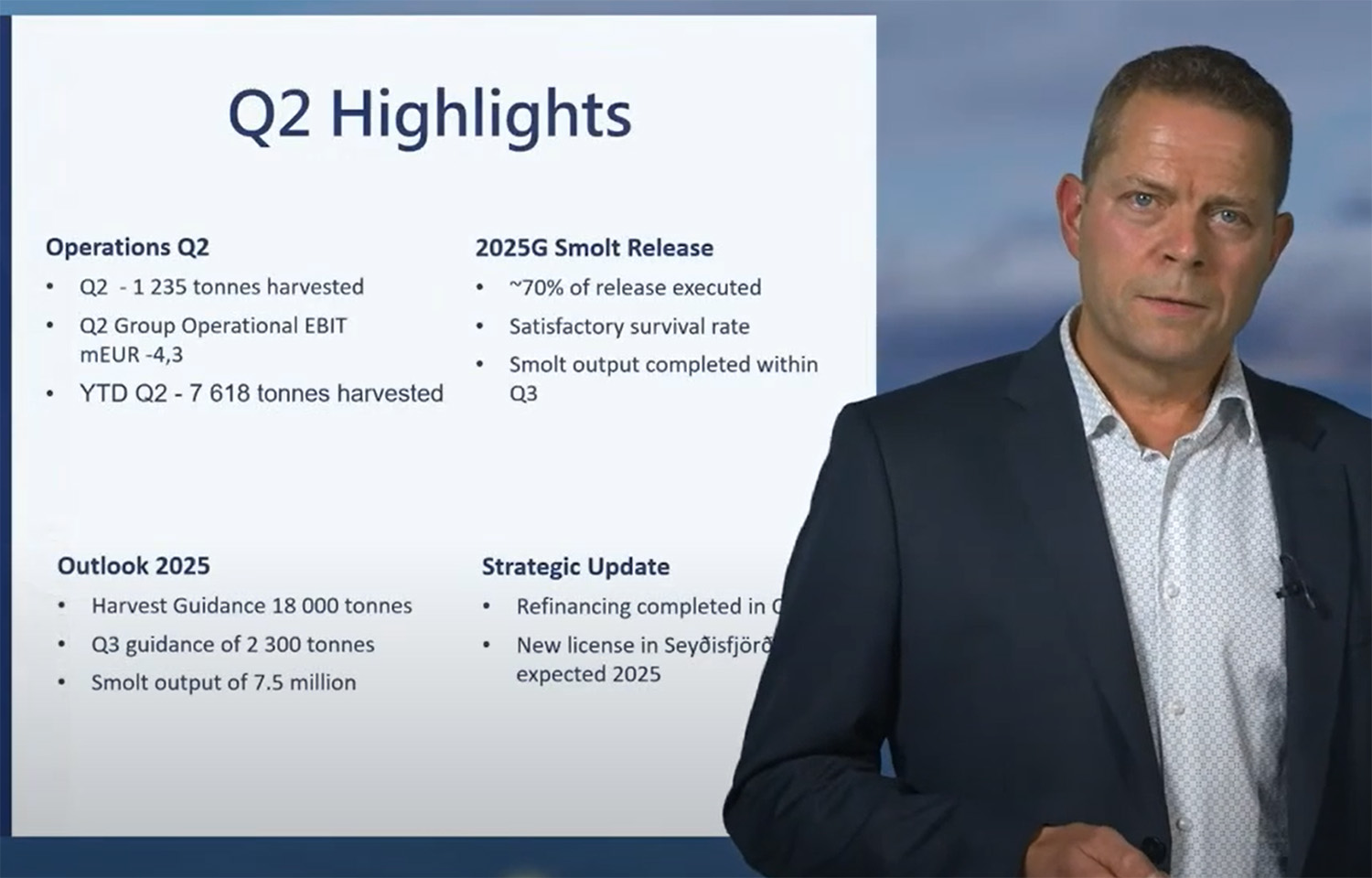
Kaldvik – which rebranded from Ice Fish Farm in July 2024 – posted increased revenue of EUR 7.9 million (USD 9.2 million) in Q2 2025, up from EUR 5.4 million (USD 6.3 million) in Q2 2024. The higher revenue came on higher salmon volumes, as the company harvested 1,235 metric tons (MT) of salmon in Q2 2025, up from 514 MT in Q2 2024.
The company’s operational EBIT, however, dropped to a loss of EUR 4.3 million (USD 5 million) in Q2 2025, down from a loss of EUR 1.3 million (USD 1.5 million) in Q2 2024.
“An important reason for this is high cost associated with low utilization of our capacity,” Kaldvik CEO Vider Aspehaug said.
Part of the decrease also stemmed from a drop in the average price achieved in the quarter. Kaldvik took in EUR 6.00 (USD 7.01) per kilogram of salmon, down from the EUR 7.34 (USD 8.58) per kilogram it saw in the same period of 2024. Aspehaug said 25 percent of sales were performed on a fixed-price contract, which helped its overall price achievement.
Partly as a result of the lower prices, the operational EBIT per kilogram of salmon dropped to a loss of EUR 3.40 (USD 3.97) per kilogram.
“With the limited harvests in this quarter, we have naturally had high unit cost per kilogram of harvest,” Aspehaug said.
Kaldvik attributed the decrease in achieved price to multiple factors, including a low amount of superior-grade salmon. The company said it achieved a superior-grade share of just 40 percent.
“Toward the end of production at the Vattarnes site, challenges with winter wounds resulted in a lower share of superior-grade fish,” Kaldvik said in its Q2 2025 report.
Kaldvik said that the 2023 generation of its salmon has experienced challenges due to suboptimal smolt quality and not responding well to a new winter wound vaccine and the investments that the company has made in its land-based facilities. Algae over the summer also caused slower growth in the salmon, which drove down harvest sizes and consequently drove down prices.
“The 2023 generation has been challenging and is also the primary reason for adjusting the harvest forecast for 2025. It has also resulted in a low superior share this quarter,” Aspehaug said. “So, starting off with a suboptimal smolt quality, on top of the unusually low sea temperatures at the end of 2024, this fish was struggling from the start and was hit more than usual by algae during the summer resulting in high mortality, reduced growth, and downgrading compared to the production plan.”
The company said that harvesting of the 2023 generation will be completed in Q3 and Q4 2025, but due to those challenges, the company also revised its projected total harvest in 2025 downward to 18,000 MT, approximately 16 percent lower than its original guidance of 21,500 MT.
That total harvest will comprise a Q3 harvest of 2,300 MT and Q4 harvest of approximately 8,100 MT.
“We’re planning to finalize the harvest of the 2023 generation this year,” Aspehaug said.
Despite the downward revision on its harvest guidance, if the Q3 and Q4 2025 harvests go as planned, the company’s harvest volume will still be up 20 percent year over year.
While its farming situation was challenging, Aspehaug said the company’s strategic investments in land-based farming operations for smolt have been performing on track toward the company’s target of releasing 7.5 million smolt in 2025.
"Seventy percent is already at sea, showing very good performance and the best survival we have seen so far," he said. “We believe that the investments that we’ve done in our land sites in the last three years are now paying off.”
Aspehaug said the company has increased production capacity thanks to a new production facility in its Land North segment, which became operational in early 2025. The company also improved water quality and operational routines and implemented a new biosecurity management protocol.
“We’ve improved operational efficiency through additional wellboat capacity,” he said. “Overall production performance in land remains strong, with the year-over-year mortality rates reduced by more than 30 percent in recent years, reflecting the improvements in fish health and operational efficiency.”
Looking further forward, the company said it has secured new licensing in Seyðisfjörður, and the company has also successfully refinanced and entered into an agreement with its bank syndicate to increase and extend its existing debt facilities during the quarter. It also had a successful private placement, worth approximately EUR 46.2 million (USD 54 million).
