



New Zealand King Salmon reported steady but mixed performance in the half-year period ending July 2024, posting lower profit but higher earnings, sales volumes, and revenue.
New Zealand King Salmon – which farms premium king salmon under the brands Ōra King, Regal, Southern Ocean, and Omega Plus – reported revenues of NZD 101.7 million (USD 64.2 million, EUR 57.4 million) in the first half of fiscal year 2025, up 11 percent from the NZD 91.6 million (USD 61.6 million, EUR 55.1 million) posted in H1 2024. That increased revenue came alongside increased sales volumes of 3,178 metric tons (MT), up from 3,023 MT.
Net profit for H1 2025 decreased year over year, dropping to NZD 6 million (USD 3.9 million, EUR 3.4 million) from NZD 10.6 million (USD 6.7 million, EUR 5.9 million) in H1 2024. The company attributed the drop to non-cash adjustments related to biological assets and inventory, as well as a smaller contribution from the unwinding of closing out foreign currency exchange contracts early in FY 2022.
Its pro-forma EBITDA – the method which New Zealand King Salmon has used to measure its earnings – increased slightly from NZD 10.7 million (USD 6.8 million, EUR 6 million) in H1 2024 to NZD 13.5 million (USD 8.5 million, EUR 7.6 million) in H1 2025.
“The half-year result for the period ended July 2024 is underpinned by the continued steady performance of our new fish-farming approach,” New Zealand King Salmon Chair Mark Dewdney said in a release. “This gives us further confidence that we will be able to deliver strong aquaculture outcomes again this summer.”
The results, while relatively flat, are a large improvement from the losses the company posted in H1 2022 and H1 2023. During a challenging 2022, the company’s former CEO, Grant Rosewarne, abruptly resigned and the company had been forced to sell off stock in an effort to pay off some of its debts, which were worsened by a challenging business climate during the Covid-19 pandemic.
Dewdney said that the positive results and increased sales came amid a challenging commercial environment, which included global cost-of-living pressures.
New Zealand King Salmon CEO Carl Carrington said that the company has had success in developing its presence in the Chinese market.
“We are focused on establishing a premium position for our Regal brand in this market through partnering with premium customers across multi-channels,” Carrington said. “Market support is positive, and king salmon is recognized by customers for its premium taste, texture, and presentation. Quality distribution is growing on a trajectory consistent with building the value proposition ahead of volume. Patience and consistency are required to lay the right foundations for the longer term.”
Despite its relatively close proximity to New Zealand, the Chinese market represented only 2 percent of New Zealand King Salmon’s sales in H1 2025 – but that also means it’s a growth opportunity, the company said.
“We continue to work together with our importer partners to build our brand and in-market relationships,” New Zealand King Salmon said in its results presentation.
As it seeks out new markets for its king salmon, the company said its recently adapted farming strategy has been working as intended. The new strategy has the company keep most of its salmon biomass in the Tory Channel during warmer months to take advantage of the cooler water. Then, the company tows its operations to Queen Charlotte Sound.
The company first tried the strategy in the summer of 2023 and said that repeating the process in the summer of 2024 resulted in another period of positive biological performance and lower mortality.
While the new adaptation is working, the company’s biology in H1 2025 wasn’t entirely positive, Carrington said.
“Looking forward, we are revising our full-year harvest downward to 6,800 MT due to elevated levels of early runting, or fish failing to adapt to seawater,” Carrington said. “Our aquaculture team is working closely with experts to address this challenge. Initial trials of mitigants are looking promising, and we are assessing options for pilot trials of freshwater recirculated aquaculture systems [RAS] which we believe may also improve fish outcomes when adapting to seawater.”
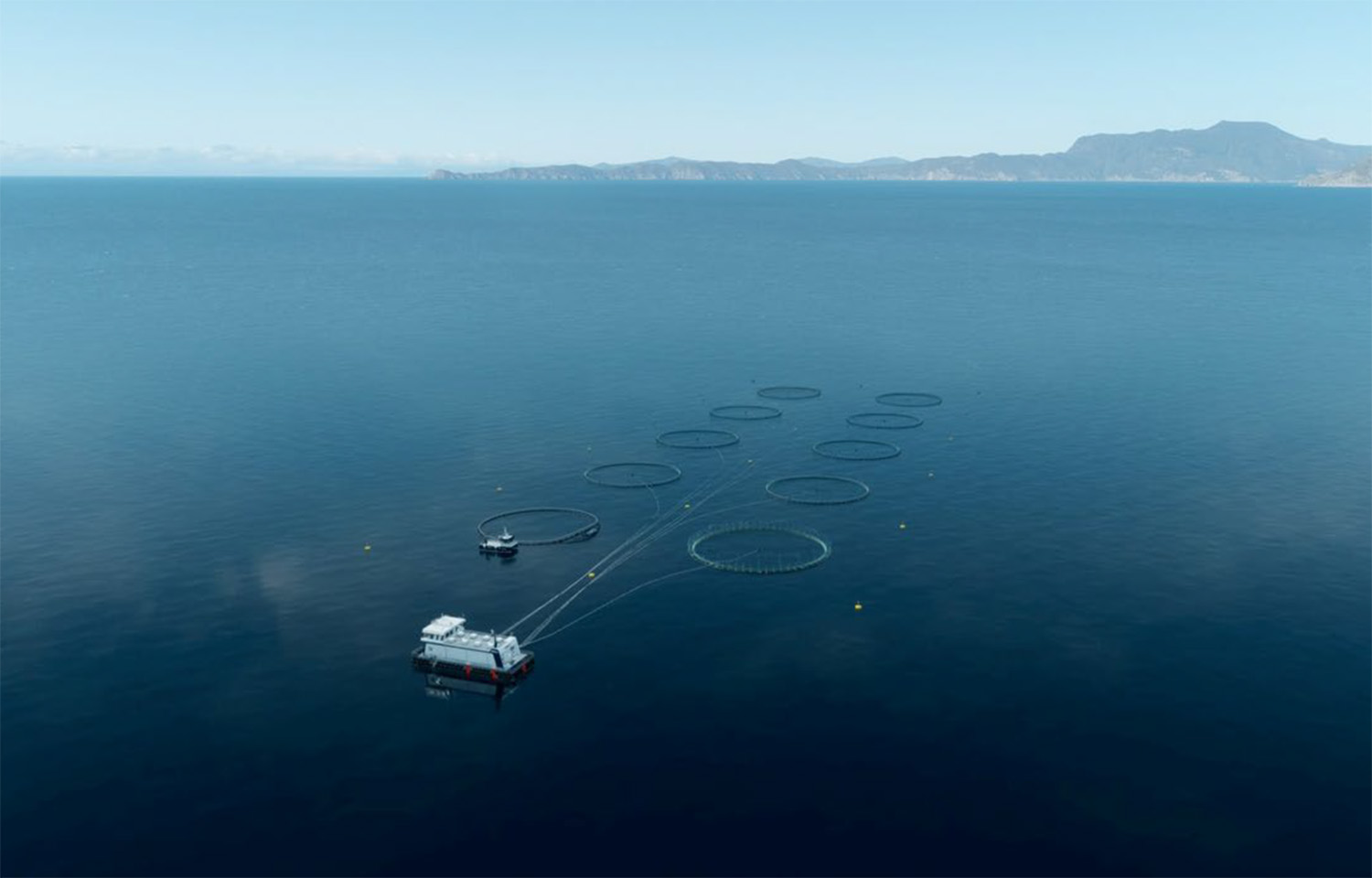
New Zealand King Salmon also said its planning for the pilot trial of its offshore aquaculture operation Blue Endeavor is also underway.
The company began planning its offshore salmon farm nine years ago and finally received full governmental permission to proceed with Blue Endeavor in March 2024. The company said it has ordered two pens and the associated mooring infrastructure for the operation, which will be capable of growing up to 500 MT.
“The first fish for this pilot farm are currently growing at our Tentburn facility. We anticipate they will be relocated to our nursery farm in Pelorus Sounds around April 2025 and then to Blue Endeavor around October 2025,” New Zealand King Salmon said.
Carrington said in March that Blue Endeavor will serve as a proof of concept for offshore salmon farming and that the company has been performing rigorous tests of the proposed site to gain a baseline of information before installing the facility.
“This is a milestone achievement for New Zealand King Salmon and New Zealand more generally, and we are cautiously optimistic the site will prove up a transformational growth pathway,” Carrington said in the H1 2025 results.
