






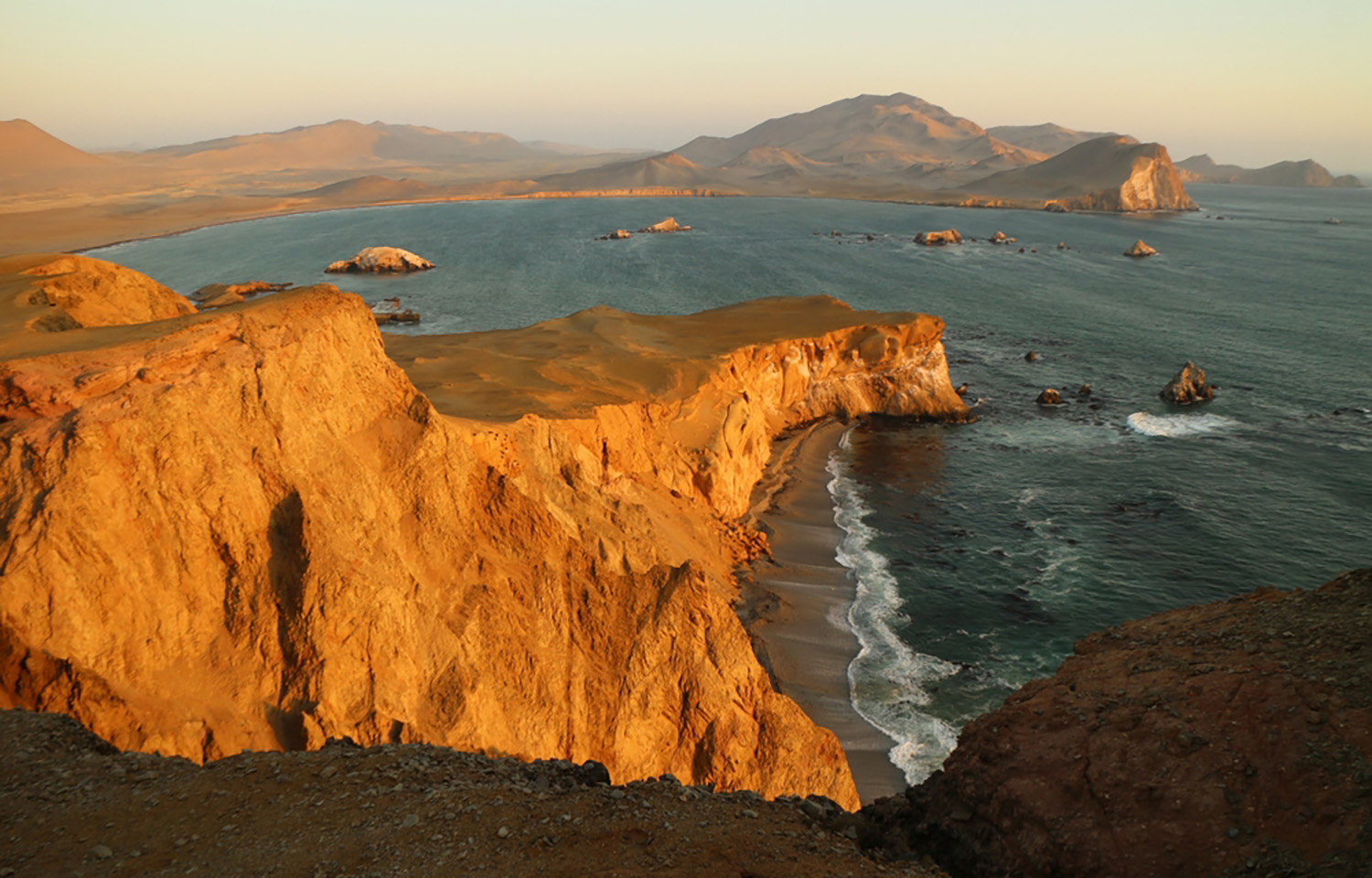
A battle is brewing over fishing rights near Peru's Paracas National Reserve.
Peru’s National Fisheries Society (SNP) has petitioned for the ability to fish 5 miles off the reserve’s shores, but environmental and conservation organizations are fighting the request.
The ecologically rich reserve is located on the coast of the Pisco province, just over 250 kilometers south of Lima. Its 335,000-hectare area – 200,000 hectares of which extend into the Pacific Ocean – was established as a national reserve in 1975 in order to protect threatened coastal marine ecosystems and conserve biological diversity in the area.
In January 2023, SNP filed a lawsuit after the Peruvian National Service of Natural Protected Areas (Sernanp) rejected its request to fish within the reserve. According to the suit, SNP maintains it holds fishing rights preexisting the creation of the reserve in 1975 and that the protected area’s master plan excluded industrial fishing activities without scientific backing for the move.
Sernanp has argued the area is reserved for artisanal fishing activity only, warning that allowing industrial fishing “would decrease food availability for birds and mammals, harming their reproductive processes and recovery of their population levels.”
Manuel Bartra, legal director of the Animal Rescue and Welfare Association (ARBA), called SNP’s request “one of the most grotesque cases of corporate greed in recent decades,” Infobae reported.
Benjamín Marticorena, president of the Peruvian government's National Council of Science, Technology, and Technological Innovation (Concytec), said in a statement SNP's claim “is a cause of outrage and grave concern and must be firmly and categorically rejected.”
NGO Coastal Areas and Marine Resources (Acorema) Biologist Julio Reyes said permitting industrial fishing fleets in the reserve “would mean the total elimination of coastal marine biodiversity.”
“Paracas is the last refuge of hundreds of marine species, and it would be a crime against our own ecosystem to let them enter,” he told Diario Correo.
SNP has taken issue with the backlash, particularly singling out environmental NGO Oceana.
The organization “has undertaken an aggressive disinformation campaign with the purpose of prohibiting the industrial anchovy fleet from continuing to operate outside the 5 miles of the Paracas National Reserve, trying to truncate the future of thousands of workers, fishermen, and their families with false arguments that do not withstand any analysis,” SNP President Eduardo Ferreyros said in a statement posted on the group's website.
“Let us remember that, for more than 40 years, the industrial anchovy fleet has fished outside the 5 miles of the Paracas Reserve, and this activity has always been carried out in harmony with the environment and taking care of fishing resources. Proof of this is the healthy population of sea lions and birds, as well as the abundance of anchovy that were never at risk from industrial fishing,” he said.
Ferreyros said scientific evidence shows the proposed industrial fishing in the area will not cause damage to marine ecosystems, evidenced by Peru having sustained around 10 million metric tons of anchovy biomass and maintaining that stable average for more than 15 years.
“It is not understood to what interests these falsehoods respond,” he said.
Oceana declined to respond to SNP's statement.
“We, as an organization, have tried to highlight Sernanp’s arguments through our social networks and when consulted by the media because we consider that they are the correct ones and deserve to be visible to all public opinion,” an Oceana spokesperson told SeafoodSource. “However, we are respectful that this judicial dispute is the exclusive competence of the two parties mentioned. In that sense, we have decided not to respond to SNP because we believe that who needs convincing is not the public opinion or us but the judges, with necessary legal arguments.”
SNP said its lawsuit is directed at obtaining a response to its concerns from the government.
“What has been requested of the judiciary is to resolve a controversy that prevents us from fishing outside the 5 miles in that area: a right acquired before the creation of the reserve, which had been exercised normally and which has been taken away without technical or scientific arguments, contravening what the law itself indicates,” Ferreyros said.
The company has faced political opposition to its request as well. Forty-one federal ministers, former ministers, and former deputy ministers signed a statement against industrial fishing in the reserve, saying the move would weaken Peru’s protection of its natural areas. The letter called on Peru's judiciary and the executive branch to safeguard the interests of the country and continue to ban commercial fishing in the reserve.
