




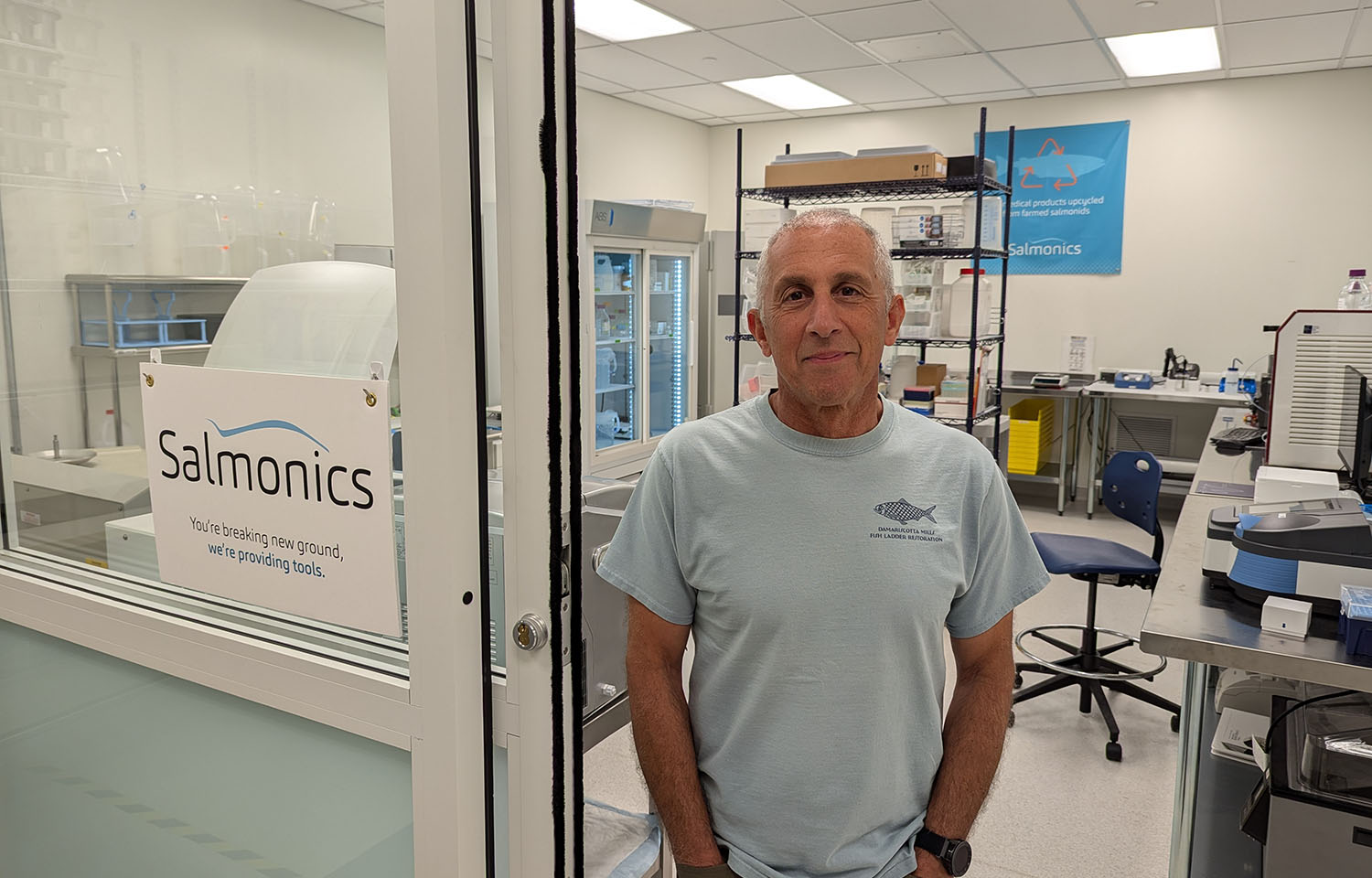
Brunswick, Maine, U.S.A.-based Salmonics, which produces reagents and products from blood harvested from farmed salmon, has come a long way from operating out of a former paint room on a defunct U.S. Naval Air Force base.
When Salmonics President and CEO Cem Giray began the company in 2020, it tapped into space available at the former base, which was in need of renovation before it could be used as a space to produce biomedical reagents.
In those early days for the company, Giray repainted the walls himself by hand to get it up to standards, and the small space was more than enough for the fledgling company’s needs. Now, just four years later, it has moved into a larger biomedical suite in the same building – parts of which it shares with a few of the roughly 130 other startups operating on the former base – and that old office has been relegated to a space to store its products destined for shipping.
Though relatively new, the company is building on decades of work by previous scientists, according to Giray.
“I can’t take credit for all the innovation. There was a Maine research and development company called Sea Run Holdings. They were based out of Freeport, and for over 20 years, they did research on how to utilize salmon blood,” Giray said. “So, they developed a lot of innovative approaches, patents, trademarks – a lot of IP.”
Sea Run Holdings created a few commercialized products for sale during its operation but mainly focused on research and development.
Giray became involved with the company and worked with it off and on, providing contract work and diagnostic help throughout part of Sea Run Holdings’ 20-year run. As the owners of the company grew older, they decided it was time to move on and sell the company.
“They wanted to kind of hand it off to somebody else who could keep it going forward and realize the full potential of what was there,” Giray said. “While they were doing that, I was lucky, and they picked me and said, ‘OK, this guy can hopefully do it.’”
Giray set up Salmonics in late 2020, and by the summer of 2021, the company fully acquired all of Sea Run Holdings' patents and research to carry on its mission.
“Ultimately, the mission is to utilize as much salmon blood waste as possible and, even if it’s not utilized by us, provide the precursor material for others to be able to do things,” Giray said.
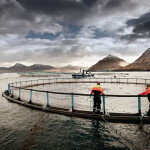
Salmon blood is largely an untapped resource for salmon farms, according to Giray. Much of it is thrown away as a waste product, in contrast to its counterparts in terrestrial farming where bovine and porcine blood are refined and used for a number of different products like growth supplements for in-vitro cell cultures.
Those uses have created a massive industry; Transparency Market Research estimates the bovine blood plasma derivatives market alone was valued at USD 1.9 billion (EUR 1.7 billion) in 2022, and those products are only one aspect of overall use cases.
Salmonics is making products similar to those already on the market but using salmon blood – which has advantages over bovine or porcine blood.
“Some of our products [aim] to really replace those bovine- and porcine-based materials, in part because they are mammalian-based. They may carry mammalian pathogens so that makes them more challenging to use for some applications, and the industry has been looking for some other alternatives,” Giray said.
Another advantage for salmon-derived products relates to animal welfare concerns. Some products like fetal bovine serum are obtained from bovine embryos – a process which has raised ethical questions over the potential suffering caused to an animal fetus.
The products also solve potential supply chain issues and, after years of refinement, are at cost parity with the mammalian counterparts, Salmonics Head of Operations Veronica Achorn told SeafoodSource.
“Our products are cost-effective now, so they cost less or the same as our alternatives were in the past,” Achorn said.
Salmon and trout serum alternatives were present in the past – but were “outrageously expensive,” she said.
“Now, we can offer the products at a reasonable price, and you don’t have supply chain issues; if there’s a drought or disease with cattle, bovine serum pricing can vary a lot,” she said.
Giray added that Salmonics’ products also provide a benefit to the salmon industry and improve sustainability. Thousands of tons of blood are discarded every year in processing facilities, representing an additional cost and a lost revenue stream at the same time.
Some of Salmonics’ current products are one-for-one replacements of existing products that come from mammals, while others have new applications, Giray said.
“We have salmon serum, salmon plasma, salmon fibrinogen, thrombin – those sorts of products,” Giray said.
Salmon fibrinogen and thrombin in particular have shown some extra promise in other applications. Giray said the products – which are clotting proteins – can be used in three-dimensional cell cultures – a way of performing research on cancer, stem cells, and nerve regeneration.
“It provides a matrix that’s similar to a tissue for cells to grow in and expand,” Giray said.
Another application for the products is to stop traumatic bleeding. Giray said Sea Run Holdings was originally researching the products for military applications as a battlefield bandage that could quickly stop bleeding.
Salmon thrombin also has potential as a pain reliever. Giray said Sea Run Holdings’ research found it could stop the “pain cascade,” and in preclinical trials, it showed it could even serve as a better pain reliever than morphine.
“That’s a patented application that we want to develop further, so we’ll be looking for pharmaceutical and biotech partners to help us develop that,” Giray said.
Giray said any human applications would only come far into the future, as gaining approval from the U.S. Food and Drug Administration can take millions of dollars and often over a decade.
Even without FDA approval, the products Salmonics currently has available can tap directly into a USD 20 billion (EUR 18.3 billion) global market in the biomedical industry, and that’s excluding human applications, which would bump that price even higher. There’s also Salmonics’ sales to other companies, such as diagnostic companies, that use its products to then make their own products for human health testing – another big market.
“Overall, we’re looking at a USD 35 billion to USD 40 billion [EUR 32 billion to EUR 36 billion] global market based on the products that we’re working on, excluding human applications,” Giray said.
Despite its recent growth and the huge market available, Giray emphasized Salmonics is still very much a startup company. A recent investment from Lerøy Seafood Group will largely be used by the company to market its existing products and find buyers.
“I reached out to them very early on while looking for potential blood suppliers, and it turned out they were very interested in doing something with their blood waste,” Giray said.
Over time, after a series of visits, the company decided to invest in Salmonics.
“It’s a nice relationship that’s based on a working relationship, so I see it as a long-term relationship. Hopefully, we’ll do similar with other investors as well, but we’re also looking for venture investment to give us a good runway to move forward,” Giray said.
Giray also credited a number of Maine-based organizations such as the Maine International Trade Center, Maine Technology Institute, and the Maine Department of Economic and Community Development for help along the way, but the company has reached a point where real investment is needed.
“We need more real capital to give us a two- or three-year runway where we don’t have to worry about funding and we can focus on getting the work done,” he said. “We know there’s going to be competition, but we want to be at the forefront.”
