






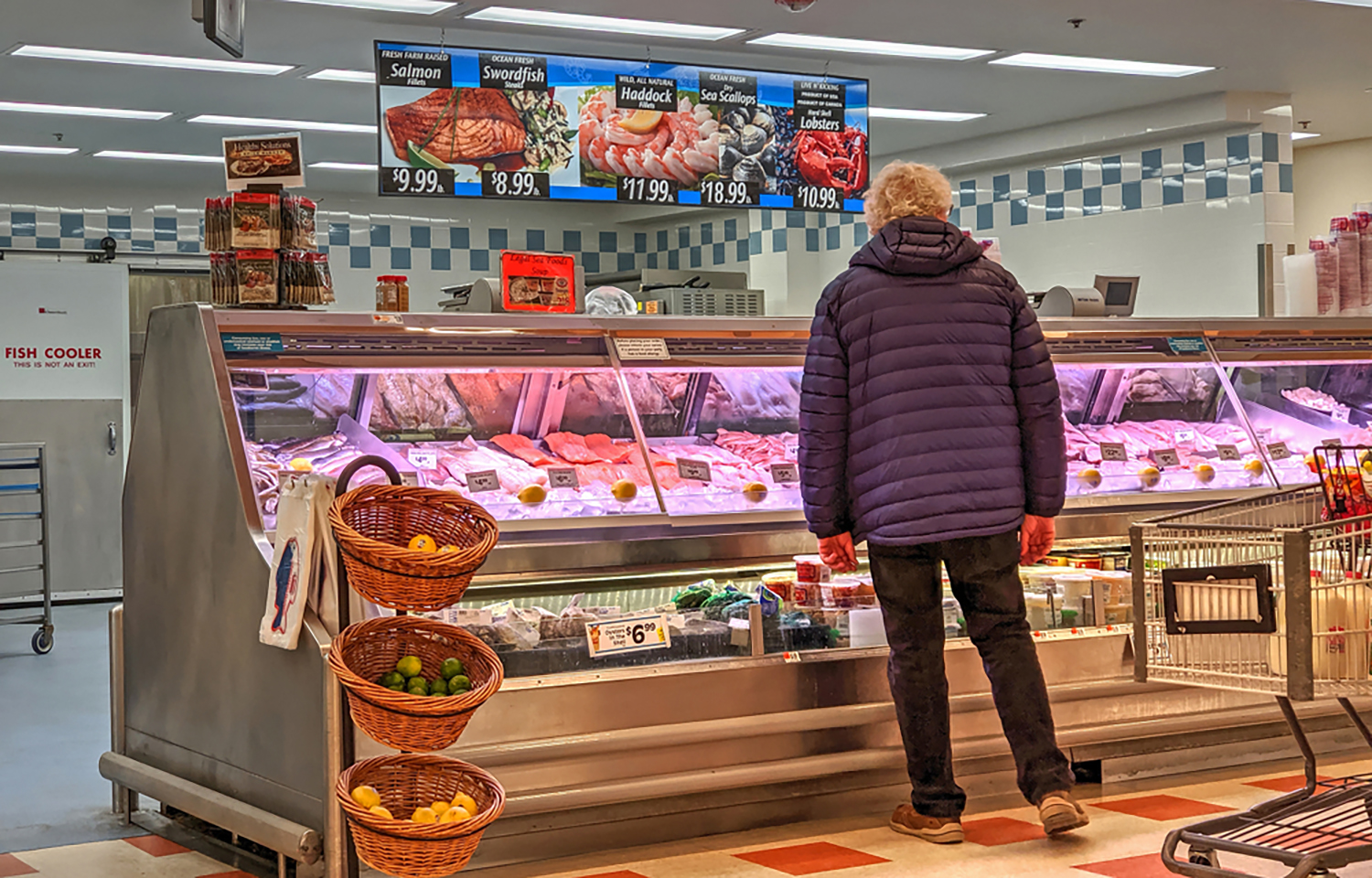
Seafood sales at U.S. retail stores maintained their momentum from March and surged again in April, largely thanks to continued tariff concerns leading to stockpiling behavior and a late Easter holiday this year.
Frozen seafood sales shot up 11.4 percent by value to USD 673 million (EUR 604 million) in the month, surpassing all other frozen proteins, while sales by volume in the category grew 3.3 percent, according to new Circana data analyzed by Lakeland, Florida, U.S.A.-based research firm 210 Analytics.
Fresh seafood sales increased 7.5 percent by value to USD 673 million (EUR 604 million), while sales by volume increased 7.8 percent.
Ambient seafood sales rose 3.4 percent by value to USD 261 million (EUR 234 million), while sales by volume soared by 7.6 percent.
“[This year’s] April had three weeks of Lent and holiday sales. This resulted in substantial growth for fresh, frozen, and shelf-stable seafood,” 210 Analytics Principal Anne-Marie Roerink said.
Fresh shrimp in particular had a “massive month,” Roerink said, as sales by value jumped 20 percent. Salmon comprised nearly half of all refrigerated seafood sales in April, with sales by value rising 6.6 percent to USD 320.4 million (EUR 287 million). Trout sales also increased 22.7 percent, and cod sales rose 15 percent in April.
In frozen seafood, shellfish sales increased 11.4 percent by value, led by a 13.6 percent increase in shrimp, Circana found. Frozen pollock sales by value soared 20.8 percent, tilapia sales increased 12 percent, and salmon sales inclined nearly 7 percent.
In the ambient category, canned seafood sales have been strong for many months, Roerink said, possibly due to social media trends.
“TikTok creators … have popularized the concept of ‘tinned fish date nights,’ showcasing how to enjoy upscale canned seafood with minimal preparation. Their videos feature elegant presentations of items such as sardines, mackerel, and squid,” she said.
The strong seafood sales came as overall grocery and beverage store sales spiked 9.5 percent in April compared to the same month a year prior and 0.6 percent compared to March 2025, according to new CNBC/National Retail Federation (NRF) Retail Monitor data.
“Spending rose again in April, driven largely by consumers continuing to pull purchases forward to stay ahead of tariffs that will inevitably lead to higher prices,” NRF President and CEO Matthew Shay said in a press release.
Shay further explained that despite declines in confidence caused by the economic uncertainty that has come along with tariffs, consumer spending remains relatively intact due to low unemployment, slow-but-steady income growth, and solid household finances.
"Consumers maintain their ability to spend and have strong reasons to spend now before tariffs can drive up prices or cause shortages on store shelves,” he said.
The stockpiling behavior led foot traffic in warehouse club retailers to rise 4 percent for the week of 28 April, according to Placer.ai data provided to SeafoodSource, while grocery store traffic inclined 0.7 percent.
“Although year-over-year retail visitation trends have generally improved compared to earlier in the year, there is evidence that macroeconomic uncertainty and the possibility of tariff-related price increases remain top of mind for consumers,” Placer.ai Head of Analytical Research R.J. Hottovy said.
Looking at the future economic landscape for U.S. retailers, the U.S. recently agreed to trade deals with the U.K. and China, with the latter deal dropping tariffs on Chinese goods from 145 percent to 30 percent.
“The tentative deal provides some breathing room as retailers gear up for back-to-school and holiday shopping,” eMarketer Analyst Zak Stambor told SeafoodSource.
However, a 30 percent tariff is still a “significant hit to retailers’ margins,” Stambor said.
“Lingering uncertainty makes long-term planning nearly impossible,” he said.
