


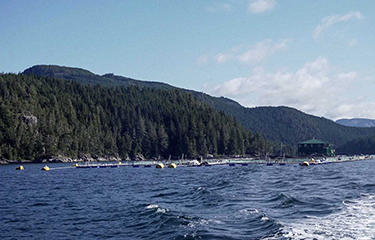
Members of the First Nations Wild Salmon Alliance (FNWSA) have renewed calls to completely remove net-pen salmon farming in British Columbia, Canada, despite pushback from salmon farmers in the region.
A group of indigenous leaders from the FNWSA – which represents more than 120 First Nations – held a press conference in Ottawa, Canada, calling on the federal government to follow-through on its plans to transition away from net-pen salmon aquaculture in B.C. Canada’s Department of Fisheries and Oceans (DFO) first announced plans to begin salmon farm closures in December 2020, and since then has kicked off a net-pen transition process for the province.
That transition plan was initially expected to be released in early summer 2023, but was delayed in June 2023 and as of November has still not been released.
The First Nations group is continuing to push for the removal of net-pen salmon farms, claiming that it impacts their cultural, economic, and spiritual way of life through impacts on wild salmon, the CBC reported.
“This is a very clear opportunity for the federal government to take meaningful actions for reconciliation with First Nations literally across the province of British Columbia and in doing so enacting a safeguard for food security,” FNWSA Chair Bob Chamberlin said.
The FNWSA is not the only First Nations group in the region oriented around salmon farming. A group of 17 first nations in B.C. formed the Coalition of First Nations for Finfish Stewardship in early 2023 advocating for the continuation of salmon farming in B.C.
The B.C. Salmon Farmers Association, responding top the FNWSA’s news conference and calls to ban salmon farming, also pointed out that all salmon farms operating in B.C. do so through agreements, negotiations, or established partnerships with First Nations groups, in whose territories the salmon farms operate.
The association said there is currently no DFO mandate to remove salmon farms from the ocean, and continued to advocate against claims that salmon farms in B.C. pose risks to wild Pacific salmon.
“Cumulative peer-reviewed and federal government science has been clear: salmon arms do not pose more than minimal risk to wild Pacific salmon, and we have repeatedly stated that we will continue to innovate to further reduce potential risk,” the B.C. Salmon Farmers Association said. “B.C. salmon farmers are committed to wild salmon conservation as modern, sustainable, in-ocean salmon farming – led by coastal First Nations, backed by peer-reviewed science, and supported by our sector – provides a future for our rural, coastal, and indigenous communities while supporting wild Pacific salmon.”
B.C. Salmon Farmers Association highlighted that the renewed push by the FNWSA came on the same day that salmon farmers were recognized by the Coller FAIRR Protein Producer index as some of the most sustainable animal protein producers in the world. Seven out of the top 10 producers on the list were salmon farmers.
One of the producers in B.C., Mowi, was recently named the world’s most sustainable producer of animal proteins in the index.
“Raising healthy food while minimizing our impact on the environment in a safe workspace is our top priority,” Mowi Canada West Managing Director Diane Morrison said in a release. “Mowi ranking number one for five years in a row is an important endorsement of our commitment.”
First Nations groups and the government have pushed for a transition to land-based salmon farming, and the DFO has already made announcements that forced salmon farmers to cull fish, and salmon farming company Mowi ended up closing a salmon hatchery. A report released by the British Columbia Ministry of Agriculture and Food and performed by Counterpoint Consulting also found that a transition to land-based salmon farming in the region was not viable, finding a full transition would require an investment of at least CAD 1.8 billion (USD 1.3 billion, EUR 1.2 billion). It also found the transition would move salmon farming away from the rural communities that currently rely on it, as most land-based farms would “more likely locate near their end markets; in British Columbia that means the Lower Mainland.”
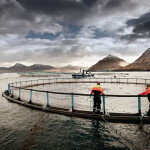
Photo courtesy of the B.C. Salmon Farmers Association
