

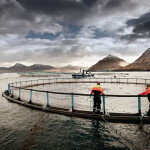

Mowi Chile’s Huenquillahue research center in Region X has been analyzing a high-quality fabric, made by Indian firm Garware Technical Fibres Ltd., to review the cloth’s ability to contain sea lice infestations in salmon farming pens.
The Garware skirts create a physical barrier that surround the fish pens, allowing water to enter but preventing sea lice. The new product allows 80 times more water-flow than common fabrics used for the purpose, but is still able to block early stages of sea lice, according to Garware Technical Fibres business associate Marcos Jofré.
“It is a non-pharmacological product, as part of the strategies to reduce the use of drugs, whose field experience shows a decrease in the frequency of baths of up to 50 percent, with a reduction of lice of up to 60 percent,” Jofré said. “We developed a three-dimensional fabric, with an opening of 80 to 150 microns for Norway, and a second generation of 60 to 100 microns for Chile, given that the local sea lice is smaller, thus generating a product applied to the national market.”
Mowi Chile’s health department, in conjunction with Universidad Austral de Chile, performed effectiveness tests of fabric cages in a test channel and found promising results – 99.6 percent blockage of Nauplii larvae and 99.7 percent of Copepoditos larvae. The company is now considering the solution within the non-drug management alternatives for parasite control.
Chile's salmon farmers have used a range of chemotherapeutants in the battle against sea lice outbreaks. However, these can have negative effects on the fish, such as reducing appetite and growth, and the products also prevent salmon from being sold for several weeks post-treatment. As a result, there has been a recent shift away from chemotherapeutants,which are applied through water-bath treatments, and avermectins, which are used in medicated feeds.
In their place, mechanical and thermal treatments – such as exposing fish to lukewarm seawater, which causes the sea lice to detach from the fish, after which they are collected and destroyed – have been introduced. Optical underwater counting systems and lasers are also gaining in popularity, along with freshwater treatments in well-boats. Mechanical delousing requires fish to be pumped through a low-pressure spray system that removes the lice.
The Garware skirt system would, in contrast, provide a passive barrier against sea lice infestation, if it is found to be effective.
“The effectiveness tests of the fabrics that have been carried out, in conjunction with the Austral University of Chile, for the combat of Caligus, have brought good results and we are considering them within the non-drug management alternatives for the control of this parasite,” Mowi Chile said.
Photo courtesy of Garware Technical Fibres Ltd.
