






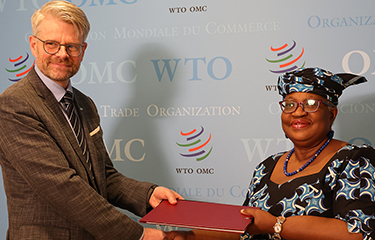
In an ongoing attempt to limit overcapacity and overfishing in the world’s oceans, the World Trade Organization (WTO) has proposed a two-tier reporting regime for its member states amid continued negotiations on ending harmful subsidies, which will subject the largest subsidizers of fishery activities to a higher level of scrutiny.
Icelandic WTO Ambassador Einar Gunnarsson described the proposed setup as a “two-tier sustainability-based qualification,” whereby the largest subsidizers – a group that could include China, the E.U., Japan, Korea, and the U.S. – would undergo a “greater degree of scrutiny than other members in demonstrating that their fisheries subsidies are provided in the context of management measures to maintain stocks at a biologically sustainable level.”
Securing an agreement on how to limit harmful subsidies that lead to overcapacity and overfishing would significantly buttress an agreement reached last year at the 12th WTO ministerial conference.
Gunnarsson said negotiations will intensify from 9 October onward, with the goal of attaining an agreement on limiting these subsidies by the time the 13th ministerial meeting takes place February 2024 in Abu Dhabi. However, Gunnarsson confirmed that questions remain as to how the two-tier reporting system would work in practice.
“One open question which [WTO] members would have to resolve in further elaborating such an approach is the basis on which the largest subsidizers would be identified,” he told SeafoodSource.
Reporting requirements in any new agreement would significantly affect larger member nations like China, a country which is often opaque about the level and nature of its subsidies.
The draft text under current negotiation also prohibits subsidies that support fishing outside a subsidizing member’s jurisdiction, which would heavily impact WTO members that have access agreements in place with distant-water coastal states.
Additionally, the draft text includes transparency provisions for information on use of forced labor – a prioritized issue for U.S. negotiators in particular.
It remains unknown how many of the existing proposals will survive in the final draft if the WTO even agrees upon one next February, but the mere mention of a two-tier reporting regime proposal is making waves in diplomatic circles.
“There will have to be a discussion on how to define a large subsidizer, but nevertheless, there is an understanding that a relatively small group of members constitute [the] largest fishing nations and largest subsidizers,” a Geneva, Switzerland-based trade official said, requesting anonymity to speak candidly. “This would lead to the work of the WTO Committee on Fisheries Subsidies being stronger and would be conducive to them [instituting] stronger discipline.”
While Gunnarsson suggested the proposal on a two-tiered reporting mechanism came directly from WTO member states, he didn’t specify which ones brought it to the table.
WTO negotiators have plenty of other thorny issues to sift through, one of which concerns special treatment for developing member states. The current draft text on this issue contains a proposed exemption on subsidy cuts for these members, ones with a small share of global catch, or, alternatively, ones with a low level of fisheries subsidies in place. There is also a proposed exemption for subsidies that go toward supporting low-income, artisanal fisheries. The draft text proposes a phase-in period for developing countries.
The WTO is aiming to implement the first installment of that agreement by next February, which will require 110 signatories. Currently, only 43 members have finished the ratification process.
Last year, India proposed a transitional period spanning 25 years, which drew opposition from states that see any such provision as weakening the broader agreement on limiting harmful subsidies. Some developing countries, however, pushed back on this notion, emphasizing what they believe to be the hypocritical nature of the negotiations that are “totally unjust” and in favor of larger fishing nations that have fleets primarily responsible for overfishing.
Recent research published in Marine Policy addressed that issue, finding that harmful fisheries subsidies from wealthier nations like China, Spain, and the U.S. are disproportionately harming developing nations like Guinea-Bissau, Somalia, and Namibia that depend on fish for their food security and livelihoods.
The study claims that 20 percent to 37 percent of all harmful fisheries subsidies worth USD 5.3 billion (EUR 4.93 billion) each year support distant-water fishing in other countries’ waters or on the high seas. The research also suggests that more than 40 percent of the harmful subsidies that support fishing in “very poor” nations, as measured by the Human Development Index, originate from the wealthiest fishing nations.
Photo courtesy of World Trade Organization
