






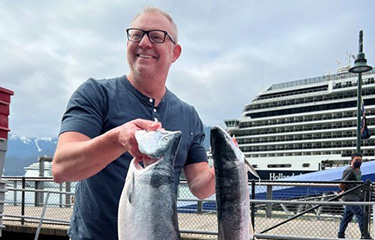
Seattle, Washington, U.S.A.-based cruise ship corporation Holland America Line has recently unveiled new Alaskan seafood-themed dishes as part of its expanded Alaska Up Close program.
Holland America has a longstanding commitment to serving local seafood, and it said its Alaska Up Close program allows guests to become “deeply immersed in the local culture with informative onboard programming, sea-to-table dining, and award-winning shore excursions,” Holland America said.
“All the feedback and data we receive show us guests want to experience local ingredients during their cruise,” Holland America Director of Culinary Operations John Mulvaney told SeafoodSource. “All menus for ships sailing in Alaska are inspired by Alaskan seafood – while of course incorporating dishes for diners who don’t eat seafood or even meat, utilizing other local fruits, vegetables, and proteins where we can.”
In one of its programs, a wildlife expert provides facts on local marine life before guests are feted with locally sourced seafood products. In another, members of the local Huna Tlingit tribe share stories about fishing and hunting for the same cuisine guests are then given to try.
Holland America serves more than 2,000 pounds of Alaskan salmon, 1,000 pounds of Alaskan cod, 800 pounds of Alaskan halibut, 500 pounds of Alaskan rockfish, and more seafood offerings on every one of its Alaskan cruises.
All the dishes on Holland America’s new Alaska Brunch menu feature fresh, local Alaskan and Pacific Northwest ingredients, the company said. Selections include salmon and potato chowder, crab and hot-smoked salmon cakes, and a smoked Gulf of Alaska cod benny.
Additionally, the cruise line’s Lido Market restaurant features special seafood dishes including a salmon bake dinner and seafood boil pop-up dinner. Holland America also offers fresh Alaskan fish throughout the week and an Alaskan salmon buffet once during each Alaskan cruise.
Mulvaney said Alaskan salmon is the most popular seafood item Holland America offers, but said Alaskan crab clusters, cod, halibut, rockfish, and sole are also well-liked. Due to fishing closures in Alaska, Holland America has replaced king crab on its menu with Dungeness crab.
Seafood sustainability is important both to Holland America and its customers, according to Mulvaney. In 2022, the company became the first cruise line to obtain Responsible Fisheries Management (RFM) certification.
“The RFM certification is significant and something we are very proud of. It shows our commitment to sustainability and the role we play as stewards of the ocean,” Mulvaney said. “Our guests also understand the importance – many of them come to Alaska to experience wild, fresh Alaskan seafood and also to see its sourcing and ‘natural habitat,’ if you will.”
The cruise line opts only to use vendors for Alaskan seafood who also carry RFM certification. For its Seattle, Washington, U.S.A.-, and Vancouver, British Columbia, Canada-based loadings, it buys from Bellevue, Washington, U.S.A.-based Peter Pan Seafoods, and for Juneau, Alaska-based loadings, it utilizes Juneau-based Taku Fisheries.
It also receives wild fresh fish catches from Ketchikan, Alaska, U.S.A.-based EC Phillips and Son, Silver Bay Seafoods in Seattle, Washington, U.S.A., and a variety of seafood from Clackamas, Oregon, U.S.A.-based Pacific Seafood.
Holland America is examining other certifications it can pursue so it can further pursue its provision of sustainable seafood, Mulvaney said. He said doing so helps maintain the beauty of Alaska and ensures a supply of Alaskan seafood for many years to come, Mulvaney said.
“Also important is to maintain the lifestyle of the local communities. Sourcing a local, sustainable product is a win-win for everyone,” he said.
Photo courtesy of Holland America Line
