

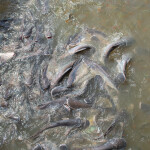


Norway’s Directorate of Fisheries has confirmed at least 10,000 metric tons’ worth of farmed salmon have died as a result of an algae bloom in the northern part of the country, but with the bloom still affecting the country’s coastline, analysts are estimating total losses could reach 40,000 metric tons.
Losses have already surpassed NOK 620 million (USD 70.9 million, EUR 63.5 million) in value, according to the Directorate of Fisheries, and the total tally of lost fish is unknown, as many of the affected farms have not yet reported their losses to the directorate.
“We do not have information on the total number of fish per now, mainly for two reasons; The breeders do not have the capacity and overview to state in numbers and the weight of the fish varies from 700 grams to 5.5 kilos,” the directorate said in a 22 May statement.
The agency said new farms had experienced salmon mortalities in Nordland and that farms in Ofotfjorden are in the projected pathway of the bloom. In Troms, which was one of the initial areas hit by the bloom, farmers have not reported any mortalities since 17 May.
Kolbjørn Giskeødegård, an analyst with Nordea Markets, told Norwegian news site E24 that his firm is estimated a minimum of 30,000 metric tons (MT) of losses from the bloom. Taking into account the growth that would have occurred in the salmon that have died or been culled, Nordea is estimating total losses around 40,000 MT.
"The question is whether it stops now, or whether it escalates further, because the more it escalates, the greater the impact," Giskeødegård told E24.
Giskeødegård said the losses will result in higher prices for Norwegian farmed salmon.
"It is tragic for the breeders concerned, but for the market as a whole, it contributes to better market balance in the second half and a higher price in the market than would otherwise have been obtained," he said.
E24 further reported that farms operated by Mowi, Lerøy, and Norway Royal Salmon have not been affected by the algae.
Water samples have revealed the algal species involved in the bloom is Chrysochromulina leadbeaterii, which is a commonly-appearing algae in Norwegian waters.
“But in conditions that are particularly good for the algae it can bloom in large numbers and be lethal to fish,” Norway’s Directorate of Fisheries said.
Photo courtesy of Norwegian Directorate of Fisheries
