


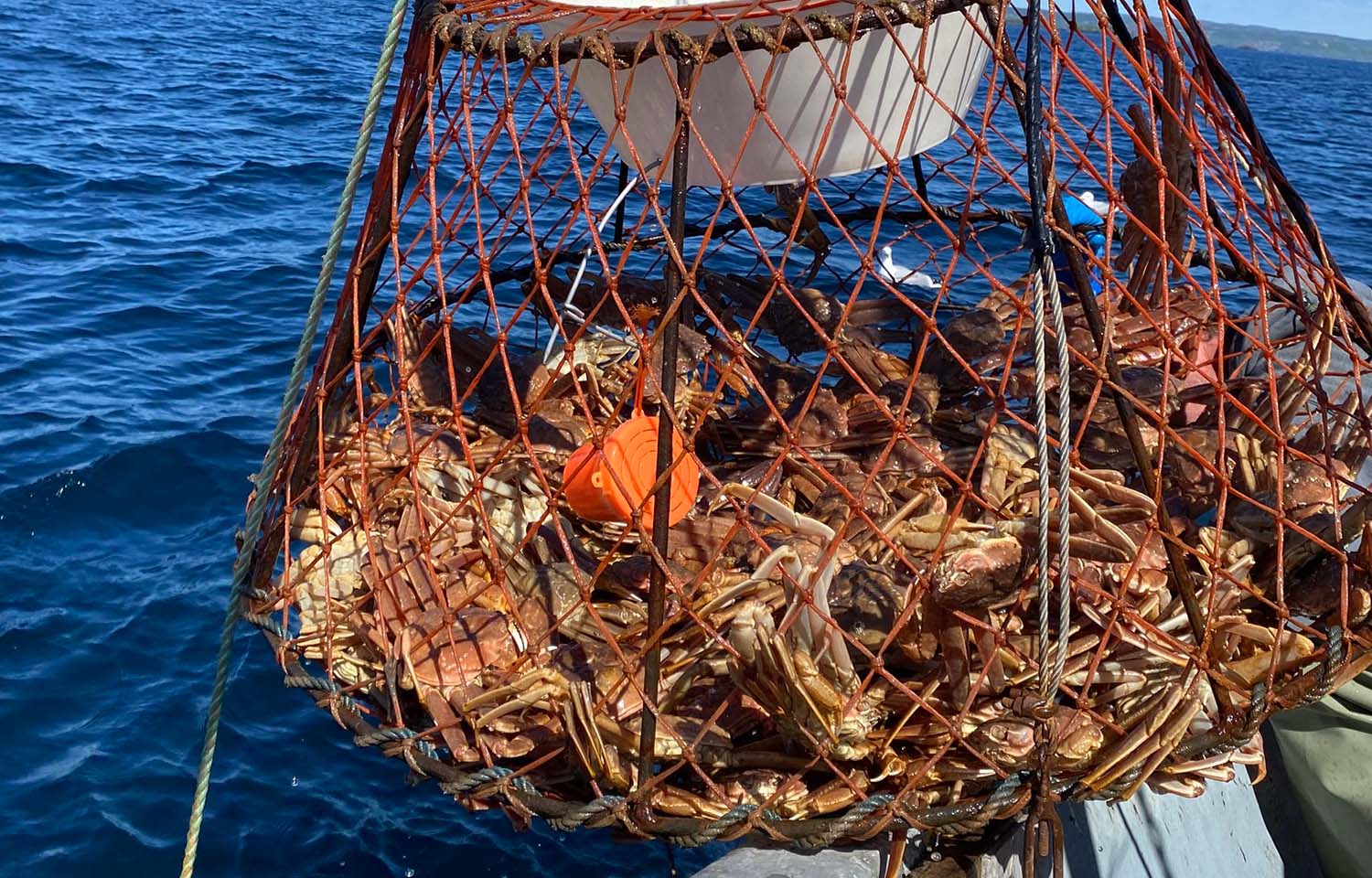
A new report by Canada’s Department of Fisheries and Oceans (DFO) indicates snow crab stocks in Newfoundland and Labrador may be on the downswing, and the leading harvester union in the region is calling for changes to the management decision model.
The new DFO report found the 3LNO fishing zone is healthy, and the 2HJ fishing zone is still in the cautious zone. However, it downgraded the 3PS fishing zone from healthy to cautious and the 3K zone from cautious to critical, CBC reported.
DFO Stock Assessment Biologist Julia Pantin told reporters during a review of the report that continued warming temperatures and a low number of mature females and non-commercial-size crabs means the exploitable biomass of snow crab is likely to drop and reach “near historic lows” by 2028.
The assessment results will be used in advisory meetings, and stakeholders in the fishery will be able to have input on the data ahead of the DFO deciding on the 2026 total allowable catch (TAC).
Soon after the report was released, the Fish, Food, and Allied Workers Union (FFAW) called on the DFO to change the models that it uses for assessing the stock. Mainly, it is calling on the government to re-run its assessment while removing pots and predators and to show the results of its trap and trawl survey separately. It’s also asking the DFO to abandon its use of the precautionary approach (PA) for management decisions in 2026.
“The PA model is misleading and underscores the need to revisit how this PA is calculated and applied to Newfoundland and Labrador’s vital snow crab fishery,” FFAW President Dwan Street said. “Such a failure in a federal scientific process must be immediately addressed due to the catastrophic economic impacts this modeling has on management decisions.”
FFAW said the decreased assessment of the 3K region is based on projecting forward landings that will now not be allowed because of the new status assessment – meaning that the negative assessment is in part thanks to projected harvests that won’t exist.
“The status in 3K is based, in part, on a prediction that cannot happen,” Street said. “We are also deeply frustrated that this management approach contributes to extreme volatility in how DFO applies the PA and sets quotas for the data. The situation has become untenable and is continuing to harm the economic sustainability of the owner-operator fleet.”
The union said harvesters in the 3K area have had to grapple with volatility in quotas in recent years.
“In 2022, we had a 40 percent increase; the following year we had another 20 percent increase. That was followed by a 17 percent decrease in 2024 and a 25 percent decrease last year. Now, here, we are looking at another significant cut,” Tony Ward, a harvester in 3K4 and a member of the FFAW crab committee, said. “When the PA was being developed, harvesters talked about wanting to smooth out the peaks and valleys; that’s still the goal. I think we need to figure out how to smooth out the peaks and valleys because this is no way to run a fishery.”
The FFAW also questioned the DFO’s prediction model and data use, given what the union said were past failures.
“The risks of DFO’s overreliance on pre-recruit and climate-based prediction models is concerning, given that they missed the mark when projecting declines in 2017 and 2018,” FFAW Secretary-Treasurer Jamie Baker said. “It is abundantly clear that we need to find a way forward that recognizes uncertainty in their projections given past projections.”
Newfoundland and Labrador’s snow crab fishery has benefited from quota increases in recent years, with the TAC hitting 57,586 MT in 2024, which was an increase over 2023. Then, in 2025, the TAC was bumped to 62,883 MT, up 9 percent over 2024.
As the DFO begins considering what the TAC will be in 2026, Canada Fisheries Minister Joanne Thompson said the government will continue its dialogue with the union and snow crab industry.
“We would always work with consultation. Science, obviously, is the backbone of fisheries management but so is consultation and input from harvesters. They are the eyes on the water,” Thompson told the CBC. “I will say, without hesitation, that I am always open to conversation. They don’t have to be easy and sometimes they shouldn't be.”
