






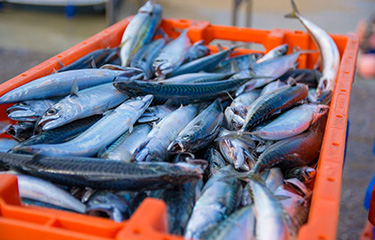
The Fish Food and Allied Workers Union (FFAW-Unifor) is calling on the Canada Department of Fisheries and Oceans (DFO) to reopen the Atlantic mackerel fishery this year, citing observations by fishermen that the population is higher than the DFO’s assessments suggest.
The DFO shut the fishery down, along with the spring herring fishery, in 2022. Minister of Fisheries, Oceans, and the Canadian Coast Guard Joyce Murray said management measures put in place to safeguard the stock didn’t cut it.
“Southern Gulf spring herring and Atlantic mackerel are stocks that have been in the critical zone for lengthy periods and need to be allowed to regenerate for the continued sustainability and success of the entire fishery,” Murray said in a release at the time. “I recognize many harvesters depend on these fisheries. I will continue working with them and fishing groups from across Atlantic Canada and Quebec to ensure the best outcomes for these stocks and the people who depend on them.”
Members of FFAW-Unifor, however, said that contrary to assessments that stock is in danger, fish harvesters have been witnessing abundance of mackerel – and the union is calling on members of the Atlantic Mackerel Advisory Committee (AMAC) to listen to those reports.
“For upwards of 10 years now, fish harvesters in our province have witnessed distribution and sizes of mackerel that shouldn’t be seen in our waters, if what DFO says is correct,” FFAW-Unifor President Greg Pretty said in a release.
According to Pretty, fishermen report finding plenty of mackerel while out fishing for other species, and during voluntary surveys conducted by the union.
“It’s one thing to shut a fishery down if it’s not doing well. But while the mackerel fishery was under moratorium in 2022, folks witnessed enormous abundance with wide distribution and year classes and there are even dozens of reports of sightings through the fall into January and February,” he said. “These observations are entirely contradictory to DFO Science’s narrative that the stock is failing.”
FFAW-Unifor member harvesters in the area voluntarily provide data for surveys on mackerel to the Union, which FFAW-Unifor Science Director Erin Carruthers said has created substantial evidence of the stock’s abundance.
“FFAW-Unifor documented harvesters’ observations of mackerel from throughout the province, with 185 harvesters responding to our survey,” Carruthers said. “This is not one or two harvesters; these are consistent observations from around the province. Documented observations from 185 harvesters cannot be disregarded as anecdotal information.”
As part of its call to reopen the mackerel fishery, FFAW-Unifor created a campaign page and launched a petition to call public attention to the issue.
FFAW-Unifor’s call to reopen the mackerel fishery based on harvester data comes just days after the DFO held a technical update on 27 February for the snow crab fishery and delivered an overall positive report of the stock’s health – an update the relied entirely on harvester data because the DFO was unable to perform its multi-species trawl surveys.
That technical update, FFAW-Unifor said soon after the DFO update, highlighted the “value and importance of collaborative research and harvester-led science.”
“Today’s snow crab update shows that collaborative surveys with industry can meaningfully inform the stock assessment process,” Pretty said soon after the update. “The Post-Season Snow Crab Survey is a success story that must be modelled in other fisheries research programs, such as that of mackerel and northern shrimp.”
A post-season survey, performed by harvesters, first started in 2003 and involves work from 80 vessels across 1,250 stations, which FFAW-Unifor calls an “enormous undertaking.” Then, six years ago, the union and the DFO agreed to expand the post-season survey – which meant stock health could be assessed without the DFO’s multi-species trawl surveys.
That agreement, FFAW-Unifor Executive Board Member Nelson Bussey said in a release, has clearly made a “real difference” for the crab fleet.
“For two years in a row now, DFO would not have had the information needed for the stock assessment if it weren’t for harvesters and our Union taking the initiative and building an important data series,” Bussey said. “This means we could fill the gaps left by DFO Science when their surveys are incomplete or just not done.”
As DFO relies entirely on harvester data for one quota, fishermen are calling on it to recognize harvester data on mackerel.
“Minister Joyce Murray must look at all the facts. She must listen to the hundreds of people who spend their lives on the water. Our observations, knowledge, history and contributions hold meaning and value,” Trevor Jones, a Notre Dame Bay fish harvester who is attending the AMAC Meeting this week. “More than that, Minister Murray must look at the evidence and the science that goes beyond DFO’s limited focus.”
Courtney Glode of FFAW-Unifor told SeafoodSource the union has been asking for more opportunities to collaborate.
"The FFAW has been asking for more collaborative opportunities such as these in other species like mackerel, redfish and northern shrimp," she said. "It’s unfortunate that Minister Murray and DFO are not prioritizing expanding these collaborative opportunities."
Photo courtesy of Richard Bell/maplerockdesign/Unsplash
