





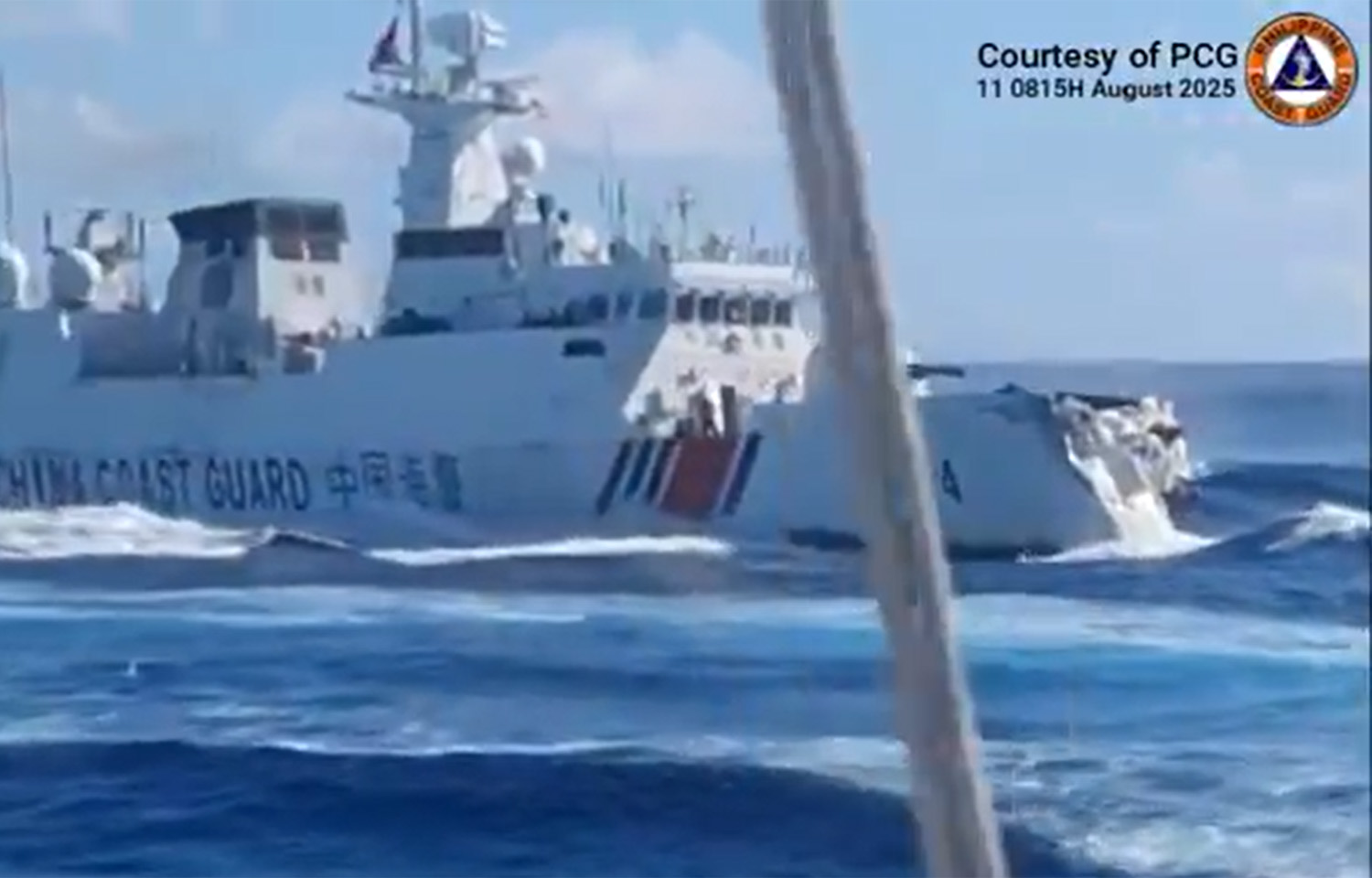
A Chinese coast guard vessel collided with a Chinese navy vessel in the latest conflict over Filipino fishers operating near the disputed Scarborough Shoal.
The Chinese military has engaged in risky and aggressive maneuvers in its attempts to discourage Filipino fishers from operating in the South China Sea, which the former nation claims solely as its own. The government of the Philippines disputes those claims, as have other nations that have traditionally fished those waters, and the Philippines has encouraged Filipino fishers to continue harvesting in the region. The government recently launched a new pilot program, the “Kadiwa Para sa Bagong Bayaning Mangingisda (KBBM)” initiative, which provides fuel subsidies and ice to the distant water fishers while purchasing their catch at sea.
In addition to providing supplies to the far-flung fishers, the Philippine Coast Guard (PCG) has used its vessels to shield them from Chinese harassment at sea. The Chinese government has used navy and coast guard vessels to blockade Filipino fishers from reaching the shoal, sprayed fishign crews with heavy water hoses to force them to turn back, and conducted dangerous maneuvers that have occasionally led to collisions.
The latest incident took place 11 August, when, according to the Philippine Coast Guard (PCG), the service deployed three government vessels to support roughly 35 Filipino fishing vessels in Bajo de Masinloc as part of the KBBM initiative.
“During the operation, Philippine vessels and fishermen encountered hazardous maneuvers and blocking actions from other vessels in the vicinity. In particular, the MRRV 4406 was targeted with a water cannon, but the seamanship skills by PCG crew members allowed the vessel to successfully evade from getting hit,” a PCG spokesperson said.
In his regular 11 August remarks, China Foreign Ministry Spokesperson Lin Jian characterized the collection of Filipino vessels as an unlawful intrusion into Chinese territorial waters.
“On August 11, the Philippines sent multiple Coast Guard vessels, official vessels, and so-called fishing vessels to intrude into the territorial waters of Huangyan Dao, and in the meanwhile, Philippine military aircraft also intruded into the air space of Huangyan Dao,” he said. “The Philippines’ moves seriously infringed upon China’s sovereignty and rights and interests, and seriously harmed peace and stability at sea. These moves are of a malign nature. It is legitimate and lawful for China to do what is necessary to safeguard our territorial sovereignty and maritime rights and interests in accordance with the law.”
Nearby, China Coast Guard (CCG) vessel 3104 was pursuing one of the Filipino government vessels at high speed, according to PCG, when it took a risky maneuver and collided with People's Liberation Army Navy (PLA Navy) ship 164. The PCG claims the collision left the CCG vessel unseaworthy, and the Filipino crew stopped to provide man-overboard recovery and medical aid to the Chinese service members.
US Ambassador to the Philippines MaryKay Carlson immediately condemned the incident.
“Unfortunately, that type of aggressive behavior out on the West Phillipine Sea by China is not unusual. We’ve seen shouldering and ramming and water cannoning – we’ve seen the use of military-grade lasers – virtually every month since I arrived here three years ago,” Carlson said. “This type of activity is happening outside of camera range all the time.”
Following the collision, the U.S. Navy deployed two of its warships to the area without incident.
