



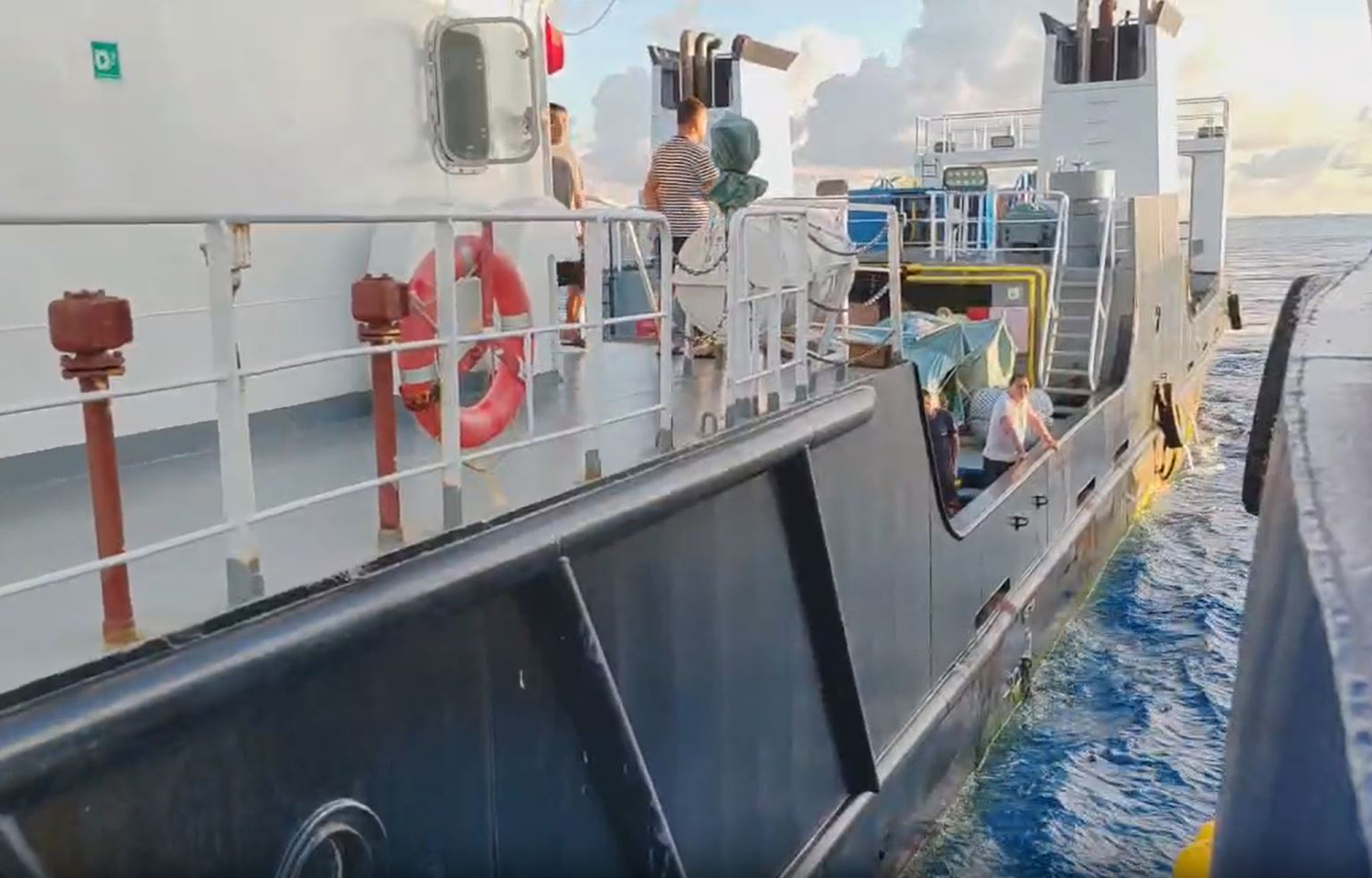
The Philippines government has accused a “Chinese maritime militia” vessel of deliberately sideswiping one of its fisheries vessels in the contested South China Sea.
The government claims a Chinese vessel with the bow number 00108 conducted dangerous maneuvers to block the path of a Philippines Bureau of Fisheries and Aquatic Resources (BFAR) vessel, ultimately leading to the collision.
“These dangerous maneuvers caused the sideswiping and collision with the BFAR vessel, which sustained minor dents in its starboard bow,” the Philippines government said in a statement.
The Filipino vessel was able to continue its mission after the incident and was able to dock safely at the Pag-asa Sheltered Port on Pag-asa Island in the South China Sea.
The Filipino government alleges another incident occurred 8 October, when three Chinese coast guard vessels and a navy vessel approached two BFAR vessels on a resupply mission in the South China Sea. BFAR claims the Chinese vessels conducted dangerous maneuvers to impede the mission and fired water cannons at the Philippines vessels, though the cannons did not reach their targets.
“Not withstanding the dangerous maneuvers and opening of water cannons, both BFAR vessels were able to resupply the Filipino fisherfolk in the vicinity of Bajo de Masinloc,” the Philippines government said in a statement. “The two [vessels] resupplied a total of seven Filipino mother boats and 16 small fishing boats who continue to fish in our waters.”
The bureau said it would not be deterred by the Chinese vessels’ actions.
“The BFAR will not be deterred from fulfilling its mission of patrolling all Philippine maritime zones and providing support and assistance to Filipino fisherfolk in the West Philippine Sea pursuant to its mandate of enforcing all laws and rules and regulations in the management and conservation of fishery resources,” BFAR said.
The collision is just the latest escalation in the territorial conflict between the Philippines and China, with both nations claiming exclusive fishing rights to several areas in the South China Sea.
In May, China sent a blockade of coast guard and militia vessels to block a flotilla of about 100 small Filipino fishing boats from accessing the Scarborough Shoal, a territory claimed by the Philippines but controlled by China. In June, a Filipino and Chinese vessel collided in the South China Sea, and in August, roughly 40 Chinese vessels blocked two Filipino vessels conducting a mission, leading to collisions, according to the Filipino government, among other contentious interactions.
Several foreign governments have criticized China’s military activity in the South China Sea, including the United States.
“The United States stands with its ally, the Philippines, and condemns the dangerous and escalatory actions by the People’s Republic of China (PRC) against lawful Philippine maritime operations,” U.S. State Department Spokesperson Matthew Miller said in an 31 August statement. “A China coast guard vessel deliberately collided three times with a Philippine Coast Guard vessel exercising its freedom of navigation in the Philippines’ exclusive economic zone (EEZ), causing damage to the vessel and jeopardizing the safety of the crew onboard.”
The U.S. State Department also noted that the 1951 United States-Philippines Mutual Defense Treaty applied to attacks on Filipino public vessels in the South China Sea.
“This is the latest in a series of dangerous and escalatory actions by the PRC,” Miller said. “On multiple occasions throughout August 2024, the PRC has aggressively disrupted lawful Philippine aerial and maritime operations in the South China Sea, including at Sabina Shoal. The PRC’s unlawful claims of 'territorial sovereignty' over ocean areas where no land territory exists and its increasingly aggressive actions to enforce them threaten the freedoms of navigation and overflight of all nations.”
